 Historical Figure MBTI
#411 · 4-6-26 · The Mongol Khanates
Berke Khan
Khan of the Golden Horde · First Muslim Mongol Sovereign
c. 1208 — 1266
6 min read
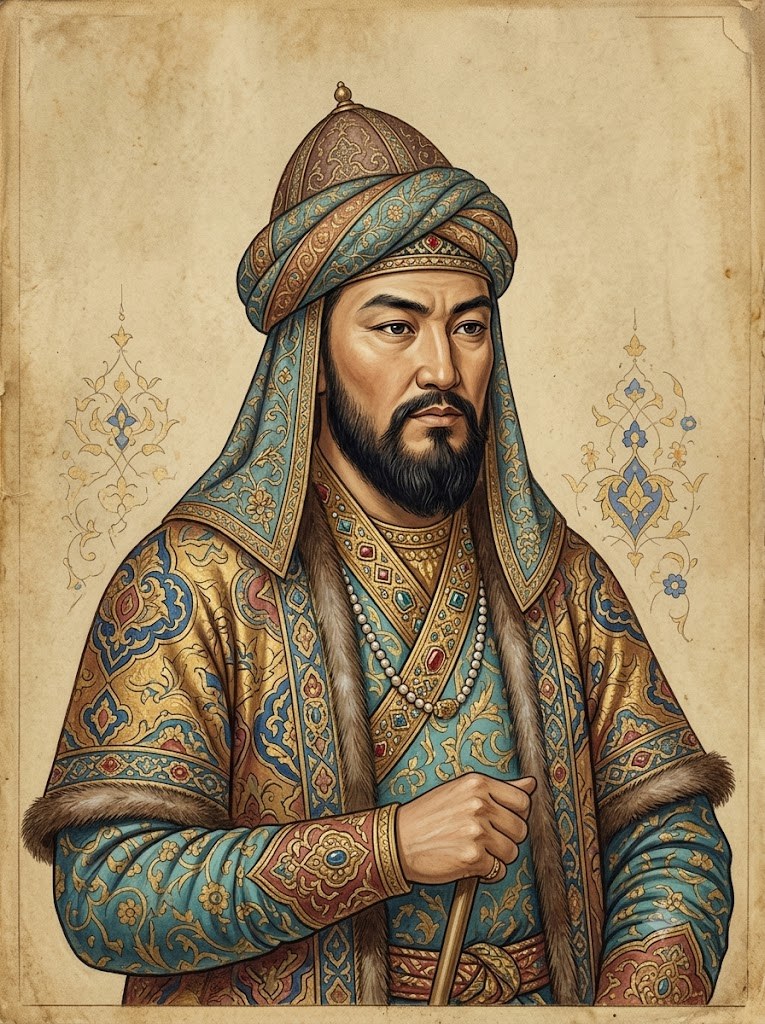
AI-assisted Portrait of Berke Khan
The Khan Who Turned His Sword on His Own Blood
In 1258 Berke's cousin Hulagu sacked Baghdad, butchered its population, and put the last Abbasid caliph to death — reportedly rolled in a carpet and trampled by horses. Berke, grandson of Genghis Khan and the first Mongol sovereign to embrace Islam, took the news as a personal wound. Within four years he had allied with the Mamluk sultan Baybars in Egypt and marched against Hulagu's Ilkhanate — the first open war between Mongol states, and the moment the unified empire of his grandfather cracked along a religious fault line.
Berke (c. 1208 – 1266) ruled the Golden Horde, the westernmost Mongol realm, from 1257 until his death on campaign. Brother of Batu, who had founded the Horde and ground the Russian principalities into tributaries, Berke inherited a going concern and ran it with a hard, organizing hand: tightening the grip on the Rus', fixing the apparatus of tribute, and opening the Horde to the Islamic world through trade and treaty with Mamluk Egypt. He did not dream a new empire into being. He took a built one, defended it, and bent its diplomacy toward the faith he had chosen.
Berke was the ESTJ on a Mongol throne — Te organizing and commanding, Si anchoring him to a creed he upheld to the letter. He warred his own cousin not over a far-sighted strategy but over a concrete outrage that violated everything he believed.
The Organizer of the Horde
Te — dominant
Dominant Te governs by structure, command, and result. Berke did not inherit a throne so much as a machine — the tribute system, the postal relays, the census rolls Batu had imposed on the Rus' — and his instinct was to make it run harder and tighter. He pressed the Russian principalities for revenue, backed the apparatus that turned conquest into steady income, and treated the Horde as an enterprise to be administered rather than a conquest to be relived.
Te also builds alliances as instruments. Berke's pact with the Mamluk sultan Baybars was a working arrangement: a shared enemy in the Ilkhanate, a commercial corridor through the Black Sea and Egypt, and an exchange of envoys that gave the Horde a partner in the Islamic world. When he went to war with Hulagu, he prosecuted it as a campaign — coordinating fronts, leveraging the alliance, pressing where the enemy was exposed. He was, in the most literal sense, a commander: a man who organized force and directed it toward a clear objective.
The Convert Who Kept the Rule
Si — auxiliary
Auxiliary Si is the order-keeper — the function that commits to a structure and then upholds it faithfully, by observance and routine. Berke's conversion to Islam was not a passing political tilt but a sincere, durable adherence. He was, by the accounts that reach us, devout: he took the faith seriously, surrounded himself with Muslim scholars and advisers, and held to its obligations once he had bound himself to them. Where Ne would have kept his options open, Si chose a creed and stayed inside it.
That settledness is the key to the man. Si does not improvise its values; it inherits or adopts a code and defends it as a fixed point. Berke's Islam gave him exactly that — a definite standard of right conduct, with definite duties and definite enemies. It also gave the war with Hulagu its moral charge. The sack of Baghdad and the killing of the caliph were not, to Berke, a strategic setback to be weighed coolly; they were a desecration of the order he had sworn himself to. Si felt the violation in the gut, and Te answered it with an army.
Berke chose a creed and held it to the letter — the Si conservative's loyalty to an adopted order, carried onto a throne and into a war.
The Opening to a Wider World
Ne — tertiary
Tertiary Ne in an ESTJ is the modest capacity to see a possibility outside the inherited frame — not a fountain of speculation, but enough lateral vision to recognize an opening when one appears. Berke's reach toward Mamluk Egypt was that flash of Ne in service of Te. Most Mongol khans defined the world by who could be conquered; Berke saw that a distant Islamic sultanate could be a partner rather than a target, and that an enemy to the south of Hulagu was worth more allied than crushed. It was an unconventional alignment, and it held.
But tertiary Ne stays bounded by the dominant pair. Berke used the new connection to serve a fixed aim — the security of the Horde and the cause of his faith — rather than to reinvent what the Horde might become. He glimpsed a possibility and harnessed it; he did not chase it into open-ended grand design. The idea served the structure, never the reverse.
The Conviction He Could Not Set Aside
Fi — inferior
Inferior Fi surfaces in an ESTJ as a deep, unargued conviction that, once triggered, overrides cold calculation. Most of the time Berke ran on Te — weighing advantage, managing the realm, treating diplomacy as a ledger. But the destruction of Baghdad reached past the ledger to something he held as a private absolute, and there he would not be reasoned out of it. Going to war with a fellow Mongol prince was, by any strategic measure, a costly fracture of the empire. Berke did it anyway, because the outrage offended a personal value too foundational to bargain away.
That is inferior Fi at full pressure: an interior moral line, normally inarticulate beneath the machinery of command, erupting with disproportionate force when it is crossed. Berke could administer tribute and broker alliances all day with detached competence. But touch the faith he had adopted, and the cool administrator gave way to a man who would split the Mongol world rather than let the offense stand.
Why ESTJ Over ENTJ
Why not ENTJ?
His brother Batu, his cousin Hulagu, and their grandfather Genghis were ENTJs — visionary builders whose Ni reimagined what an empire could be and then conquered the world to fit the vision. Berke is the family member who does not re-envision; he runs and defends. His war with Hulagu was not a far-sighted strategic gambit (Ni) but a principled, indignant reaction to a concrete atrocity — revenge for a desecration, not the opening move of a grand design. He consolidated an existing realm rather than dreaming a new one into being.
The distinction is between the visionary and the administrator-of-conviction. The ENTJ asks what could be and bends reality toward it; Berke asked what was right and what would hold, and governed accordingly. Concrete, practical, duty-bound, he was driven by consolidation and creed rather than by a re-envisioned future. That is the difference between Ni-led ambition and Te-Si conviction — and it is why Berke reads as the ESTJ in a dynasty of ENTJs.
Connected Figures
Further Reading
- Mongols and Mamluks: The Mamluk-Ilkhanid War, 1260–1281 — Reuven Amitai-PreissThe definitive study of the conflict Berke joined — the Mamluk alliance, the Berke–Hulagu war, and the fracturing of the Mongol world along religious lines.
- Russia and the Golden Horde — Charles J. HalperinAuthoritative on the Horde's grip over the Rus' and the tribute apparatus Berke inherited and tightened.
- The Mongols and Russia — George VernadskyA classic survey of the Golden Horde's place in Russian and Eurasian history, including Berke's reign and Islamization.
