 Historical Figure MBTI
#394 · 4-5-26 · The Mongol Empire
Jochi
Eldest Son of Genghis Khan · The Khan in the Shadow · Father of the Golden Horde
c. 1182 — 1227
7 min read
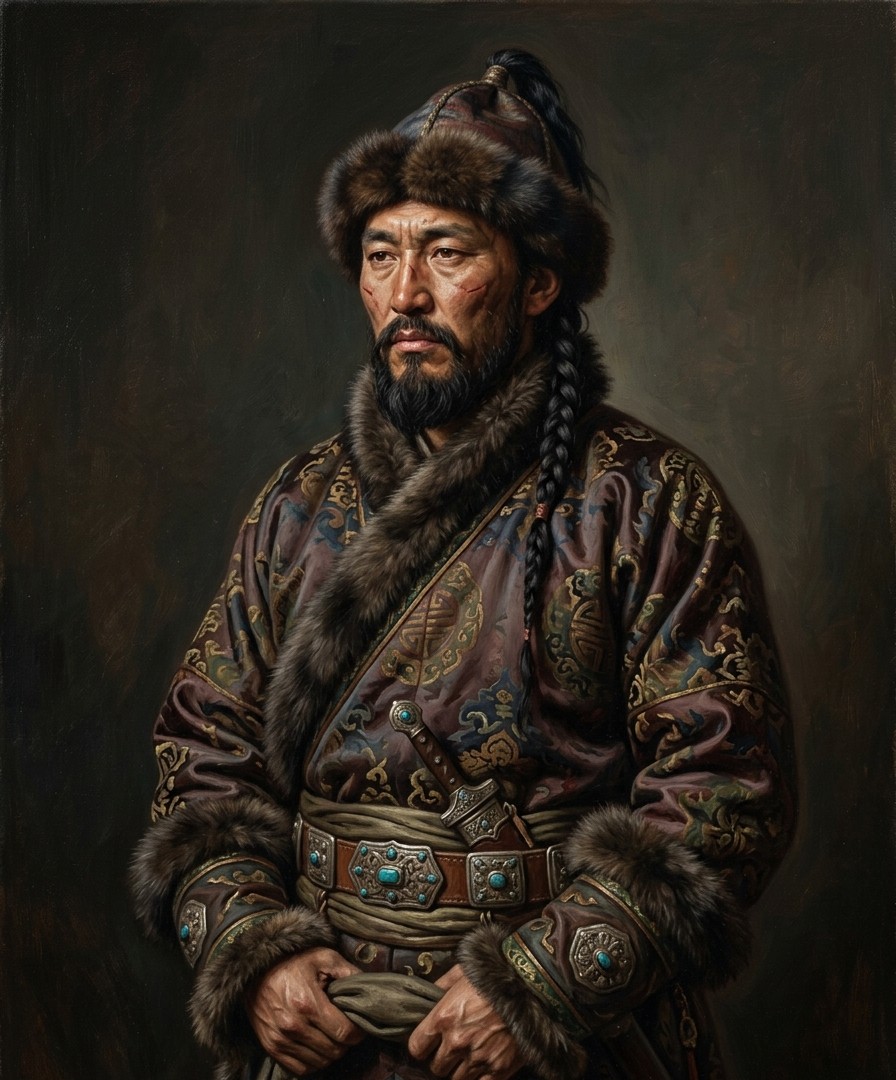
AI-assisted Portrait of Jochi
The Son Under a Permanent Cloud
He was the eldest son of Genghis Khan, and that should have made him the natural heir to the largest empire the world had ever seen. Instead it made him the loneliest. Jochi was born around 1182 to Börte, the Khan's first and most honored wife—but born into a question that would shadow every day of his life. Börte had been carried off in a Merkit raid; by the time her husband fought to recover her, she was already pregnant. No one could say with certainty whether the father was Temüjin or one of her captors. They named him Jochi—“the unexpected one”—and the name itself carried the doubt.
Genghis Khan claimed Jochi as his own, but the doubt festered within the family. His brother Chagatai threw it in his face before the assembled court—refusing to follow “this Merkit bastard”—and the brothers nearly came to blows. The Khan silenced them, but everyone understood: the throne would pass to the conciliatory third brother, Ögedei. Jochi had been disqualified not by anything he did, but by a question he had no power to answer. He died around 1227, six months before his father, the estrangement never healed. The psychological profile that explains him is the ISFP: dominant introverted feeling carrying the wound inward; auxiliary extraverted sensing in the capable warrior; a man who answered exile with withdrawal rather than ambition.
Jochi was the ISFP prince exiled by a doubt he never caused and could never escape—dominant Fi carrying the wound inward as a private sense of injured worth, auxiliary Se making him a brave and humane warrior, a man who answered the question hanging over his name not with argument but with silence and distance.
The Wound Carried Inward
Fi — dominant
The question of his birth was, to Jochi, not an abstract political problem but a daily injury to the core of who he was. He could not refute it—no one could—and so he absorbed it, and it became the quiet, aching center around which his whole life organized itself. When Chagatai branded him a bastard before the court, Jochi did not launch into a self-justifying defense of his bloodline; he answered with wounded dignity—challenging his brother to a personal contest of skill rather than a war of words—and then, when their father had spoken, he withdrew. This is the Fi signature: a sense of personal honor too private and too precious to put on public trial, defended by retreat rather than argument.
His famous mercy belongs here too. Where his father razed cities and left mounds of skulls behind, Jochi was said to spare towns and populations, arguing that subjects were worth more alive than dead. It was not strategy—a Te calculation would have followed the Khan's logic that exemplary slaughter induces surrender elsewhere. It was a personal refusal, a private conviction about the worth of the living held against the demands of expedience and the disapproval of the most powerful man on earth. That is Fi reasoning: the inner value that will not bend.
The Hunter and the Horseman
Se — auxiliary
Whatever the doubts about his blood, no one doubted that Jochi could fight. He grew up in the saddle, proved himself early commanding campaigns that subdued the forest peoples of southern Siberia and pressed the conquest of the western steppe. The Mongol style of war—the long ride, the great nerge hunts in which thousands of riders closed a vast arc of land into a ring, reading ground and momentum in real time—was Se made into a culture, and Jochi was fluent in it. He was entrusted with real armies and real territory because he could deliver in the field. Auxiliary Se kept his Fi from collapsing into pure melancholy: it gave the wounded inner man a vigorous outer life, a body that could ride and act in a world that questioned his right to belong to it.
The Retreat to a Distant World
Ni — tertiary
Jochi seems to have understood, long before the succession council, that the throne would never be his—that no valor could dissolve the question over his birth. Rather than fight that current, he accepted it. The lands granted him were the farthest west—beyond the Aral Sea, toward the Russian steppe—and he leaned into the distance, retreating into his vast appanage rather than orbiting court contests. To a father who governed by surveillance and command, that self-contained remoteness read as disobedience, even rebellion. But it was less a conspiracy than a temperament—a wounded man following a settled inner sense that his place lay away from the center.
The Politics He Would Not Play
Te — inferior
In the ISFP, the inferior function is extraverted thinking—the capacity to build factions, maneuver through systems, impose order on the outer world. Ögedei succeeded by being agreeable to everyone; Jochi never played that game. He did not assemble allies at court or work the levers that might have softened the verdict against him. Where his father was a Te colossus who engineered his own succession in advance, the son would not scheme for a throne even when it was within reach. Faced with the political problem of his birth, he responded with Fi and Ni: withdrew, nursed the wound inwardly, retreated to his distant lands. Jochi could win battles. He would not win the war of court politics—and that was the war that decided everything.
Why ISFP Over ESFP
Why not ESFP?
The ESFP shares Jochi's Se—the physical boldness, the warrior's ease in the field—and the courage might tempt the read. But the ESFP leads with Se outward: present, performing, thriving at the center of things. Jochi was the reverse. His defining trait was not extraverted vitality but a deep, private, inward-turned sense of injured worth; his answer to crisis was to withdraw, not to perform. An ESFP in his position would have charmed the court past the doubt; Jochi retreated to the farthest edge of the world and nursed the wound alone. That is dominant Fi over a quieter Se—ISFP, not ESFP.
Both types are sensors of action and feeling, but the ESFP turns outward—toward the room, the crowd—while the ISFP turns inward, toward a guarded inner life. Everything we know of Jochi points inward: carrying a private hurt he refused to litigate in public, answering his brother's contempt with wounded dignity and his father's suspicion with distance. He retreated to his distant lands and lived there until the estrangement was ended by his death. That silence is ISFP, not ESFP.
Connected Figures
Further Reading
- The Secret History of the Mongols — Anonymous (13th century); trans. Igor de RachewiltzThe primary Mongol source — records Jochi's birth, the Merkit raid, and Chagatai's denunciation at the succession council.
- Genghis Khan and the Making of the Modern World — Jack WeatherfordReadable narrative of the Mongol empire; covers Jochi's role and his troubled relationship with his father.
- The Mongol Empire: Genghis Khan, His Heirs and the Founding of Modern China — John ManTraces the arc from Genghis to the successor khanates, including the western appanage that became the Golden Horde.
- The Golden Horde: The Mongol Conquest of Medieval Russia — Marie FavereauThe most rigorous modern study of the khanate founded by Jochi's descendants — begins with Jochi's western campaigns.
