 Historical Figure MBTI
#393 · 4-5-26 · The Mongol Empire
Börte
Grand Empress · Wife and Counsel of Genghis Khan · Mother of the Khans
c. 1161 — c. 1230
6 min read
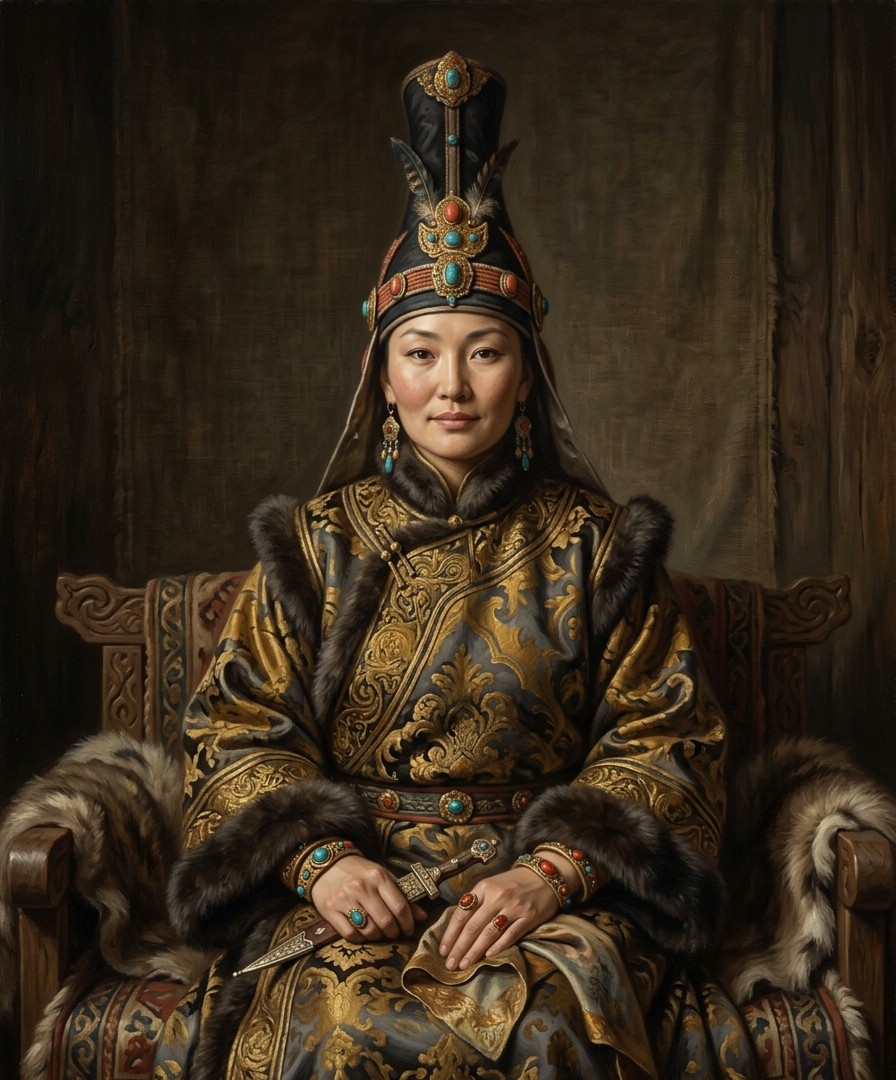
AI-assisted Portrait of Börte
The Anchor Beside the Throne
Börte enters history as a girl of about ten, betrothed to a boy named Temüjin—the future Genghis Khan—when his father left him at her family's camp to be raised as a son-in-law. The marriage that followed would outlast every alliance Temüjin ever made, every brother-in-arms he ever trusted, every steppe confederation he ever broke. While the men around him rose and fell, Börte remained: his Grand Empress, the mother of the four sons who would inherit the world, and by every source the steadiest counsel he ever had.
The defining ordeal came soon after the wedding, when a Merkit raiding party carried Börte off. She was held for months while Temüjin—with Jamukha and his patron Toghrul—raised an army to recover her. She returned pregnant, and the question of whether her eldest son Jochi was Temüjin's child or a Merkit's would shadow the succession for generations. Yet Temüjin claimed Jochi as his own without public hesitation, and the Khan's constancy toward the boy mirrored Börte's own. Twice more in the histories she saw danger before her husband did—warning him that Jamukha had grown into a rival they must break from, and later that the shaman Teb Tengri threatened the dynasty itself. Both times her husband acted on her word and both times she was right. She profiles cleanly as an ISFJ—the steady, devoted guardian whose power was never displayed and never doubted.
Börte was the ISFJ who anchored the Khan and mothered the khans—dominant Si in the unbroken constancy, the keeping of the hearth and the family and the old loyalties through every upheaval; auxiliary Fe in the protective, people-reading wisdom that twice told her husband who could no longer be trusted.
The Keeper of the Hearth
Si — dominant
Dominant introverted sensing is the function of continuity—loyalty to people and obligations that endure, the instinct to hold the center while the world churns. In a steppe culture where alliances dissolved overnight and sworn brothers became mortal enemies in a season, Börte's defining quality was that she did not move. Temüjin had lost his father as a boy, watched his clan abandon his widowed mother Hoelun, and built his power from nothing but loyalty he could gather and keep. Börte was the first loyalty he ever counted on, and she remained the most reliable to the end of his life.
The Merkit captivity is the truest measure of her dominant function. She was taken, held for months, returned carrying a child whose paternity would be whispered about for the rest of her life. Börte did not make it a permanent wound; she resumed her place, raised Jochi without visible reservation, and bore three more sons. The Si response to violation is to absorb it into the ongoing fabric of the family. Her steadiness became her husband's; the Khan's refusal to disown Jochi rested on the empress who had never disowned him either. As Grand Empress she presided over the empire's domestic and dynastic order—the camps, the marriages, the extended household that was, in the Mongol system, an instrument of state. While Genghis conquered, she held what was conquered together as a family enterprise to be inherited.
The Reader of Men
Fe — auxiliary
If Si gave Börte her constancy, auxiliary extraverted feeling gave her the gift that made her a counsel rather than merely a wife: she could read people. Fe attends to the relational field, to loyalty and resentment and the slow shifts of allegiance—the difference between a man who serves you and a man who is beginning to measure himself against you. Twice her relational judgment changed the course of events.
The first was Jamukha. He and Temüjin had sworn blood-brotherhood, but when Jamukha spoke a cryptic word about where the two camps should pitch, it was Börte whom Temüjin consulted. She told him plainly that Jamukha had grown into a man who wanted to be first and that they must break from him that night. The split set in motion the long rivalry that ended only when Temüjin became sole master of the steppe. Decades later the same gift named a different danger: the shaman Teb Tengri, whose spiritual authority had swollen until it rivaled the throne's. Börte warned sharply that a man who could set the brothers against one another was a mortal threat. Genghis acted, and Teb Tengri was destroyed. This is auxiliary Fe at its most valuable: not warmth for its own sake, but a protective social intelligence trained on the people closest to power.
The Shrewdness in Service
Ti — tertiary
Tertiary introverted thinking in an ISFJ is not the cold logic of the analyst; it is a quiet shrewdness that operates in service of people and stability. Börte's counsel was never philosophical. She diagnosed specific men and specific situations and reached a clear, hard-edged conclusion about what had to be done. The judgment that Jamukha must be left behind, that Teb Tengri must be cut down—these were analytical conclusions drawn entirely toward the protection of her family. Ti gave her the clarity; Si and Fe told her what the clarity was for.
The Secret History of the Mongols—the one near-contemporary source that preserves her voice—gives us only a handful of scenes, stylized by the conventions of an oral epic. We cannot reconstruct the texture of her mind. But what the surviving scenes consistently show is a woman whose interventions were correct, decisive, and unsentimental about threats, even threats wearing the face of a brother or a holy man. That combination—warmth toward her own, a cool read on danger—is the signature of an ISFJ whose tertiary Ti has matured into genuine judgment. Her shrewdness always pointed inward, toward holding the household together, not outward toward conquest. The analytical edge served the guardian's ends.
The Future She Did Not Chase
Ne — inferior
Inferior extraverted intuition shows itself less as a positive trait than as an absence—a temperamental indifference to open-ended possibility. Her husband Genghis Khan was driven by a vast intuition of destiny, a vision that pulled him toward a future no one else could yet see. Börte was his opposite and his complement: where his gaze was fixed on the horizon, hers was fixed on the camp. Her gift was never to dream up new possibilities but to evaluate the ones other people brought and test them against the steady measure of loyalty and consequence. When she weighed Jamukha or Teb Tengri, she was reading present men with a clear eye, not imagining branching futures. The marriage worked because each supplied what the other lacked: he the boundless reach, she the unbreakable ground.
Why ISFJ Over ESFJ
Why not ESFJ?
The ESFJ shares Börte's Si and Fe but leads with extraverted feeling—the outward, organizing social command of someone who runs the room and holds a community together by visible presence and active management. Börte does not read that way. The sources show a woman whose authority was quiet and inward, exercised in private counsel rather than public command; she shaped events through decisive, trusted words to one man, not by marshaling a court. Her constancy—the keeping of the hearth and old loyalties through every upheaval—reads as dominant Si steadying an auxiliary Fe: the guardian, not the social organizer. Across forty years beside one of history's most expansive lives, she is never described reaching for influence or commanding a room—only as the fixed thing, trusted, consulted, and content to keep the dynasty whole from beside the throne.
Connected Figures
Further Reading
- The Secret History of the Mongols — Anon. (trans. Igor de Rachewiltz)The single most important primary source for Börte's life — the 13th-century chronicle that records her warnings about Jamukha and Teb Tengri.
- Genghis Khan and the Making of the Modern World — Jack WeatherfordA widely read narrative history that treats Börte as a genuine political partner and examines her role in the empire's early formation.
- The Mongols — David MorganA reliable scholarly overview of Mongol history and society, providing the political context in which Börte operated.
- Women in Mongolia: Mapping Progress under Socialism — Evelyn MichalowskiSituates Börte within the longer tradition of female authority in Mongol nomadic culture.
