 Historical Figure MBTI
#392 · 4-5-26 · The Mongol Empire
Hoelun
Mother of Genghis Khan · The Widow Who Survived the Steppe · Matriarch of the Empire
c. 1140 — c. 1221
6 min read
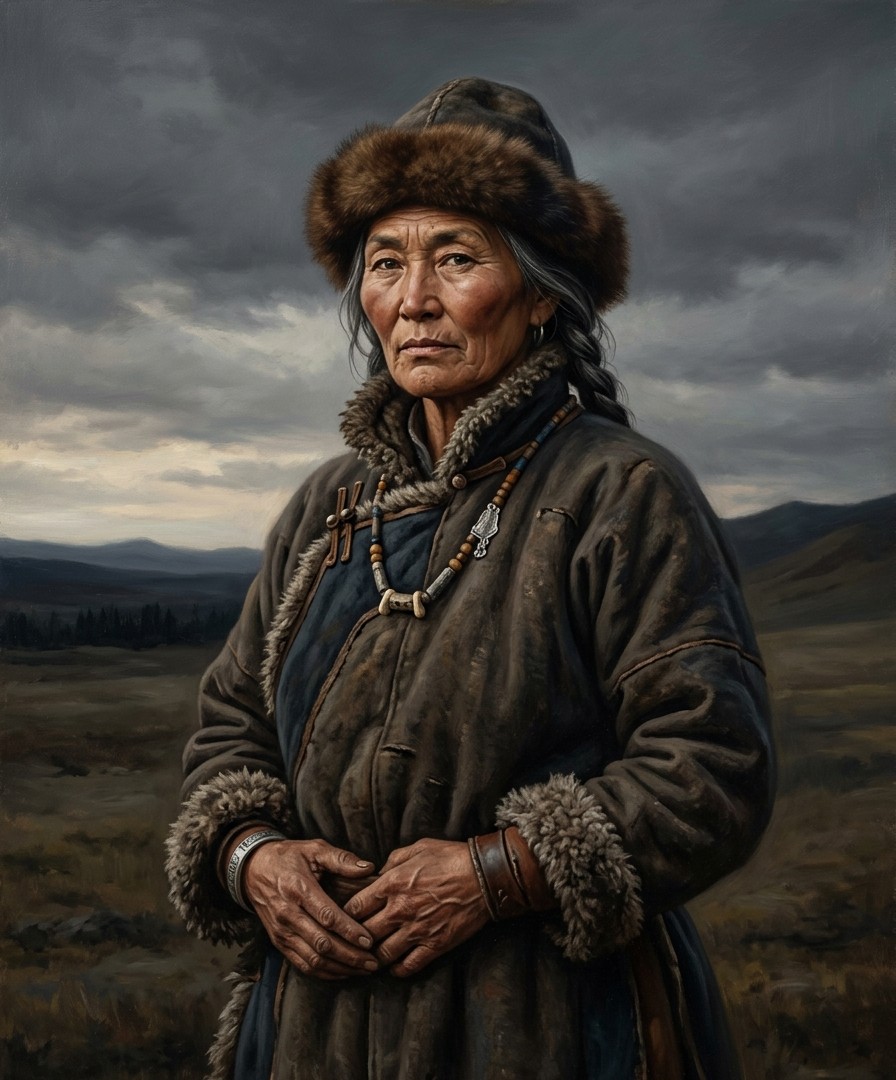
AI-assisted Portrait of Hoelun
The Widow Who Refused to Let Her Children Die
She enters history as a captive. Hoelun was riding home as the new bride of a Merkit man when a Borjigin chieftain named Yesügei took her by force. She bore him sons, the eldest of whom was Temüjin, who would one day be called Genghis Khan. Then the world collapsed. Tatars poisoned Yesügei on a journey home, leaving Hoelun a widow with small children in a society that had no use for a leaderless family.
The Borjigin clan struck camp and rode off, abandoning them on the open steppe to starve. Hoelun's response is preserved in The Secret History of the Mongols: she seized the horsetail standard of her dead husband and rode after the departing clan to shame some of the families back. It did not last. But the gesture is everything. A woman left to die did not weep. She raised the banner and tried to command.
Then she kept them alive. She foraged wild roots and onions; she taught the boys to net fish and trap marmots—food a proud steppe family would once have scorned, now the thin line between living and dying. She was no silent sufferer. She was the engine, and her son inherited the engine. The diagnosis is a textbook ESTJ.
Hoelun is the ESTJ stripped to its core—a woman abandoned to die who answered not with grief but with command, raising the banner herself, organizing the daily work of survival, and driving her children with the hard, dutiful discipline of dominant Te resting on the practical, tradition-rooted knowledge of Si.
She Raised the Banner Herself
Te — dominant
Dominant Te does not grieve the loss of authority; it reaches for the instrument of authority and tries to use it. When the clan rode off, Hoelun seized the command-standard of her dead husband and rode after them. When that failed, she ran the destitute household like a small operation—assigning tasks, holding her children to a discipline that did not bend to hunger or self-pity—until her children did not die, in a situation their own clan had engineered to ensure that they would.
The sharpest expression of her Te was her willingness to confront authority to its face. When Temüjin and Khasar murdered their half-brother Begter, The Secret Historypreserves the rebuke: she compared her sons to wild beasts—a dog devouring its own afterbirth, a panther, a lion—raging that they had destroyed their own kin. Decades later, as empress-mother, she still corrected the Great Khan when she judged him wrong. Dominant Te does not defer to power. It tells power when it has erred.
The Roots, the Fish, the Hard-Won Knowledge
Si — auxiliary
Auxiliary Si gave her dominant Te something to command with. Her survival was not improvised genius but the application of lived knowledge: which roots were edible, when the wild fruit came, how to read the land for marmots and the rivers for fish. Not glamorous knowledge, and knowledge a chief's wife was not supposed to need—but she had it, used it, and taught it.
Her Si grounds her rebukes in tradition: the clan owed the widow protection; the brothers owed each other loyalty. She carried the codes of her society in her bones and measured every betrayal against them. Through Si she became the transmitter of the lessons that built her son. The famous illustration—the single arrow easily snapped, the bundle of arrows unbreakable—is Si knowledge in its purest didactic form: she did not theorize about loyalty, she showed it in the way she had survived.
The Resourcefulness of the Cornered
Ne — tertiary
Tertiary Ne in an ESTJ is a supporting faculty—a capacity to see possibility where the situation seems closed. In Hoelun it appears as the resourcefulness of the cornered. A purely conventional mind would have starved, because the conventional sources of food—the herd, the hunt of large game—were gone. Hoelun turned to the despised, marginal resources of the land and made them the foundation of survival. Ne recognizes a possibility the tradition would have refused; Te seizes it and makes it a routine. She was not a visionary, but she kept finding the next workable move when every obvious move was gone.
The Mother Who Led by Standard, Not by Tenderness
Fi — inferior
Hoelun led by will and standard far more than by warmth. Her intervention after the killing of Begter is instructive: not the grief of a mother for a lost child but the fury of a matriarch at the violation of family order. She does not mourn Begter; she rages that her sons have proven themselves beasts. The feeling is real and ferocious, but it runs through the channel of standards and duty—which is exactly where inferior Fi expresses itself in the ESTJ.
At Hoelun's core was a fierce conviction about loyalty and kin, forged the moment her clan abandoned her to die. She expressed it as command and rebuke rather than as confession or affection. When she savaged her sons for fratricide, when she later defended Temüjin's brothers against him, she was enacting a private value system through public, directive force. The wound of betrayal lived in her, and she answered it by trying to compel loyalty into existence—in her household first, and then across the empire her son built on that principle.
Why ESTJ Over ISTJ
Why not ISTJ?
The ISTJ shares Hoelun's duty, practical knowledge, and tradition-rooted Si. But the ISTJ leads with introverted sensing; it endures and preserves more than it directs. Hoelun did not quietly endure. She actively commanded—seizing the war-standard, organizing survival as an operation, rebuking the Great Khan to his face. That take-charge, confront-authority signature is dominant Te, not the inward Si of the ISTJ. She did not survive the steppe by enduring it. She survived it by taking charge of it.
Connected Figures
Further Reading
- The Secret History of the Mongols — Trans. Igor de RachewiltzThe single near-contemporary Mongol source; Hoelun appears directly in its early chapters as widow, forager, and rebuker of her sons.
- Genghis Khan and the Making of the Modern World — Jack WeatherfordAccessible narrative history that reconstructs Hoelun's pivotal role in Temüjin's survival and formation.
- The Mongols — David MorganA concise scholarly survey of the Mongol Empire that situates Hoelun within the wider political and social context.
- Women in the Mongol Empire — Anne F. BroadbridgeA focused scholarly study of Mongol queens and imperial women, with sustained attention to Hoelun's power and legacy.
