 Historical Figure MBTI
#395 · 4-5-26 · The Mongol Empire
Chagatai
Son of Genghis Khan · Guardian of the Yassa · Khan of Central Asia
c. 1183 — 1242
6 min read
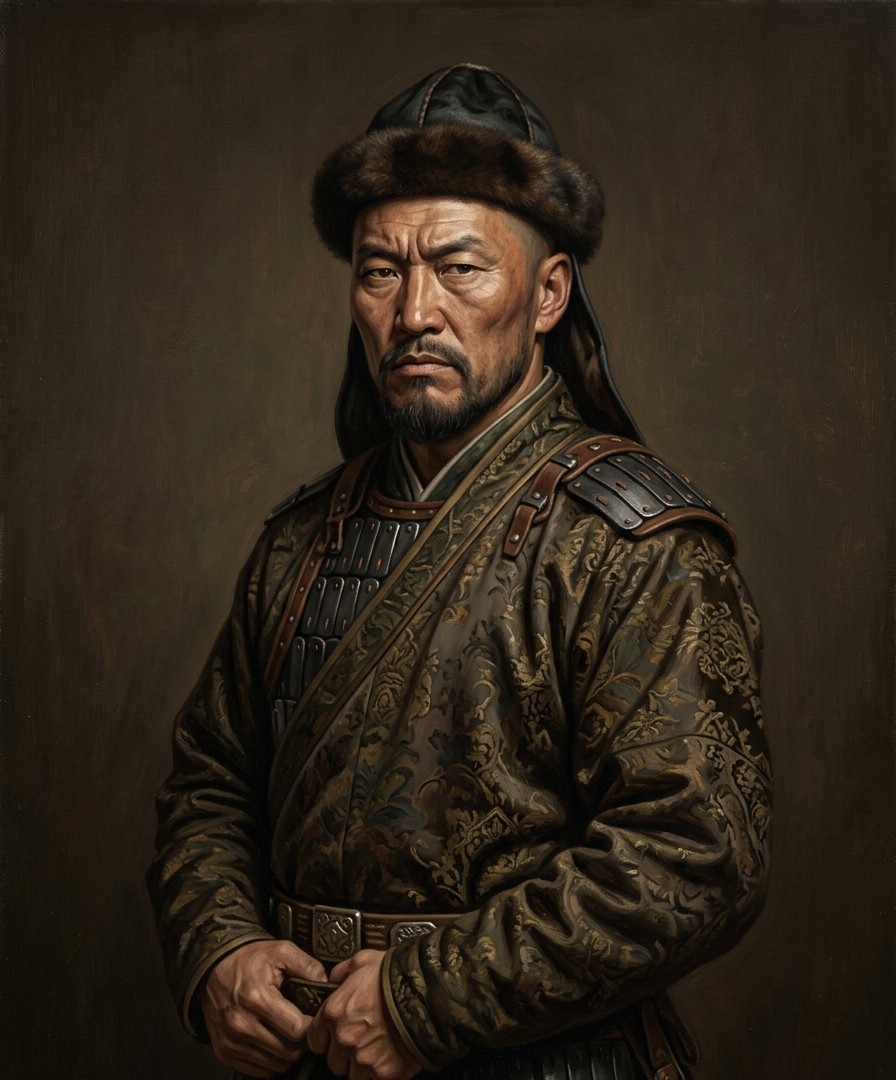
AI-assisted Portrait of Chagatai
The Son Who Was the Law
Born around 1183, the second son of Genghis Khan and Börte, Chagatai was the hard one. Where Ögedei was genial and easy to like, Chagatai was blunt, hot-tempered, and rigid. Of all the sons it was Chagatai who took the Yassa—his father's written law—most completely into himself, becoming not merely its observer but its strictest interpreter and most feared enforcer.
His defining moment was aimed at his own brother. When Genghis Khan weighed the succession, Jochi had the natural claim—but Börte had been captured in a Merkit raid and recovered pregnant, and the question of Jochi's blood had haunted the family for thirty years, spoken in whispers and never aloud. Chagatai spoke it aloud. At the council he exploded that he would never serve “this Merkit bastard,” provoking a brawl that had to be physically broken up. In refusing Jochi, he destroyed his own claim. The succession passed to Ögedei, whom Chagatai supported with stern loyalty—because Ögedei was the lawful Khan, and the law was the one thing Chagatai would never break. He received the Muslim lands of Transoxiana and ruled them as exactly the man he had always been: harsh, conservative, order-obsessed.
Chagatai was the ESTJ disciplinarian at full severity—dominant Te enforcing his father's law outwardly and inflexibly on everyone, auxiliary Si holding the established code as sacred, a man who guarded the Yassa so absolutely that he broke his own brother on it and never once thought he had done wrong.
The Enforcer of the Code
Te — dominant
In Genghis Khan, dominant Te built an empire from nothing. In Chagatai it turned on the empire already built and became something narrower: not creation but policing. He took his father's code as a finished instrument and applied it with a literalism that left no room for circumstance or mercy. He held himself to the Yassa as strictly as he held anyone, policing its prohibitions—ritual slaughter, bathing in running water, a hundred points of steppe observance—without favor. To the settled Muslim populations of his domain this was crushing severity. He did not soften it. Te serves the office, not the person, and Chagatai served it to the letter.
The Reverence for the Old Law
Si — auxiliary
Auxiliary Si supplies Te with the trusted body of precedent against which the present is judged. In Chagatai this became near-religious conservatism. The Yassa was not one possible legal arrangement; it was the law, fixed by the founder, and its authority came from being the inherited thing handed down by his father. The cities of Transoxiana—merchants, scholars, intricate civilization—were exactly the unfamiliar terrain Si cannot accommodate. He governed them as a steppe lord, imposing the old observances. This explains the man's peculiar consistency: Chagatai did not evolve, soften, or reconsider. The enforcer of the succession council was identical to the enforcer who ruled Central Asia decades later.
No Patience for Ambiguity
Ne — tertiary
Tertiary Ne in the ESTJ is weak—the capacity to see alternatives, to hold a situation open, to entertain that things might be otherwise than the rule prescribes. In Chagatai it was almost absent. He had no feel for nuance, no patience for the argument that a particular case might warrant an exception. The world arrived in his mind sorted into lawful and unlawful, the established way and the deviation from it, and nothing in between.
This is why the succession crisis became catastrophic. A man with developed Ne would have understood that Jochi's birth had been left unspoken for thirty years because nothing good could come of resolving it. Chagatai could not perceive the value of the unresolved. He stated the fact and the rule he derived from it, flatly, at the worst possible moment—exactly the Ne he did not have.
The Blunt Heart
Fi — inferior
Inferior Fi is the buried register of the ESTJ—the private inner world that outward, rule-bound Te neither cultivates nor expresses. In Chagatai it was very deep. What he felt, he felt as conviction—hard, moralized—not as empathetic responsiveness. When his feeling surfaced it came out as righteous rigidity: his revulsion at serving Jochi expressed itself not as grief or compassion but as a moralized refusal, feeling already converted into judgment. Yet the same buried Fi made him equally pitiless toward himself—no private exceptions, no gap between the standard he enforced and the standard he obeyed. Te conviction turned upon himself.
Why ESTJ Over ISTJ
Why not ISTJ?
The ISTJ shares Chagatai's reverence for established law—the same auxiliary Si, the same dutiful conservatism. But the ISTJ leads with introverted sensing: it keeps the rules privately, within its own sphere, as a matter of personal obligation. Chagatai did not merely keep the law privately. He enforced it outwardly and inflexibly on everyone, projecting his conviction as command, erupting at a council, breaking his own brother in public, ruling a continent by the lash of the code. That is the outward, commanding, dominant Te of the ESTJ, not the inward dutifulness of the ISTJ.
Both types hold the established order sacred; the question is whether conviction faces inward or outward. An ISTJ would have obeyed the Yassa and held his tongue at the council. Chagatai aired his doubts loudly, making the empire's succession hostage to his outburst. He policed others, not merely himself—the commanding enforcer over the law, not the quiet keeper within his own conscience. That is dominant Te, and it is why Chagatai is an ESTJ.
Connected Figures
Further Reading
- Genghis Khan and the Making of the Modern World — Jack WeatherfordThe most accessible account of the Mongol rise; covers the family's succession crisis and Chagatai's role in it.
- Genghis Khan: His Life and Legacy — Paul RatchnevskyThe standard scholarly biography of Genghis Khan, with detailed treatment of the sons and the Yassa.
- The Mongol Empire: Genghis Khan, His Heirs and the Founding of Modern China — John ManTraces the empire's arc from Genghis through his heirs, with attention to the Chagatai Khanate's distinctive conservatism.
- The Mongol Art of War — Timothy MayExamines the military and legal structures — including the Yassa — that Chagatai spent his life enforcing.
