 Historical Figure MBTI
#407 · 4-6-26 · The Mongol Khanates
Hulagu Khan
Sacker of Baghdad · Founder of the Ilkhanate
c. 1217 — 1265
8 min read
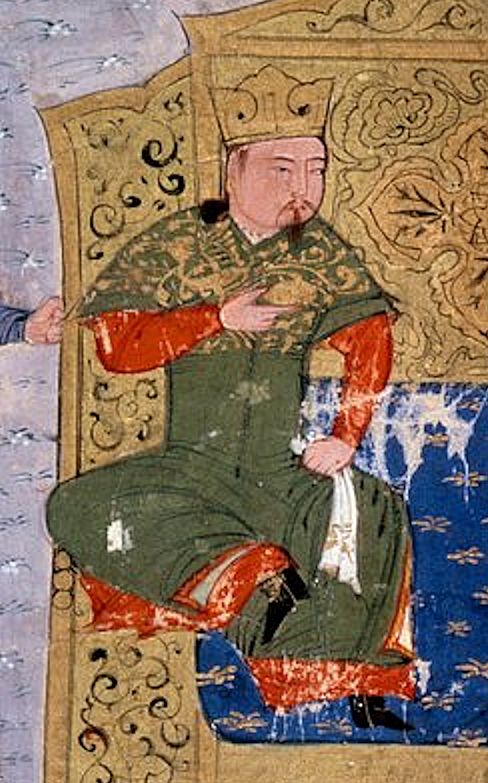
Portrait of Hulagu Khan
The Man Who Ended an Age
In February of 1258, the armies of Hulagu Khan broke the walls of Baghdad. For five hundred years the city had been the seat of the Abbasid Caliphate and the brightest lamp of the medieval world—its House of Wisdom the place where Greek philosophy, Persian science, and Arabic mathematics had been gathered, translated, and advanced. Within days it was ash. The libraries were thrown into the Tigris until, the chroniclers say, the river ran black with ink. The last caliph, al-Musta'sim, was rolled in a carpet and trampled to death by horses—a Mongol courtesy, since royal blood was not to be spilled on the ground. Perhaps a hundred thousand people died, or many more. With one campaign, Hulagu closed the Islamic Golden Age.
He was the grandson of Genghis Khan, son of Tolui and the formidable Sorghaghtani Beki, and brother to three other men who would rule the world—the Great Khan Möngke, Kublai, and Ariq Böke. Dispatched westward in 1253 to subdue the whole of the Islamic world, Hulagu executed the order with a thoroughness that still reads as merciless seven centuries later. He annihilated the Nizari Ismailis, sacked Baghdad, took Aleppo and Damascus, and then, from the wreckage, founded the Ilkhanate—the Mongol dynasty of Persia that would endure for eighty years. Destruction and construction in a single hand.
Hulagu was the ENTJ as instrument of conquest—Te executing a strategic design with overwhelming force, Ni supplying the architecture, Se feeding the appetite for sheer applied power. He did not brood over the war. He commanded it, frontally, and won.
The Commander
Te — dominant
Dominant Te organizes the world into objectives and the most efficient means of taking them. In Hulagu it produced not a battlefield tactician of the improvising kind but a systems-conqueror—a man who treated the subjugation of an entire civilization as a logistical problem to be solved completely. The western campaign was provisioned on a scale the Mongols had rarely attempted: roads cleared, bridges built, siege engineers and naphtha-throwers recruited from China, pastureland reserved along the line of march so the cavalry would never want for grass. He moved methodically, reducing one obstacle before turning to the next, and he did not leave problems half-finished behind him.
The Ismaili campaign of 1256 shows the method at its coldest. The Nizari “Assassins” had defied conquerors for a century and a half from their mountain fortress at Alamut, a stronghold thought impregnable. Hulagu did not gamble on a single assault. He took their castles one by one, accepted the surrender of the young Grand Master, paraded him as proof that the order was finished—and then had him and his family killed anyway, because a living figurehead was a loose end. Baghdad two years later was the same logic at imperial scale: encircle, bombard, breach, and then liquidate the institution so thoroughly that it could never reconstitute. The execution of the caliph was not rage. It was the deliberate deletion of a five-hundred-year office.
And then, having destroyed, he built. Te does not merely break things; it wants a working machine at the end. Out of the conquered provinces Hulagu assembled the Ilkhanate, a functioning Persian state with a capital, a treasury, a tax system, and a chancery staffed by the very Persian administrators he had spared for their usefulness. The man who erased the Abbasid order replaced it with one of his own—and it outlasted him by three generations.
The Long Design
Ni — auxiliary
Auxiliary Ni gives Te its horizon. Where the pure tactician fights the battle in front of him, the Te-Ni commander fights the war that has not happened yet—he sees the shape the campaign will take years out and arranges the present to arrive there. Hulagu's march west was not a raid but a settlement plan disguised as an invasion. He brought his wives, his herds, and his household. He intended, from the outset, not to plunder Persia and leave but to stay and rule it, and every conquest was a brick in a state he could already picture.
The clearest proof that Hulagu thought past the war is the observatory at Maragheh. In the same years he was burning libraries, he was endowing one. He drew the astronomer Nasir al-Din al-Tusi out of the rubble of the Ismaili fortresses—a man he had captured rather than killed—and gave him an institution to rival anything the Abbasids had built: a great observatory, a library of hundreds of thousands of volumes salvaged from the conquest, instruments of unprecedented size. It produced the Zij-i Ilkhani, the astronomical tables that bore Hulagu's dynastic name and were consulted for centuries. A man of pure appetite does not fund astronomy. Hulagu understood that a dynasty is remembered by what it leaves standing, and he meant the Ilkhanate to be remembered.
The same foresight governed his statecraft. He kept his beloved Christian wife Doquz Khatun close and tilted his court toward Christianity and Buddhism, reading—correctly—the strategic value of an anti-Muslim alliance that might one day join the Mongols to the Crusader powers of the West against the Mamluks of Egypt. The plan never quite came together, but the instinct behind it was Ni: a single converging design pursued across decades and continents.
The Appetite for Force
Se — tertiary
Tertiary Se is what made Hulagu terrifying rather than merely effective. It is the function of overwhelming physical force, of seizing the present moment with maximum intensity, and in a Te-dominant conqueror it supplies the raw destructive appetite that the strategy then aims. The sack of Baghdad was not a calculated minimum of violence; it was a saturation. The slaughter ran for days after resistance had ended. Where a colder planner might have stopped once the city was secured, Hulagu let the storm run its full course—the visceral overkill of a man who took a kind of satisfaction in the sheer weight of the blow.
Se also reads the immediate field with an animal accuracy. Hulagu fought from the front, up among his men in the way of the steppe lords, and he had an instinct for the theatrical use of terror as a weapon. The carpet-and-horses death of the caliph, the pyramids of skulls, the deliberate destruction of the irrigation canals that had watered Mesopotamia since antiquity—these were not only cruelty but display, force made legible to every city that had not yet surrendered. Resistance, Hulagu showed, would be answered not with defeat but with erasure.
The One Loyalty
Fi — inferior
Inferior Fi in an ENTJ is the buried, inarticulate private conviction—rarely shown, fiercely held, and usually attached to one or two people rather than to humanity at large. A man who could trample a caliph and drown a city's libraries without apparent hesitation reserved a startling tenderness for his wife Doquz Khatun, the Nestorian Christian princess whose faith he protected and whose counsel he honored. When she and Hulagu died within months of each other in 1265, the Christian chroniclers mourned them as a pair—a strange epitaph for the destroyer of Baghdad, and a glimpse of the narrow channel through which his Fi ran.
The inferior function also explains the one war Hulagu fought that was personal. His cousin Berke, khan of the Golden Horde and a convert to Islam, was appalled by the murder of the caliph, and the two went to war—the first time Mongol turned on Mongol in open battle. The conflict was framed in the language of religious grievance, but underneath it was something more raw: a clash of two men's deepest unspoken values, the kind of quarrel that inferior Fi makes implacable. Hulagu, who could be coldly rational about an entire civilization, could not be rational about Berke. The feud outlived him and hardened into a permanent fracture in the Mongol world.
Why ENTJ Over INTJ
Why not INTJ?
The INTJ is the inward, patient planner—the strategist who wins from behind the map, conserving force and preferring the indirect stroke. That describes Hulagu's brother Möngke, the family's true introverted architect, far better than it describes Hulagu himself. Hulagu was a frontal commander who led from the saddle, governed by appetite as much as by design, and reached for overwhelming applied force where the INTJ would have looked for leverage. The destruction of Baghdad was not a quiet, surgical move; it was a saturation of power, Te and Se together. An INTJ takes the city. Hulagu obliterated it—and wanted to.
The distinction is one of direction. Both types build durable systems and think in long arcs, and the Toluid brothers shared a dynastic intelligence that came down from their mother Sorghaghtani Beki. But where Möngke planned and dispatched, Hulagu executed in the open, his energy turned outward at the world rather than inward at the problem. The same extraverted ferocity that made him the most destructive of the brothers also made him the founder of the most cultured of their successor states. That is the ENTJ paradox: the man whose force ends an age is often the one with the will to begin a new one in its place.
Connected Figures
Further Reading
- The Mongols — David MorganThe standard one-volume scholarly introduction in English; lucid on the Ilkhanate and the wider Mongol world Hulagu helped shape.
- The Mongol Empire — Timothy MayA current, comprehensive synthesis of Mongol history with strong coverage of the western campaign, Baghdad, and Ain Jalut.
- Khubilai Khan: His Life and Times — Morris RossabiThe definitive biography of Hulagu's brother; essential for understanding the Toluid family and the succession that recalled Hulagu east.
- Kublai Khan — John ManA vivid popular account of the same generation that supplies useful narrative context for Hulagu's campaigns and the empire's fracture.
