 Historical Figure MBTI
#406 · 4-6-26 · The Mongol Khanates
Möngke Khan
Fourth Great Khan · Last Lord of the United Empire
1209 — 1259
8 min read
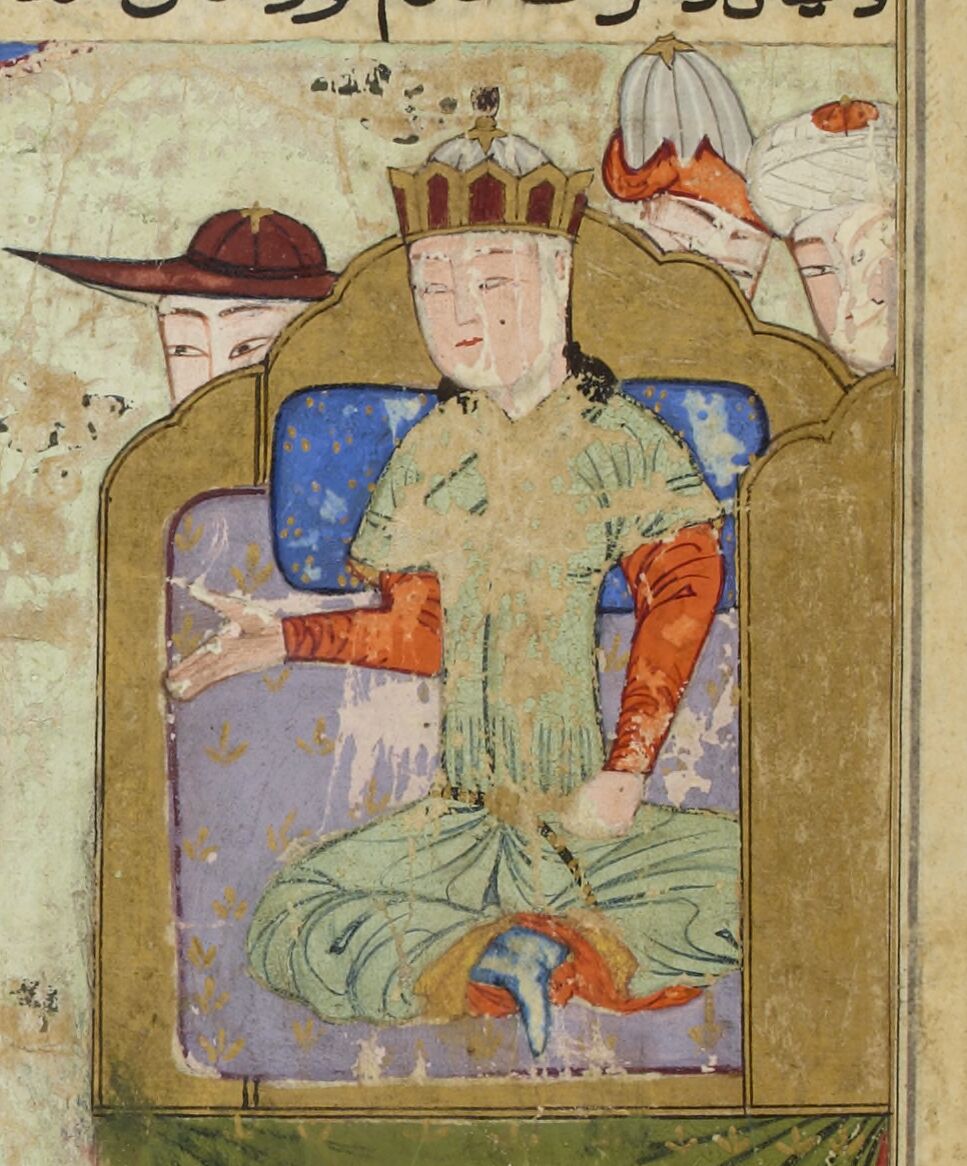
Portrait of Möngke Khan
The Last Lord of the Whole
Möngke Khan was the last man to rule the Mongol Empire as a single thing. Every khan after him inherited a fragment—a Yuan, an Ilkhanate, a Golden Horde, a Chagatai ulus—but Möngke, who reigned from 1251 to 1259, held the whole of it, from the Yellow River to the gates of Eastern Europe, and ruled it not by charisma but by design. He was the eldest son of Tolui and Sorghaghtani Beki, the formidable widow who spent two decades building the machinery of his accession, and he was the grandson of Genghis Khan, whose empire he found drifting and left tightened to a single point of command.
He is the least romantic of the great khans, and that is precisely the point. Where his brothers conquered with appetite, Möngke administered with method. He came to the throne through a coup—the “Toluid Revolution” that wrenched the khanate from the line of Ögedei and into his own—and he secured it with a purge so thorough that the rival princely houses never recovered. Then, having cleared the board, he did something no Mongol ruler had done before: he sat down and counted. He ordered an empire-wide census, rebuilt the tax system, reformed the postal relays, and cracked down on the princely looting that had hollowed out the state under his predecessor. Only when the apparatus was repaired did he loose the armies—two of them, in opposite directions, at once.
Möngke is the INTJ on a throne—Ni furnishing the single coordinated vision, Te building the census and the war-machine to execute it. He did not ride at the front of the empire. He sat at its center and moved the whole of it like a problem to be solved.
The Two-Front Mind
Ni — dominant
Dominant Ni converges. It does not gather options the way Ne does; it narrows toward a single anticipated outcome and then bends everything available toward it. Möngke's signature act of rule was a feat of convergence almost unique in medieval history: in 1252 he planned, and over the following years executed, a coordinated expansion in two directions at once. He dispatched his brother Hulagu westward with a vast army to break the Ismaili Assassins of Alamut and then to take Baghdad, the seat of the Abbasid Caliphate, which fell in 1258. Simultaneously he turned the bulk of the empire's strength against Song China, the richest and most populous holdout left on earth, and resolved to lead that campaign himself.
This is the strategic imagination of Ni rendered at imperial scale. Holding two theaters separated by four thousand miles inside a single design—allocating men, timing the advances, foreseeing how the fall of Baghdad would reshape the balance in the west while the slow strangulation of the Song reshaped it in the east—requires a mind that lives in the projected future rather than the immediate field. Möngke rarely improvised. He decided where the empire would be a decade out and then spent years assembling the conditions for it. The restoration of central control that preoccupied the first half of his reign was the same instinct turned inward: he could see the long arc by which Mongol unity would dissolve into squabbling appanages, and he moved to arrest it before it began.
What makes the Ni reading specific to Möngke rather than generic is the austerity of it. He was not a visionary in the expansive, world-painting sense; contemporaries describe a grave, taciturn, suspicious man who trusted few and explained little. The vision lived inside him, unshared and unsoftened, and surfaced only as command. That is Ni in its most introverted register—certainty without display, the future arriving as decree.
The Census and the Purge
Te — auxiliary
If Ni supplied the vision, auxiliary Te built the apparatus to enforce it. Te wants systems, measurement, and accountability; it converts a goal into a procedure and a procedure into an institution. Möngke's reign reads like a Te manifesto. He ordered a comprehensive census across the empire—counting people, livestock, and fields so that taxation and conscription could be set on a rational basis rather than left to the predatory whim of local princes. He standardized the tax burden, reorganized the yam postal relay that carried information across the continent, and audited the empire's accounts to claw back the loans and exactions that grandees had been levying in the khan's name. The lax, generous years of his predecessor Ögedei had let the central treasury bleed; Möngke closed the wounds with a ledger.
The same systematizing coldness governed his rise. The Toluid Revolution that put him on the throne was contested by the Ögedeid and Chagataid houses, and Möngke's answer was not reconciliation but elimination. He convened tribunals, extracted confessions, and executed rivals and their partisans in numbers that ran into the dozens of senior princes and their followings—a purge that broke the competing lineages as political forces. Te does not agonize over whether a rival might be redeemed; it asks whether the rival is a structural threat, and if so, removes the threat. There is something almost bureaucratic in the thoroughness of it: the opposition was not merely defeated but processed.
Te is also why Möngke could run a war as an operation rather than an adventure. The disciplined logistics that let two armies advance on opposite ends of Eurasia—the supply lines, the staged objectives, the relays carrying orders back and forth—were Te made visible. His brothers won battles; Möngke ran the institution that made the battles winnable.
The Private Conviction
Fi — tertiary
Tertiary Fi in an INTJ is a quiet, interior thing—not warmth offered outward but a personal code held privately, a set of convictions the bearer does not feel obliged to explain. Möngke's austerity was partly this. He was famously abstemious by the standards of a dynasty that drank itself to death—his uncle Ögedei and several of his kinsmen died of alcohol—and he held himself to a discipline of personal conduct that read as moral seriousness rather than mere policy. The crackdown on corruption was a Te measure, but the disgust at princely excess that fueled it had the flavor of Fi: a felt conviction about how a ruler and his servants ought to behave.
The most revealing window onto this interior Möngke is the famous religious debate he staged at Karakorum in 1254, which the Franciscan friar William of Rubruck attended and recorded. Möngke summoned Christians, Muslims, and Buddhists to argue their creeds before him, listened, and then delivered a verdict that was less theological than personal. He likened the faiths to the fingers of one hand and declared that as God had given the hand several fingers, so He had given mankind several ways—a statement of private, idiosyncratic conviction rather than orthodoxy. It is Fi speaking: a man who has reasoned his way to his own settled belief and states it plainly, without much interest in whether the assembled clerics approve.
The Fortress at the End
Se — inferior
Inferior Se is the INTJ's blind side—the present, the physical, the immediate field, all the things a mind that lives in projection tends to underweight. For most of his life Möngke commanded these realms at a safe remove, moving armies across a map rather than standing in the dust of their advance. But in 1258 he made the decision that cost him everything: rather than direct the conquest of Song China from the rear, he took the field himself, leading the main thrust into Sichuan while Kublai pressed from another quarter.
The campaign bogged down where a planner's map gives no help: in the wet, disease-ridden heat of the Sichuan basin, before the stubborn walls of a mountain fortress called Diaoyu. The siege dragged through 1259. The climate the strategist had not reckoned with did the work no Song general could—Möngke fell ill, almost certainly of dysentery or cholera in the camp, and died at the wall of a fort he could not take. The most controlled khan of all met his end not by miscalculation of grand strategy but by the brute facts of terrain, season, and contagion—the precise domain of the inferior function. The man who saw a decade ahead was undone by the ground beneath his feet.
He could plan the fall of Baghdad from two thousand miles away, but he could not plan around the fever of a Sichuan summer. The strategist died at the one kind of obstacle his strategy could not dissolve—the immediate, physical, present-tense world his Se never quite trusted.
Why INTJ Over ENTJ
Why not ENTJ?
The Mongol dynasty was crowded with ENTJs—Genghis the founder, Batu who built the Golden Horde, Hulagu who carved out Persia, Kublai who would seize China. They share a signature: expansive, appetite-driven, outward command, leading from the front and bending the world by force of presence. Möngke was the family exception. He ruled from the center, not the frontier; his instrument was the census and the ledger, not the charge; and his temperament was guarded and austere where the ENTJ is magnetic and projecting. He delegated the conquering to his brothers precisely because the conquering was the part he did not need to do himself.
The distinction is dominant function, and it is decisive. The ENTJ leads with Te—outward organization aimed at the world, charisma in the service of marshalling people toward an objective. Möngke led with Ni: the vision came first, inward and unshared, and Te followed to build the machinery. That ordering shows in everything. He was a designer of empire rather than a conqueror of it—a man who saw the whole structure in his head, decided what it should become, and then spent years quietly assembling the apparatus to make it so. His brothers wanted territory. Möngke wanted control, coherence, a system that held. That is the difference between the commander who rides at the head of the army and the planner who never needed to.
Connected Figures
Further Reading
- Khubilai Khan: His Life and Times — Morris RossabiThe standard life of Möngke's brother and heir; indispensable on the Toluid succession and the war that broke the empire after Möngke's death.
- The Mongols — David MorganThe classic concise survey of the empire — lucid on Möngke's reforms, the census, and his place in the dynasty's arc.
- The Mongol Empire — Timothy MayA modern, authoritative synthesis that situates Möngke's two-front expansion and administrative restoration within the whole imperial story.
- The History of the World-Conqueror — Ata-Malik Juvayni (trans. J. A. Boyle)The contemporary Persian chronicle by an official who served the Mongols; a primary witness to Möngke's reign and Hulagu's western campaign.
