 Historical Figure MBTI
#547 · 4-26-26 · The Mamluk Sultanate
Qutuz
Sultan of Egypt · Victor of Ain Jalut · Murdered by Baibars
d. 1260
11 min read
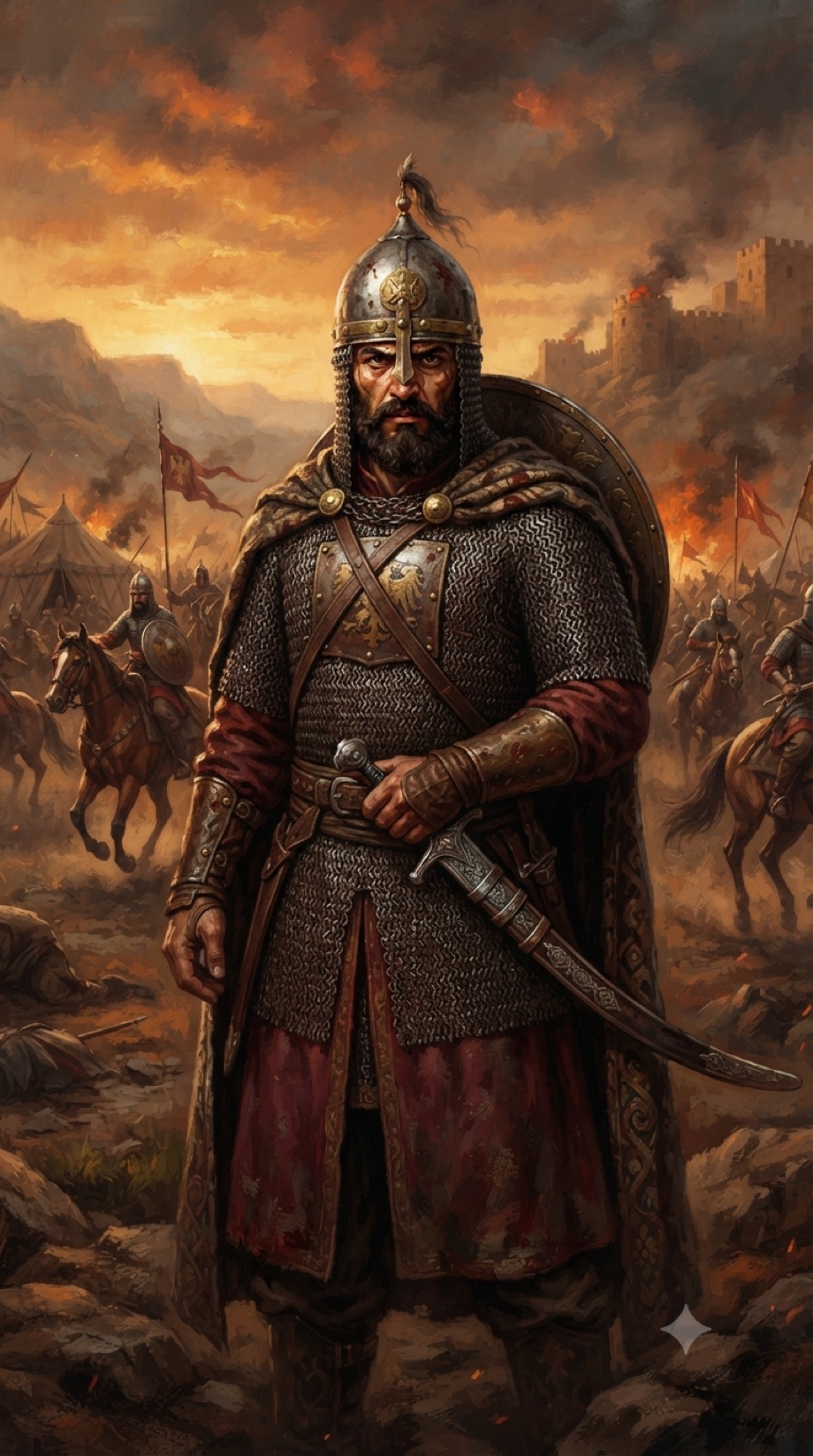
AI-assisted Portrait of Qutuz
The Man Who Broke the Mongols
When the envoys of Hulagu Khan reached Cairo in 1260, they carried the same letter that had preceded the fall of Baghdad, Aleppo, and Damascus — a demand for total submission, delivered in the confident prose of men who had never been refused. The Mongols had swallowed half the known world in two generations, and no ruler who defied them had lived to boast of it. Qutuz read the ultimatum, ordered the ambassadors seized, had them executed, and mounted their severed heads on the Zuwayla gate of Cairo for the whole city to see. It was not a fit of temper. It was a decision to make retreat impossible — a public, irreversible act that bound the state to war and left himself no exit but victory.
Sayf al-Din Qutuz (died 1260) was, by tradition, a prince of the Khwarezmian house — enslaved as a boy after the Mongols annihilated his people's empire, sold into the Mamluk military caste of Egypt, and carried by that system to its summit. In 1259, with the storm bearing down from the east, he pushed aside the teenage son of the murdered sultan Aybak, arguing plainly that a boy could not command an army against Hulagu and that Egypt needed a grown man at its head. Within a year he had recalled the exiled Baibars, reconciled the feuding Mamluk factions, marched into Palestine, and at Ain Jalut broke the first Mongol army ever to be decisively beaten in the field. Weeks later, on the road home in triumph, his own best officer cut him down.
Qutuz is the ESTJ as crisis-manager: dominant Te that seizes command, issues the ultimatum, and mobilizes a state for one decisive confrontation — driven by an Si sense of duty and a remembered grievance that made the fight personal long before it was strategic.
He was not a visionary or an architect. He was the man you want in the room when the building is on fire — and, having put the fire out, the man his lieutenants no longer needed.
Command in an Emergency
Te — dominant
Dominant Te reads a situation, sees what must be done, and takes hold of the machinery to do it. Qutuz's entire brief career is a sequence of such seizures. When he judged that a child on the throne would doom Egypt, he did not intrigue for years or wait for a convenient death — he deposed the boy and justified it in the flattest possible terms: the emergency required an adult ruler, and he was one. It is the reasoning of a man who subordinates legitimacy to effectiveness, and who trusts that results will make the seizure look right in hindsight.
The execution of Hulagu's envoys is Te at its most ruthless and most calculated. Killing ambassadors was a grave breach of custom, and Qutuz knew exactly what it purchased: it welded a fractious, frightened Mamluk elite to a single course by destroying the option of surrender. He then did the unglamorous organizational work that wins wars. He recalled his most dangerous rival from exile because he needed the best cavalry commander alive; he brokered peace among the Bahri and Mu'izzi factions that had been murdering one another for a decade; he secured his rear, provisioned the march, and moved the whole apparatus of the state north into Palestine on a timetable dictated by the enemy's advance. This is Te as logistics and command, not rhetoric.
At Ain Jalut on 3 September 1260, the dominant function met its supreme test. Qutuz held the main body in reserve, let Baibars's vanguard draw Kitbuqa into the killing ground, and sprang the trap. When the Mongol charge buckled his line and his men began to waver, he threw off his helmet so they could see his face and rode into the breach shouting “wa Islamah!” — O Islam! He commanded the battle personally, from the front, at the exact moment command mattered most. It was the first decisive defeat the Mongols had ever suffered, and it was engineered by a man who treated a battlefield the way a foreman treats a job: identify the outcome, marshal the means, and drive it through.
The Grievance He Carried
Si — auxiliary
Auxiliary Si gives Te its fuel and its ballast — a fierce loyalty to what is owed, remembered, and inherited. Qutuz did not hate the Mongols as an abstraction. By tradition he was Khwarezmian royalty, and the Mongols had destroyed his house, obliterated his empire, and turned a prince into a slave. He carried that wound as a fixed internal fact, the way Si carries the past: not as a fading memory but as a standing account. When he stood at Ain Jalut he was settling a debt three decades old. The invasion that had made him a slave was the same invasion he now had the power to break.
That remembered grievance fused with an equally concrete sense of duty. His rallying cry was not a boast about himself but an appeal to something larger and older than himself — Islam, the community, the obligation to defend it. Qutuz framed the war in the language of a sacred trust he was bound to honor, and there is every sign he believed it. The Si defender fights not for what might be but for what already is and must not be lost: a faith, a people, a homeland that had taken him in. He was, in the truest sense, a conservative — a man conserving a civilization against annihilation.
Si also shows in his method. He did not improvise a new kind of army or gamble on some untested doctrine; he took the proven Mamluk instrument — disciplined horse-archers bred in the barracks of Cairo — and used it on ground of his own choosing, at Ain Jalut, near springs the Mongol horses had watered before. He fought the war the way it could be won with the tools already in hand, refined by hard experience rather than reinvented. The remembered lesson, applied with total conviction: that is the Si signature under the Te command.
Seeing the Crack in the Invincible
Ne — tertiary
Tertiary Ne gives the ESTJ commander a flash of possibility — the ability, in a crisis, to see an opening no one else can see. In 1260 the settled wisdom of the entire Islamic world was that the Mongols could not be beaten. They had broken every army sent against them and erased the caliphate itself. Qutuz's decision to fight was, at bottom, a wager on an idea most of his contemporaries could not entertain: that the horde was not a force of nature but an army of men, and that a specific army, in a specific place, under specific conditions, could be destroyed.
He read the moment shrewdly. Hulagu had withdrawn the bulk of his forces east after the death of the Great Khan, leaving Kitbuqa with a reduced army — and Qutuz grasped that this was the window, that the invincible enemy was, for once, overextended and thin. The trap at Ain Jalut, with the feigned retreat drawing the Mongols onto prepared ground, shows a mind willing to improvise around the enemy's expectations rather than simply meet him head-on. It was tactical imagination in service of the plan.
But Ne is tertiary, not dominant, and it shows in the shape of his ambition. Qutuz saw the one opening and drove everything through it. He did not spin out a web of alternative futures or a long strategic design for the region after victory; his imagination fired for the single decisive stroke and then went quiet. He glimpsed the possibility, seized it, and left the building of what came next to other men — which is precisely where the type comparison turns.
The Promise He Did Not Keep
Fi — inferior
Inferior Fi is the ESTJ's buried interior — a private register of conviction and personal loyalty that the commanding mind rarely consults and manages poorly. In Qutuz its positive face is the depth of his conviction: the war against the Mongols was, for him, a genuinely moral cause, and the man who cried “wa Islamah!” in the smoke of Ain Jalut meant it. The vengeance he sought for his ruined house had hardened into something he experienced as righteousness. His defiance of Hulagu was principled, not opportunistic; he staked his life on a duty he felt he could not refuse.
But the shadow of inferior Fi is a tone-deafness to the inner life of other men — a failure to feel what a loyal subordinate is owed. Baibars had led the vanguard that won the battle, and had been promised, by tradition, the governorship of Aleppo as his reward. Qutuz withheld it. Whatever his reasons — distrust of an over-mighty rival, a Te calculation that a general who already commanded the army's love should not also command its richest city — he seems never to have reckoned with how the denial would land in the heart of the man he denied. He managed the state brilliantly and misjudged one furious individual fatally.
Weeks after the victory, on the road back to Cairo, Baibars and a knot of conspirators fell on Qutuz and killed him. The sultan who had read the Mongol horde so accurately could not read the resentment of the officer riding beside him. It is the classic collapse of the inferior function: the commander who masters the outer machine of war undone by the one interior account — a wounded man's sense of what he was owed — that he never bothered to settle.
Why ESTJ Over ENTJ or ESTP
Why not ENTJ?
The ENTJ is a long-range architect: Te harnessed to Ni, building a strategic vision and a lasting order that outlives the founder. That is precisely what Qutuz was not. He rallied a state for one supreme confrontation and had neither the time nor, on the evidence, the design for the institution-building that would define his killer. Baibars — who spent seventeen years welding the Mamluk sultanate into an empire of fortresses, postal relays, and dynastic succession — is the ENTJ of this story. Qutuz was the superb executor of a single crisis, Te steadied by Si duty rather than steered by Ni vision.
Why not ESTP?
ESTP would make sense of the sheer physical nerve — the helmet thrown off, the ride into the breach — and there is real Se boldness in the man. But the ESTP is an opportunist, reading the immediate advantage and striking for it. Qutuz's defiance was the opposite: principled, duty-bound, and deliberately self-binding. He killed the envoys precisely to destroy his own room to maneuver, chaining himself to a moral cause rather than keeping his options open. That is Te–Si conviction, not Se–Ti improvisation.
The essential distinction is the horizon. The ENTJ fights for the order he will leave behind; the ESTP fights for the opening in front of him; the ESTJ fights for the duty he has been handed and the emergency he has been given to solve. Qutuz saw one catastrophe bearing down on the civilization that had raised him, took command because someone had to, executed the plan flawlessly, and won the one battle that had to be won. His genius was tactical resolve and remembered duty — and when the emergency was over, so, it turned out, was his usefulness. That is the ESTJ crisis-manager in its purest and most tragic form.
Connected Figures
Further Reading
- Mongols and Mamluks: The Mamluk-Ilkhanid War, 1260–1281 — Reuven Amitai-PreissThe definitive scholarly account of Ain Jalut and the long war that followed — essential for the strategy, logistics, and aftermath of the battle.
- The Middle East in the Middle Ages: The Early Mamluk Sultanate, 1250–1382 — Robert IrwinThe standard narrative history of the Mamluk state, setting Qutuz's seizure of power and the succession crisis in their full political context.
- The Lion of Egypt: Sultan Baybars I and the Near East in the Thirteenth Century — Peter ThorauThe fullest study of Baibars — indispensable for understanding the rivalry, the withheld reward, and the murder that ended Qutuz's reign.
- Ayn Jalut: Mamluk Success or Mongol Failure? — John Masson Smith Jr.A pointed scholarly essay on the battle and Mongol logistics, arguing over how much of the outcome was Qutuz's achievement and how much Hulagu's overreach.
