 Historical Figure MBTI
#545 · 4-25-26 · The Mamluk Sultanate
Aybak
First Mamluk Sultan · Husband of Shajar al-Durr · Murdered in the Bath
d. 1257
8 min read
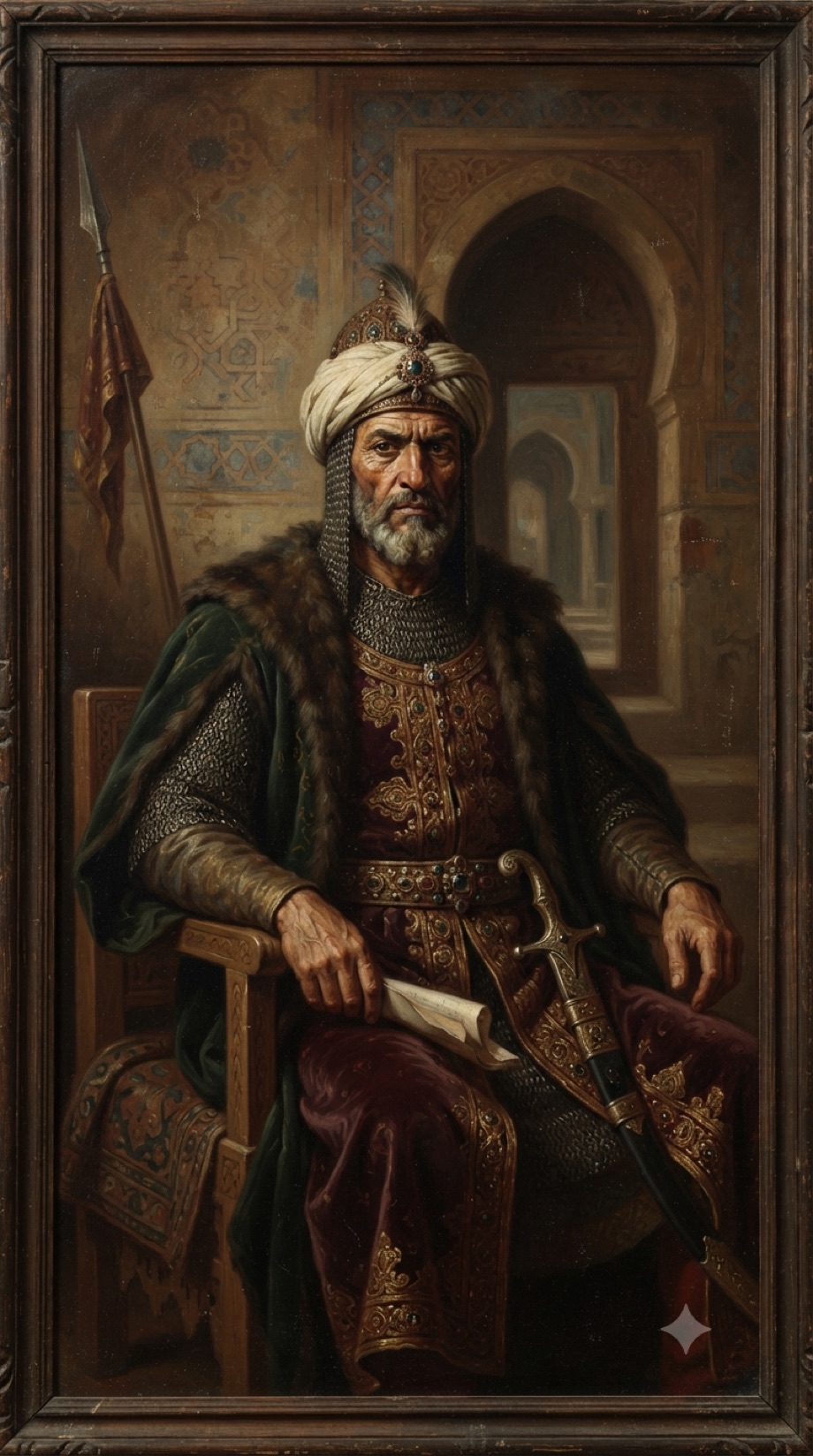
AI-assisted Portrait of Aybak
The Man in the Middle
He was not the best soldier in Egypt, nor the boldest, nor the one the army loved. That is precisely why he became its first Mamluk sultan. When the Ayyubid line collapsed and the slave-soldiers who had won the war against Louis IX's crusaders found themselves masters of the country, they had a problem: too many strong men and no legitimate king. The most formidable emir, Faris al-Din Aqtay, and his Bahriyya regiment were the real power, and no faction would submit to another. Into that deadlock stepped Izz al-Din Aybak al-Turkmani — a competent, reliable, unthreatening officer whom everyone could tolerate because no one truly feared him. He was chosen for his very ordinariness.
The path to the throne ran through a woman. After the sultana Shajar al-Durr had ruled Egypt for some eighty days, the Abbasid Caliph in Baghdad refused to recognize a female sovereign. The compromise was as bureaucratic as it was fateful: she would marry Aybak, and Aybak would be proclaimed sultan — al-Malik al-Mu'izz — while she, everyone understood, would keep the real authority. Aybak took the title of the man in the middle and then spent seven years trying to make it mean something. He murdered his rival, married for alliance, and was murdered in his bath for his trouble. It is not the arc of a visionary. It is the arc of a capable administrator who kept reaching for a control the situation would never let him hold.
Aybak is the ESTJ as compromise strongman: Te that commands, forces, and eliminates rivals directly, anchored by Si's loyalty to rank, procedure, and the system that made him. A man who held office by hard executive action and alliance — never by vision.
Rule by Removal
Te — dominant
Dominant Te confronts a threat by acting on the external world until the threat is gone. Aybak had no gift for the long strategic feint or the patient coalition; his instrument was direct force. The central act of his reign was blunt and physical: in 1254 he had Aqtay, the leader of the Bahriyya and the one man whose prestige overshadowed his own, assassinated in the citadel. It was not a subtle maneuver. It was the executive solution of a man who saw an obstacle and eliminated it — command exercised as sheer removal.
The trouble with Te unpaired with foresight is that it solves the problem in front of it and creates a worse one behind. The killing of Aqtay did break the Bahriyya as a rival power in Egypt — but it scattered them. Baibars and the other Bahri Mamluks fled into exile in Syria rather than serve the man who had murdered their chief, and that scattering seeded the very force that would one day return to dominate the sultanate. Aybak had won the immediate contest and lost the future, which is the recurring signature of a Te operator with no map beyond the next threat.
Everything Aybak did carried this stamp of the reactive executive. He did not build; he managed and he struck. He held his sultanate the way a strong officer holds a post — by asserting authority, closing ranks, and cutting down whoever climbed too high. It was enough to keep the throne for seven years. It was never enough to make the throne secure.
A Made Man of the System
Si — auxiliary
Auxiliary Si grounds the Te commander in the established order — the ranks, the procedures, the institutions that made him. Aybak was, in the most literal sense, a product of the system: a slave-soldier purchased and trained in the household of al-Salih Ayyub, raised inside the Ayyubid military machine, promoted by service and reliability rather than birth or brilliance. He was the organization man of a slave army, and his instincts were the organization man's instincts: work the existing structures, respect the forms, secure your position through the proper channels.
This is why the marriage to Shajar al-Durr and the proclamation as sultan mattered so much to him. Aybak needed the sanction of established legitimacy — the Caliph's recognition, the sultana's hand, the formal title — because Si trusts the procedure that confers authority far more than it trusts raw charisma. He was not a usurper who seized a crown by acclamation; he was a functionary elevated by a proper, if awkward, arrangement, and he clung to that legitimacy as the ground he stood on.
The same conservatism shows in how he governed: holding the office, defending the precedent, keeping the machinery of the Ayyubid state running under new management. Aybak did not reimagine the sultanate. He inherited a going concern and tried to keep it going — the caretaker's temperament, loyal to the system that had lifted a slave to a throne.
The Fatal Improvisation
Ne — tertiary
Tertiary Ne gives the ESTJ a limited, occasional reach for a new option when the familiar ones run out — and in Aybak it appears at the worst possible moment, badly handled. By 1257 his marriage to Shajar al-Durr had curdled into a struggle for control. She had made him and expected to keep the real power; he had spent years chafing to be sultan in fact and not just in name. Cornered, Aybak reached for a fresh maneuver: he opened negotiations to marry a daughter of Badr al-Din Lu'lu', the ruler of Mosul, and seal an alliance that would give him an independent base of support against his own wife.
On paper it was a sound piece of statecraft — the kind of alliance-by-marriage the age ran on. But Aybak lacked the strategic imagination to see how it would land. To Shajar al-Durr it was not a diplomatic option; it was a mortal insult and an existential threat, an announcement that he intended to replace and outflank her. The tertiary function overreached: a clumsy improvisation, undertaken without any feel for the reaction it would provoke, from a man whose whole temperament was built for holding ground rather than gambling on new terrain.
The Blind Spot in the Bath
Fi — inferior
Inferior Fi is the ESTJ's weakest instrument: the reading of another person's private feeling, loyalty, and wounded pride. Aybak governed by rank and force, and he seems to have understood his wife almost entirely as a political factor to be managed — a title-conferring instrument, a rival for authority, an obstacle to his independence. What he could not read was the depth of what he was doing to her. Shajar al-Durr had ruled Egypt in her own name; she had chosen him; and the Mosul marriage told her that her creation now meant to discard her.
He misjudged the human being across from him completely, and the misjudgment killed him. In 1257 Shajar al-Durr had him murdered in his bath — strangled, by the traditional account, by servants she commanded, in the most intimate and defenseless setting of his day. The Te commander who ruled by removing rivals was himself removed by the one rival he had never taken seriously as a threat: his own wife, whose feeling he had treated as a manageable inconvenience.
It is the classic inferior-function catastrophe. A man superbly equipped to eliminate a general or hold a citadel was undone in a private room by a personal loyalty he could not measure and a wounded pride he never saw coming.
Why ESTJ Over ENTJ
Why not ENTJ?
The forceful command and the direct elimination of rivals could read as ENTJ — the type shares that executive drive. But an ENTJ builds toward a strategic vision, and Aybak had none. He was a placeholder sultan reacting to threats: murdering Aqtay when the emir loomed too large, marrying for alliance when he felt cornered, defending his position rather than pursuing a design. The ENTJ's Ni supplies a picture of the future that all the force serves; Aybak's force served only the emergency in front of him. Tellingly, he was outmaneuvered and destroyed by a genuinely strategic mind — his own wife — who saw several moves ahead while he improvised into a trap. A capable Te–Si operator, not a Te–Ni architect.
The distinction is the difference between the man who holds the fort and the man who wins the war. Baibars, the Bahri leader Aybak drove into exile, was the true ENTJ of this story — a strategist who would return, take the sultanate, and forge it into an enduring military state. Aybak measured success by the threat he had just neutralized; the architect measures it by the institution he is building. Aybak never built. He administered, he struck, and he clung to a legitimacy conferred on him, right up to the afternoon a cleverer opponent had him strangled in his bath. That is Te–Si keeping its post — never Te–Ni playing for the whole board.
Connected Figures
Further Reading
- The Middle East in the Middle Ages: The Early Mamluk Sultanate, 1250–1382 — Robert IrwinThe standard narrative of the sultanate's founding — essential on the factional politics that made Aybak a compromise ruler and then destroyed him.
- From Saladin to the Mongols: The Ayyubids of Damascus, 1193–1260 — R. Stephen HumphreysTraces the collapse of Ayyubid power out of which the Mamluk regime emerged, setting Aybak's rise in its dynastic context.
- The Mamluks in Egyptian Politics and Society — Amalia Levanoni and Michael Winter (eds.)Scholarly essays on the early sultanate and its factional structure; Levanoni's work is especially sharp on the Bahriyya and the succession crises.
