 Historical Figure MBTI
#542 · 4-25-26 · The Mamluk Sultanate
Shajar al-Durr
Sultana of Egypt · Slave-Concubine Turned Sovereign · Architect of the Mamluk Coup
c. 1220 — 1257
10 min read
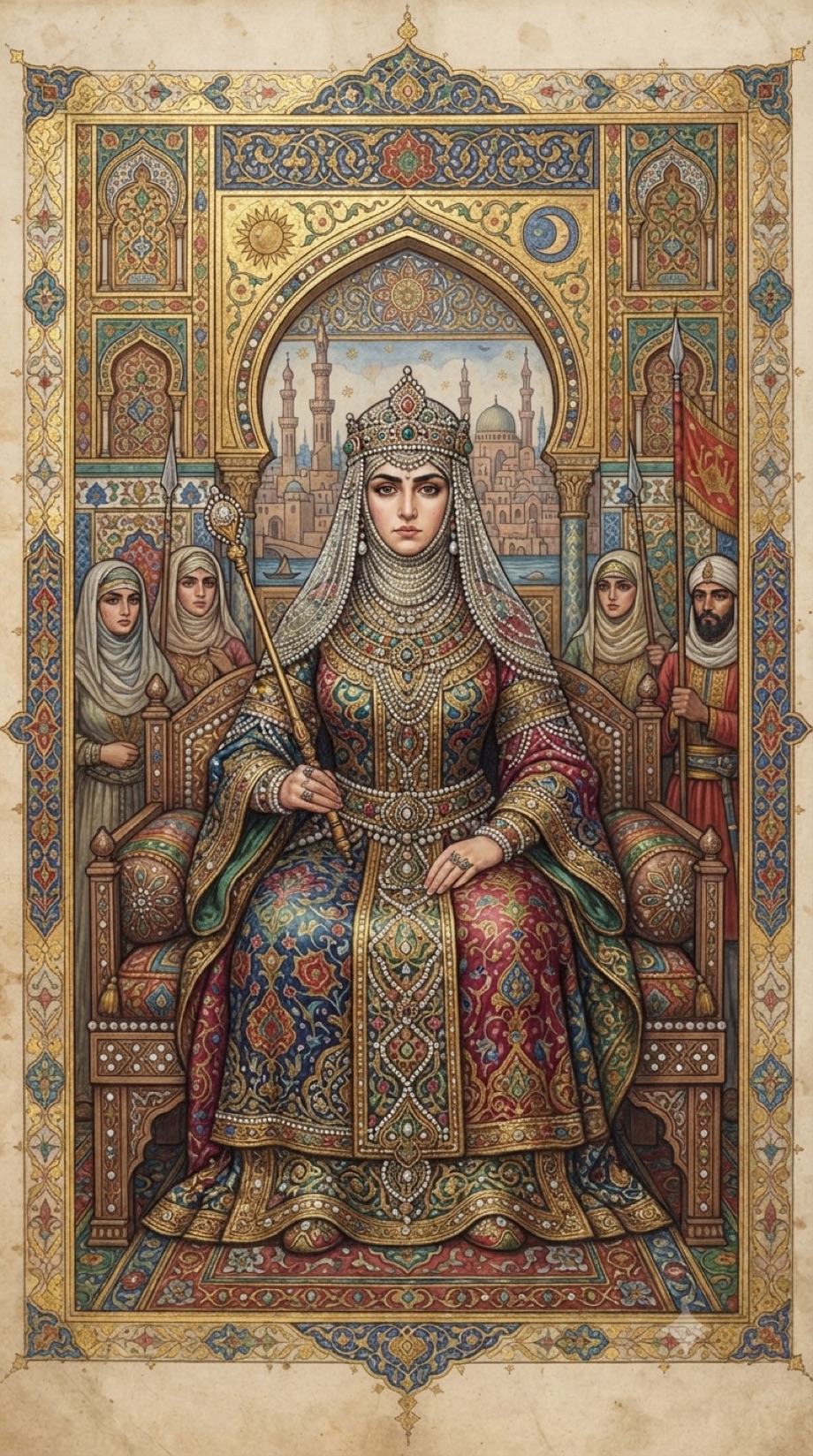
AI-assisted Portrait of Shajar al-Durr
The Woman Who Ruled From the Dark
In November 1249 the Sultan of Egypt died at the worst possible moment. Louis IX of France had landed at Damietta, taken the city, and was pushing up the Nile toward Cairo; the Egyptian state was a headless army facing a crusade. Into that vacuum stepped not a general or a prince but a slave — a concubine of the dead sultan named Shajar al-Durr, “Tree of Pearls.” Her response was the single coolest act of nerve in the whole affair: she told no one. She hid the body, kept the death secret for weeks, forged the dead man's signature on decrees, ran the war in his name, and held the realm together until the Egyptians shattered the Crusaders at Mansura and took Louis IX himself prisoner. A dead sultan won that war because a living woman refused to let anyone know he was gone.
Everything about her is a study in power exercised from behind a curtain. Born probably Turkic or Armenian, sold into the household of al-Salih Ayyub, she rose by bearing him a son and became, when the son died, first his freedwoman and then his wife. From that intimate, dependent position she engineered an outcome no woman in Islamic Egypt had ever reached: after the Mamluk emirs murdered the returning heir, they proclaimed her Sultana. Coins were struck in her name; the Friday sermon was read in her name. For roughly eighty days she was the sovereign of Egypt in her own right — the only woman ever to hold that throne. She is the INTJ in its rawest political form: a mind that fixes on a single distant outcome and moves toward it patiently, invisibly, through other people, controlling information the way a lesser ruler controls an army.
And she was never safe. Her power was always mediated, always at one remove — through a forged signature, through the treasury, through the men she installed and, when they failed her, destroyed. It is the vulnerability written into the whole design, and in the end it killed her. But for a few astonishing years, a woman who owned nothing but her own judgment out-thought caliphs, crusaders, and Mamluk warlords alike.
Shajar al-Durr is the INTJ as the power behind the throne: Ni's fixed, patient vision of an outcome no one else could yet see, executed through Te's cold mastery of the machinery of state — decrees, coinage, the treasury, and the men she could make and unmake.
The Secret She Kept for a Month
Ni — dominant
Dominant Ni holds a single fixed picture of how things must end and bends the present toward it with unnatural patience. Shajar al-Durr's masterpiece of the function is the concealment of al-Salih Ayyub's death. A reactive mind announces the sultan is dead, convenes the succession, negotiates with the Crusaders from weakness. Shajar al-Durr saw the whole board at once: reveal the death now and the army dissolves, the emirs fracture, Egypt falls. So she simply refused to let the present catch up with reality. She sealed off the sultan's tent, admitted only a trusted eunuch, issued orders as if he were alive, and forged his hand on the documents that held the state in place — sustaining a fiction for weeks against the pressure of an invading crusade. That is not improvisation. It is a vision of the required outcome (Egypt must win intact) executed with the patience to keep a corpse ruling until it did.
The same long sight governs her rise. She did not lunge for the throne; she waited for the configuration that would offer it. When the heir Turanshah arrived and began to threaten both her and the Mamluk emirs who had won the war, she did not strike him herself. She let the situation ripen until the Bahri Mamluks — men whose interests she understood better than they did — removed him, and the throne came to her as the only figure who commanded both continuity and their trust. She read where events were flowing and positioned herself at the point they would have to arrive.
Ni is also what let her turn a catastrophe into an unprecedented sovereignty. No woman had ruled Islamic Egypt in her own name; there was no template, no precedent, nothing to imitate. Shajar al-Durr grasped that the crisis had loosened the rules enough to make the impossible briefly possible, and she moved into that opening before it closed. The coins struck in her name and the sermon read in hers were the visible edge of a vision she had held privately long before anyone else could see it was even available.
Coinage, Decrees, and the Levers of a State
Te — auxiliary
Auxiliary Te gives the Ni vision its hands — the instinct to reach for the concrete instruments of control rather than the symbols of it. When the Mamluks proclaimed her sultana, Shajar al-Durr did not stage a coronation pageant; she did the two things that make a medieval Islamic ruler real. She had coins struck in her name and she had the Friday khutba read in hers. Currency and the sermon are the machinery of legitimacy, and she went straight for the machinery. Even her titles were administrative rather than romantic: she styled herself in the formal language of rule and let the apparatus of the state, not personal charisma, carry her authority.
Her whole method is the management of levers other people don't notice until they are already pulled. During the concealment it was the signature and the chain of command; in the aftermath of victory it was the treasury and the negotiation of Louis IX's enormous ransom, the money and terms that turned a battlefield win into a settled advantage. When the Abbasid Caliph in Baghdad refused to recognize a woman on the throne — sneering that if Egypt had no man fit to be sultan, he would send them one — she answered not with defiance but with an administrative fix. She married the Mamluk commander Aybak and formally ceded him the throne, satisfying the letter of the objection while keeping the substance of power in her own hands. It is Te solving a legitimacy problem the way one restructures an office.
This is the core of the reading: her control was structural, not theatrical. She governed through the men she installed and the instruments she commanded, treating Aybak as a public face for a power she still ran from behind. When he finally moved to escape that arrangement — taking a second wife, a princess of Mosul, to build an alliance independent of her — she reached for the ultimate lever and had him killed. Every move is the same move: identify the mechanism that actually decides the outcome, and take hold of it.
The Private Line She Would Not Cross
Fi — tertiary
Tertiary Fi in an INTJ is a buried, personal code — not warmth on display but a private register of loyalty and injury that the strategic mind mostly overrides, until it doesn't. Shajar al-Durr's attachment to al-Salih Ayyub reads this way. Her fidelity to his cause outlasted his life; concealing his death was self-preservation, but it was also the act of the one person who would not let his war be lost the moment he stopped breathing. She had risen from his bed to his throne, and she guarded the state he left with a proprietary intensity that was as personal as it was political.
Where Fi shows most sharply is in how she took betrayal — not as a strategic setback to be absorbed, but as a violation to be answered. Aybak was a marriage of convenience she had engineered, and for years she tolerated the arrangement. But when he moved to take a second wife and slip her control, she experienced it as a personal breach of the compact between them, and her response was total. Having him murdered in his bath was not cold policy alone; there is a wounded, absolute quality to it — the tertiary function's private ledger settling a score the strategist could have chosen to swallow.
The most human trace of Fi is the mausoleum. Long before her fall she built herself a fine domed tomb in Cairo, decorated it, and endowed it — and it still stands. A purely instrumental mind cares nothing for how it will be remembered once the game is over. Shajar al-Durr cared enough to shape her own memorial with her own hands, a private statement of self that survived even the squalid manner of her death.
The Bath and the Bath-Clogs
Se — inferior
Inferior Se is the INTJ's blind side: the physical, immediate, present-tense world that the visionary mind never fully masters. Shajar al-Durr ruled through information, forgery, coinage, and proxies precisely because raw physical force was the one currency she could not personally command. She never led an army, never rode at the front, never held power by the sword in her own hand — she held it by out-thinking the men who did. Her strength was the deferred, mediated move; her weakness was the brute fact of the moment.
That weakness is why the murder of Aybak, for all its strategic logic, was also a fatal misjudgment of the physical present. She could remove the man, but she could not control the room afterward — the faction of soldiers loyal to him, the mother of his son, the immediate, bodily reality of armed men wanting revenge. The strategist who could hold a secret for a month could not hold the raw aftermath of a killing, because that aftermath belonged to the world of force she had always ruled around rather than through.
The end is inferior Se made grotesquely literal. When Aybak's faction took her, they did not grant her the dignity of a political execution. Slave-girls beat her to death with wooden bath-clogs — the crudest, most bodily instruments imaginable — and her corpse was thrown from the walls of the Citadel. The woman whose entire power lay in the invisible and the deferred was destroyed by the most brutally immediate means, in the very domain she had spent her life avoiding.
Why INTJ Over ENTJ
Why not ENTJ?
The ENTJ and the INTJ share the Ni–Te strategic engine, and Shajar al-Durr has the ruthlessness of both. But the ENTJ commands from the front — it takes the throne openly, leads the army, rules in its own visible name. Shajar al-Durr did the opposite at every turn. She hid a death rather than announcing a succession; she ruled through a forged signature, the treasury, and men she installed like Aybak rather than in her own person; when challenged she ceded the visible throne and kept the invisible power. That is dominant Ni working through the shadows, with Te as its instrument — not dominant Te seizing the field. Compare her to a true ENTJ of her world like Baibars, who took the sultanate by the sword and ruled it in the open.
Why not ISTJ?
An ISTJ would have preserved order by the book — guarding precedent, deferring to the legitimate heir, working within the established rules of succession. Shajar al-Durr did none of that. She forged a dead man's decrees, presided over the removal of the rightful heir, and seized a sovereignty for which there was no precedent in Islamic Egypt at all. She was not a rule-bound traditionalist conserving a system; she was a radical improviser reading a crisis for the impossible opening it offered. That is Ni's vision of what could be, not Si's loyalty to what has always been.
The distinction that settles it is the location of her power. An ENTJ's authority sits in the open, in the person of the ruler; an ISTJ's sits in the institution and its rules. Shajar al-Durr's sat somewhere else entirely — in what she knew and others didn't, in the signature no one realized was forged, in the coins and the sermon and the men she could make and unmake. She is the archetypal behind-the-throne strategist: a fixed private vision executed patiently, secretly, and through the control of information rather than the display of command. That is the INTJ, and specifically the INTJ denied the open power its mind was built to wield.
Connected Figures
Further Reading
- The Forgotten Queens of Islam — Fatima MernissiPlaces Shajar al-Durr among the rare women who actually held sovereign power in Islam — the classic feminist reading of her reign and its erasure.
- The Middle East in the Middle Ages: The Early Mamluk Sultanate, 1250–1382 — Robert IrwinThe standard history of the Mamluk state her coup helped create — essential for the world she opened.
- From Saladin to the Mongols: The Ayyubids of Damascus, 1193–1260 — R. Stephen HumphreysThe authoritative account of the Ayyubid dynasty she served and effectively ended.
- Life of Saint Louis — Jean de JoinvilleThe eyewitness crusader chronicle of Damietta and Mansura — the campaign her nerve turned into an Egyptian victory, from the other side.
- The Mamluks in Egyptian Politics and Society — Amalia Levanoni (essays)Scholarly essays on the early Mamluk sultanate that situate her brief reign within the transition of power.
