 Historical Figure MBTI
#541 · 4-24-26 · Plantagenet England
William Caxton
England's First Printer · Who Printed the Canterbury Tales
c. 1422 — 1492
9 min read
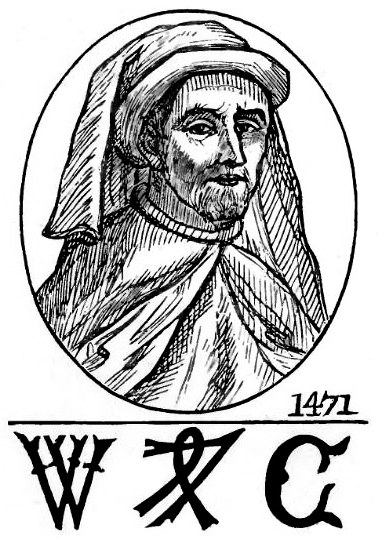
AI-assisted Portrait of William Caxton
The Man Who Manufactured the English Word
Most of the figures who shaped the English language were writers. William Caxton was not. He was a merchant — a dealer in cloth who spent the better part of three decades in the great commercial city of Bruges, rose to lead the English trading community there, and negotiated on its behalf with princes. He came to books late, and he came to them the way a man of business comes to anything: as a venture to be organized, capitalized, and made to pay. That he became, almost incidentally, the single person most responsible for fixing the written form of English is one of the stranger accidents of cultural history — and not really an accident at all.
Born in Kent around 1422, Caxton made his fortune in the mercer's trade before the new technology of movable type drew him in. He learned the craft in Cologne, printed the first book ever set in English — his own translation, the Recuyell of the Historyes of Troye, around 1473 — and in 1476 carried a press across the Channel and set it up at Westminster, beside the Abbey. Over the next sixteen years he turned out roughly a hundred books. He did not write most of them; he chose them, edited them, translated a good number himself, and sold them. The choosing was the genius. Where a Continental printer might have ground out Latin liturgy and law, Caxton printed the Canterbury Tales, the poems of Gower, and Sir Thomas Malory's Le Morte d'Arthur — and in doing so handed England a usable literary vernacular and a standard for how it should be spelled.
Caxton was the practical, enterprising ESTJ — not a visionary inventing a new world but a businessman-craftsman who imported a proven machine, ran it with industry and good judgment, and by the diligent exercise of taste did as much as any single person to standardize the English language.
The Press as a Going Concern
Te — dominant
Dominant Te is the drive to organize the external world into something productive and efficient, and Caxton spent his whole life doing exactly that. Long before the press, he was a manager of men and money — governor of the English nation of merchant adventurers at Bruges, a negotiator of trade treaties, a man trusted to handle the collective business of his countrymen abroad. The mercer's instinct never left him. When he encountered printing, he did not see a curiosity; he saw an enterprise. He raised the capital, mastered the workflow, secured the patrons, and set up the first English press as a commercial workshop with output to match.
The numbers tell the Te story. Roughly a hundred books in sixteen years, in a craft that demanded type, presses, paper, skilled labor, and a market — this is not the record of a dabbler but of a man running a productive concern and keeping it solvent. He chose Westminster shrewdly: beside the Abbey and the court, close to the clergy, lawyers, and nobles who could afford books and the patronage that underwrote them. He printed what would sell and what powerful men wanted printed. Te does not pursue the perfect object; it pursues the working system, and Caxton built one that outlived him, passing intact to his foreman Wynkyn de Worde.
What separates Caxton from a mere tradesman is that his Te organized not just a business but a literature. He treated the English canon as inventory to be acquired, prepared, and brought to market — and in managing that inventory with a merchant's thoroughness, he gave it the fixity of a manufactured product.
The Conservator of the Canon
Si — auxiliary
If Te built the workshop, auxiliary Si decided what came out of it — and Si is fundamentally conservative, methodical, and reverent toward what has been tested by time. Caxton did not gamble on the new. He printed the works that England already honored: the Canterbury Tales, the moral poems of Gower, Le Morte d'Arthur, the devotional and chivalric texts that the educated reader of his day expected to find on a shelf. His taste was the settled taste of his class and century, and that very conservatism is what made his press a stabilizing force rather than a disruptive one.
Si shows most clearly in his care for getting the text right. When his first edition of the Canterbury Tales was challenged as corrupt, he did not shrug; he sought out a better manuscript and printed a careful second edition, explaining in his preface why. That is auxiliary Si serving dominant Te — the craftsman's conscience about accuracy harnessed to the businessman's product. He fretted, famously, over which form of a changeable English to use, noting how the word for “eggs” varied from county to county, and settled on the usage of the London and court circles he knew. Every such decision, multiplied across a hundred books, hardened into a standard.
This is the quiet revolution of Si: not invention but codification. By preferring the established text, the familiar spelling, the canonical author, Caxton took a language that splintered into a dozen regional habits and pressed it — literally — into one stable, reproducible form.
The Merchant Who Saw What Print Could Be
Ne — tertiary
Tertiary Ne is a flicker of possibility-sensing inside an otherwise practical mind, and Caxton's came alive at one decisive moment: when a successful cloth merchant in his fifties looked at a German invention and grasped, before almost anyone in England, what it could become. He did not invent the press. But he saw — with a spark of imagination his trade had never demanded of him — that this machine could carry not just Latin scripture but the literature of his own country, to a wider audience than scribes could ever reach. That intuition pulled a comfortable man of business off his settled path and into a wholly new craft.
Ne kept the venture from being merely mechanical reproduction. Caxton wrote lively, personal prologues and epilogues, mused on his choices of text and translation, cracked the occasional joke, and treated the book as an occasion for his own voice as well as the author's. He ranged widely in what he was willing to take on — romance, history, philosophy, devotion, fable — trusting his sense of what might find readers. The reach was the Ne contribution.
But it stayed tertiary, in service to Te and Si rather than driving the man. Caxton was no inventor or theorist; his imagination was the practical kind that spots an opportunity and acts, not the kind that dreams up the machine in the first place. He saw the possibility — and then, characteristically, he organized it into a business.
The Love of Books He Could Not Quite Name
Fi — inferior
For all his commercial cast of mind, Caxton was not a man printing only for profit. Beneath the merchant's account-book ran a genuine, if rarely articulated, love of books and of the English tongue — the inferior Fi that surfaces, awkwardly and sincerely, in his prefaces. He confesses there how a great lady or a noble patron pressed him to undertake a translation, how he labored over a difficult passage, how he hoped a work would do its readers good. The values are real; the expression is self-conscious, deferential, never fluent.
Inferior Fi tends to outsource its judgments of worth to authority rather than trust a private conscience, and Caxton does exactly this. He justifies his choices by appeal to his patrons' wishes and the established honor of his authors, rarely by a bald personal “I love this.” When he praises Chaucer, it is in the received language of reverence for a master. Yet the feeling is unmistakable — a tradesman who could have grown rich on cloth chose instead to spend his last years stooped over forme and frisket because the words mattered to him.
Why ESTJ Over ENTJ
Why not ENTJ?
The ENTJ is the visionary commander — a strategist who conceives a sweeping new design and drives the world toward it. Caxton did nothing of the kind. He imported a proven technology rather than inventing one, ran a workshop rather than building an empire, and printed the existing canon rather than reimagining what a book could be. His dominant Te is wedded to auxiliary Si, not auxiliary Ni: his greatness lay in execution, industry, and conservative good taste, not in grand strategy or original vision. He was a man of the established, the practical, and the hands-on — the ESTJ profile to its core.
The distinction is one of motivation. The ENTJ asks what the world could become and bends resources toward that future; the ESTJ asks what works, what is proven, and how to run it well right now. Caxton's revolution was not visionary but executional — he took a tool others had built and a literature others had written, and by sheer diligence, organization, and sound judgment turned them into something permanent. The man who fixed the English word did it not by imagining a new language but by faithfully, industriously, printing the one already in front of him.
Connected Figures
Further Reading
- William Caxton and Early Printing in England — Lotte HellingaThe authoritative modern study of Caxton's technical practice and output by the leading scholar of early English printing.
- Caxton and His World — N. F. BlakeA thorough account of Caxton's life, prologues, and editorial choices, situating him in his commercial and literary milieu.
- The Cambridge History of the Book in Britain, Vol. III (1400–1557) — ed. Lotte Hellinga & J. B. TrappEssential context on the early English book trade Caxton founded and the readership his press served.
