 Historical Figure MBTI
#540 · 4-24-26 · Plantagenet England
Katherine Swynford
John of Gaunt's Mistress and Duchess · Ancestress of Kings
c. 1349 — 1403
7 min read
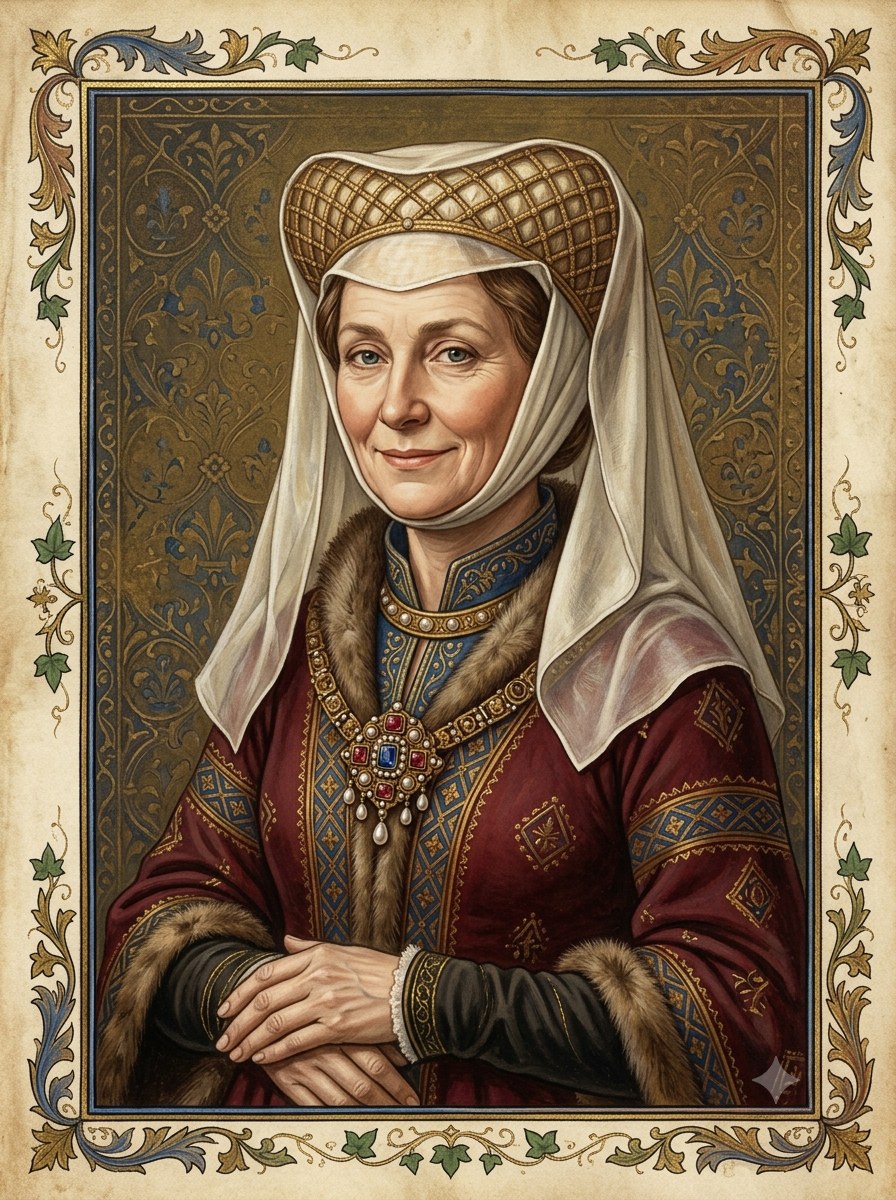
AI-assisted Portrait of Katherine Swynford
The Governess at the Root of the Tudor Tree
She entered history through a side door — the daughter of a humble herald, taken into the greatest household in England not as a guest but as a servant: governess to the small daughters of John of Gaunt, Duke of Lancaster, the richest and most powerful prince of the realm. From that modest post Katherine Swynford did something almost no medieval woman managed. She held the love of a king's son for the better part of three decades, bore him four children, weathered public scandal and political danger, and at the last — against every expectation of rank — was married by him and raised to Duchess of Lancaster, the first lady of the realm.
Born around 1349 and dying in 1403, she lived through plague, peasant revolt, and the long quarrel of princes that would harden into the Wars of the Roses. Her four children by Gaunt were given the surname Beaufort, and once their parents' marriage made them legitimate, that line ran straight on into history: the Beauforts produced Margaret Beaufort, and Margaret produced Henry VII, and so the entire Tudor dynasty — and, through other branches, the Yorkist kings too — descended from this quiet, steadfast woman. Every English and British monarch since carries her blood.
What is striking is not ambition but constancy. Katherine did not scheme her way upward; she simply stayed — loyal, discreet, and devoted, year after year, through the shadows of an irregular position, until time and death vindicated her. That patient, dutiful steadiness is the signature of the ISFJ.
Katherine Swynford's power was not presence but persistence — the ISFJ's Si steadiness fused with Fe devotion, a quiet faithfulness held unbroken across twenty-five years until it founded a royal line.
The Constancy That Outlasted Everything
Si — dominant
Dominant Si is the faculty of the long, settled commitment — the steady keeping of a thing once chosen, year upon year, regardless of how circumstance shifts. Katherine's whole life is its proof. She attached herself to one man and one purpose and did not waver. For roughly twenty-five years she was Gaunt's companion and mistress, a position that offered no security and no public honor, only the slow accumulation of devotion. Where an ambitious woman might have angled for more, or a fearful one withdrawn when the scandal grew dangerous, Katherine simply remained.
That steadiness was tested hard. During the Peasants' Revolt of 1381 the rebels named her by reputation; the relationship was condemned from pulpits as a public sin, and for a time Gaunt was pressured into a formal renunciation of her. She retreated into discretion, managed her household, raised her children, and waited — not in flight but in patience. Si endures by holding fast to the known and the established rather than chasing the new. Katherine's vindication came precisely because she had never abandoned her post: when both their spouses had died, the man she had loved without title for a quarter century came back and married her.
Even her competence was Si's competence: the practical, reliable governance of a great household, the careful raising of children, the discreet management of a delicate situation over decades. She was trusted to run things and to keep things steady, and she did. The duchess crown, when it came in 1396, did not change her — it merely confirmed in public what her constancy had quietly been all along.
The Devotion That Won and Held a Prince
Fe — auxiliary
Auxiliary Fe is warmth turned outward into care — the tending of others, the reading of a beloved's needs, the making of a home that holds. It is what Katherine first offered as a governess: the patient, affectionate nurture of another woman's children. That same caretaking tenderness is, by every account, what won Gaunt and what kept him. She was not a great beauty wielding court power; she was the steady, comforting presence at the center of his private life, the one who offered ease and constancy amid a prince's wars and politics.
Fe seeks harmony and attaches deeply to particular people rather than to abstractions. Katherine's love was personal and enduring — directed at one man and at the children of their union, sustained through years in which the relationship brought her more reproach than reward. When Gaunt at last married her, he was not making a dynastic match; the unions of his life that served ambition were the earlier ones. The marriage to Katherine was the unusual thing a medieval magnate almost never did — a marriage of long affection, returned. That is the testament of her Fe: that a lifetime of warm, quiet devotion proved strong enough to bend even the iron logic of rank.
The Quiet Shrewdness Beneath the Discretion
Ti — tertiary
Tertiary Ti in an ISFJ rarely announces itself; it works underneath the warmth as a private, practical intelligence — the capacity to size up a situation clearly and conduct oneself with care. Katherine's long survival in an impossible position required exactly this. To remain the cherished companion of the realm's most powerful magnate for decades, through political storms that destroyed others, demanded a steady understanding of what could and could not be said, of when to withdraw and when to hold.
Her tact was its own form of logic. She did not overreach or force the issue of her status; she grasped, accurately, that her power lay in being indispensable rather than conspicuous, and she governed her conduct accordingly. The discretion that kept the relationship workable for twenty-five years was not mere timidity — it was a quiet, accurate reading of her own interests and limits. Ti supplied the cool judgment that let her Fe devotion and Si steadiness endure where less measured passions would have burned out or been crushed.
The Future She Could Not Have Imagined
Ne — inferior
Inferior Ne is the ISFJ's blind spot — the dimension of wild possibility and unforeseen consequence that such a person neither seeks nor easily trusts. Katherine lived inside the concrete present: this household, these children, this man, this day's duty. She did not, and could not, plot a path to a throne; the woman who waited in discretion through the 1380s was not running a dynastic strategy. She was simply being faithful.
And yet the inferior function delivers, in its strange way, the largest outcome of the whole life. The future Katherine never schemed toward arrived anyway: her legitimized Beaufort children became the trunk from which the Tudor dynasty grew, and the discreet governess turned out to be the ancestress of every monarch who followed. It is the signature irony of inferior Ne in a devoted Si dominant — that a life given entirely to the steady, the near, and the loyal should ramify, far beyond any plan, into a destiny of unimaginable reach.
Why ISFJ Over ESFJ
Why not ESFJ?
The ESFJ shares Katherine's Si and Fe but leads with the outward warmth — the socially commanding, room-filling presence that organizes others and holds a place through visible charm and authority. Katherine's power ran the opposite way. She held her position through quiet, private, dutiful devotion: the discreet companion who endured years in the shadows, governed a household without fanfare, and waited rather than presided. Her strength was constancy, not presence — the inward-anchored steadiness of the ISFJ, not the extraverted social engine of the ESFJ.
The whole shape of her life argues for introversion. An ESFJ in Katherine's position would more naturally have worked the court, built a visible faction, made her standing felt. Katherine instead drew her power from being indispensable in private and faithful over time, content to remain unseen until events vindicated her. That is the essential ISFJ motivation: not to command the social field but to keep faith with the few she loved, steadily, until the keeping itself became her monument.
Connected Figures
Further Reading
- Katherine Swynford: The Story of John of Gaunt and His Scandalous Duchess — Alison WeirThe fullest modern biography — meticulous on the chronology of the affair, the legitimization of the Beauforts, and the dynastic consequences.
- Katherine Swynford: The History of a Medieval Mistress — Jeannette LucraftA scholarly study reconstructing Katherine's identity, status, and self-presentation from the documentary record.
- Katherine — Anya SetonThe beloved 1954 historical novel that fixed Katherine in the popular imagination — romantic but grounded in serious research.
