 Historical Figure MBTI
#539 · 4-24-26 · Plantagenet England
William Langland
The Visionary Poet of Piers Plowman
c. 1332 — c. 1386
7 min read
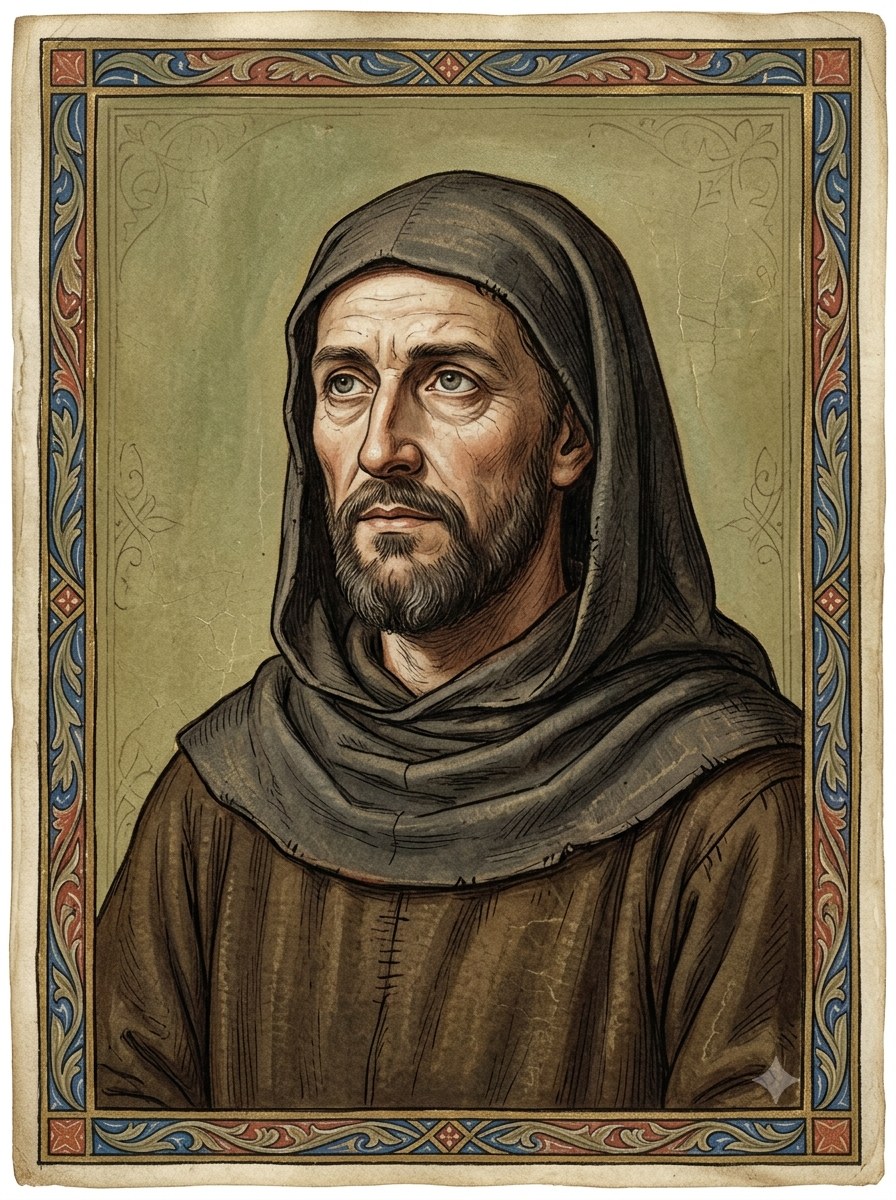
AI-assisted Portrait of William Langland
The Dreamer in the Malvern Hills
Of the man we call William Langland almost nothing is known for certain, and yet he left behind one of the greatest and strangest poems in the English language. He was, in all likelihood, a poor and unbeneficed cleric in minor orders, drifting between the west country and London, scraping a living from prayers said for the dead — the “Long Will” who seems to wander, half disguised, through the very poem he wrote. That poem is Piers Plowman, a vast alliterative dream-vision that its author could not stop rewriting, revising it across three distinct versions over the better part of his life as if he were forever circling the one question he could not lay to rest: how must a Christian live in order to be saved?
The shape of it is a sleep and a series of visions. The narrator, “Will,” lies down on a May morning among the Malvern Hills and falls into a dream, and what rises before him is a field full of folk — all of medieval England spread out between the tower of Truth and the dungeon of Hell. Through that field move Lady Meed, the glittering figure of bribery and reward; the Seven Deadly Sins making their gross confessions; and at the centre the humble plowman Piers, who labours toward Truth and slowly, astonishingly, takes on the lineaments of Christ himself. It is a poem of burning social conscience, savage about the corruption of the rich and the clergy, aflame with longing for a purer order — so charged that within a few years the leaders of the Peasants' Revolt were quoting Piers as a rallying cry.
Langland was the INFJ seer: Ni paired with Fe — a single inward vision pressing relentlessly toward one spiritual Truth, fused with a conscience that ached for the salvation of the whole Christian people.
The Single Burning Vision
Ni — dominant
Dominant Ni is the faculty of inward sight — the mind that does not so much observe the world as see through it to a hidden pattern, and then refuses to let that pattern go. Piers Plowman is one of the most sustained acts of inward sight in medieval literature. Everything in it is symbolic; nothing is merely itself. The field is England and also the world; the plowman is a labourer and also Truth's servant and finally Christ; the dream folds into further dreams, visions within visions, until the waking world and the seen world blur entirely. This is not description. It is allegory all the way down, the whole poem a single unified vision rendered in figures.
The prophetic strain is unmistakably Ni. Langland writes like a man who has glimpsed where things are tending and must warn of it — he reads corruption not as a list of grievances but as a sign, and the poem drives always toward one convergent point: the question of salvation, of how to find Truth and live by it. That he revised the poem obsessively across decades, never satisfied, is the signature of an Ni that cannot rest until the inner vision and the words on the page finally coincide. Where another poet would gather many scenes, Langland keeps boring inward toward the same singular revelation, the dream-allegory pressing relentlessly toward the one thing that matters.
The Conscience of the Commonwealth
Fe — auxiliary
If Ni gave Langland his vision, auxiliary Fe gave it its heat. Piers Plowman is not a private mysticism turned inward; it is a vision aimed outward at the whole Christian community, anguished over its sickness and longing for its healing. Langland burns with indignation at the corruption of the rich, the venality of friars and pardoners, the figure of Lady Meed who buys justice and salvation alike — and he burns with tenderness for the poor, the labouring folk, the honest plowman. His moral feeling is never merely personal preference; it is a sense of what the community owes and what binds it together before God. That is Fe: conscience scaled up to the body of the faithful.
This is why the poem could leap from the page into the streets. When the rebels of 1381 took up Piers as a watchword, they had read Langland correctly — here was a voice raging at injustice on behalf of the common people, demanding that the powerful be answerable to a higher law. Langland himself was almost certainly horrified to be conscripted into revolt; his remedy was repentance and right living, not rebellion. But the Fe charge was real, and it was contagious. He wanted the whole commonwealth saved together, and he could not write about Truth without writing about how the strong wronged the weak.
The Restless Theologian
Ti — tertiary
Beneath the visionary surface runs a stubborn, probing logic. Piers Plowman is shot through with theological argument — disputations on grace and works, on the limits of learning, on whether the righteous heathen can be saved, on the precise relation of Do-Well, Do-Better, and Do-Best. This is tertiary Ti supplying the framework that Ni's vision is poured into: a mind that needs to work out the structure of salvation for itself, testing doctrine against its own internal coherence rather than simply accepting the received scheme.
Tertiary Ti also explains the poem's unfinished, self-questioning quality. Langland never quite arrives at a settled system; he argues, retracts, dreams again, and revises the whole work across three versions because the logic never fully closes. The restless analytic itch is real but subordinate — it serves the vision and the conscience rather than ruling them, which is exactly where Ti sits in the INFJ stack: a powerful but supporting instrument, forever refining the architecture of a truth the dominant function has already seen whole.
The World Glimpsed Through the Dream
Se — inferior
For all its abstraction, Piers Plowman is startlingly vivid. The taverns and cookshops of London, the smell of bad ale, the gluttons and beggars and labourers, the muddy field and the May dawn over the Malvern Hills — Langland's sensory world erupts in bursts of unforgettable concreteness. This is inferior Se in its characteristic mode: not a steady appetite for the physical world but sudden, intense flashes of it, pressed into service of the vision. The dreamer must fall asleep in a real landscape before the allegory can begin.
And the inferior position shows in how the body is treated. Langland's relation to the physical is suspicious, even penitential — the flesh is where the Deadly Sins take their grossest shape, and the poet's own life seems to have been one of poverty and self-denial, a man uneasy in the world of getting and spending. The sensory richness is real, but it is always being moralized, always pulled back from enjoyment toward meaning. Se serves the dream; it never gets to be an end in itself.
Why INFJ Over INFP
Why not INFP?
The wide sympathy and inward fire could suggest INFP — the private Fi conscience following its own light. But Langland is not exploring his own values; he is delivering one. His poem drives a single prophetic vision relentlessly toward one spiritual Truth and demands that the world conform to it. That convergent, unifying, message-bearing intensity is Ni-Fe, not the open, exploratory Fi-Ne of the INFP. His contemporary Chaucer shows how differently the same type can face the world: also an INFJ, also holding a whole society in view, Chaucer turned his vision outward through his characters and judged none of them, where Langland turns his inward onto Truth and can see nothing else.
The distinction is not between an observer and a seer but between two seers facing opposite directions. Chaucer, an INFJ like Langland, turns his single vision outward and lets it break into a hundred human voices, refusing the final word so that each may speak; Langland turns his inward and upward, consumed by the final word and able to think of nothing else. Like his fellow moral poet Gower, Langland writes from a fixed and burning conviction about how the world ought to be set right — a man with a message to deliver rather than a company of souls to become. Same type, opposite temper: the INFJ vision can dissolve the self into humanity, as it did in Chaucer, or fuse the self to a Truth that admits no rival, as it did in Langland.
Connected Figures
Further Reading
- Piers Plowman: A New Translation of the B-Text — William Langland (ed. & trans. A. V. C. Schmidt)The standard scholarly edition and the best way into the poem for modern readers — authoritative on the three versions and the alliterative line.
- The Myth of Piers Plowman — Lawrence WarnerA bracing study of how the poem was made, transmitted, and mythologized — including how 'Langland' himself became a construction of later readers.
- A Companion to Ricardian Poetry — ed. Andrew Galloway and othersSituates Langland alongside Chaucer and Gower in the literature of Richard II's reign — the essential context for the three poets of the age.
