 Historical Figure MBTI
#537 · 4-24-26 · Plantagenet England
Geoffrey Chaucer
The Father of English Literature · The Canterbury Tales
c. 1343 — 1400
12 min read
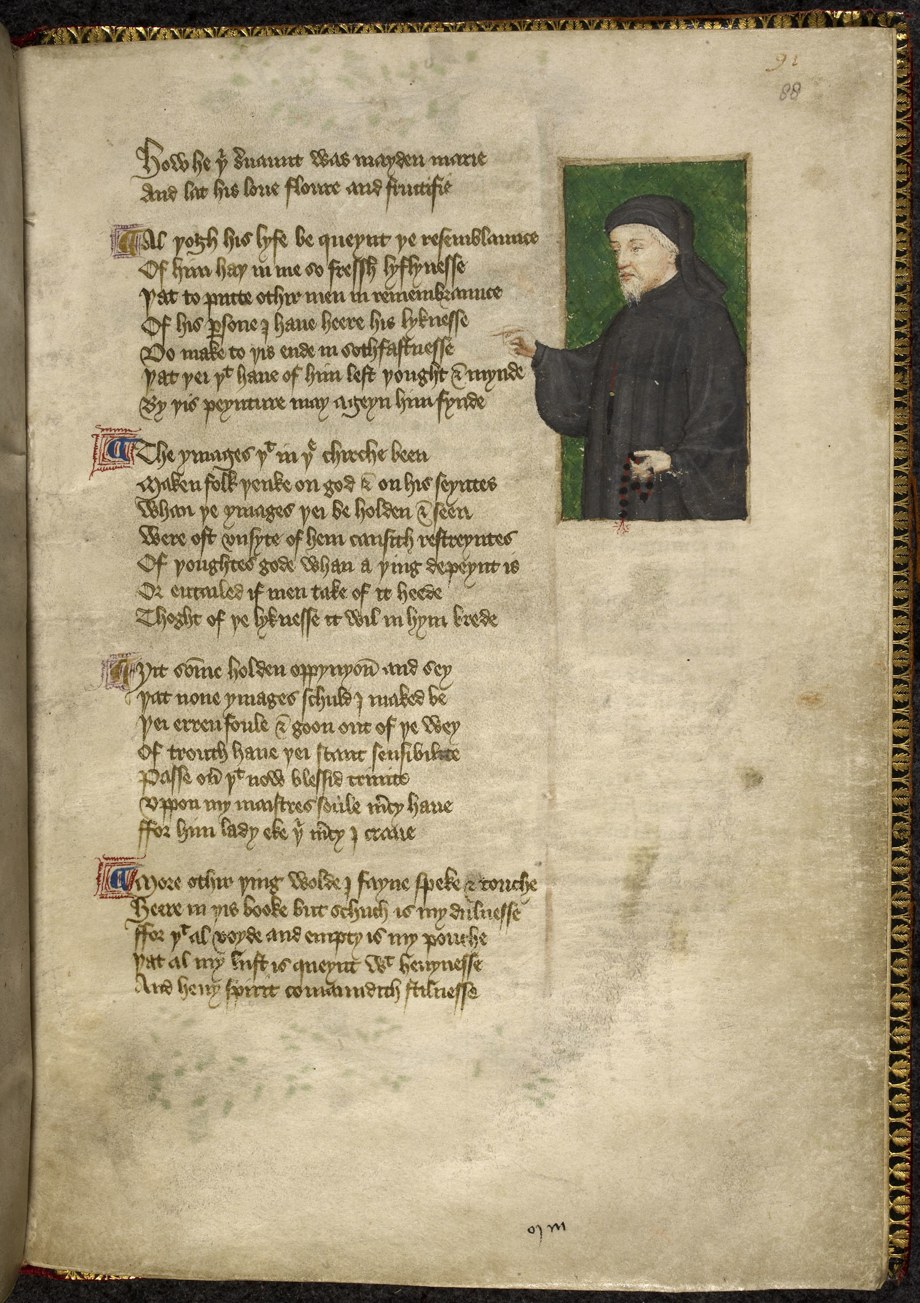
AI-assisted Portrait of Geoffrey Chaucer
The Poet Who Contained a Whole Society
On the road from Southwark to Canterbury, in the spring of some unspecified year near the end of the fourteenth century, twenty-nine pilgrims ride out from the Tabard Inn and agree to pass the journey by telling stories. A knight, a miller drunk before noon, a prioress with her lap-dogs and her too-careful table manners, a pardoner selling pig bones as the relics of saints, a clerk so poor and so bookish he would rather own twenty volumes of Aristotle than fine robes, and a five-times-widowed clothmaker from Bath who has buried her husbands and her shame together — each of them speaks, and each of them speaks in a voice so completely his or her own that no reader has ever confused one for another. The man who imagined them all was Geoffrey Chaucer, and the most astonishing thing about The Canterbury Tales is not its range but its refusal to judge. The poet enters every pilgrim's skin in turn, lends each one his whole sympathy, and pronounces sentence on none.
Chaucer (c. 1343 — 1400) is called the father of English literature, and the title is earned twice over: he was the first major poet to make his masterpieces in English rather than the French of the court or the Latin of the Church, and he wrote, in the Tales, the first work in the language that holds an entire society in a single frame — high and low, holy and corrupt, gentle and gross, all jostling on the same road. He did this, remarkably, while holding down a working life of relentless ordinariness. He was a page in a noble household, a soldier captured in France and ransomed (the king himself contributing toward the price), a diplomat sent on missions to Italy, a Controller of Customs at the port of London weighing wool for the Crown, a clerk of the king's works, a justice of the peace, a member of Parliament. The greatest observer in the English language spent his days counting fleeces on a wharf.
That doubleness — the man of affairs whose inner life was a teeming theatre of imagined others — is the key to him. It is tempting to mistake such variety for a mind that merely multiplies, scattering itself into voice after voice with no center of its own. But look at what actually holds the Tales together: a single, sustained vision of an entire society, gathered onto one road and seen whole — high and low, holy and corrupt, gentle and gross, folded into one design. Chaucer did not brainstorm his pilgrims one at a time; he grasped humankind as a whole and then let each of its estates step forward to speak. That is the mark of the INFJ: a singular inner vision of what people are, rendered not as a thesis to be argued but as a world to be inhabited, and reached through a sympathy so total it can become anyone.
Chaucer is the INFJ dramatist at full reach — one encompassing vision of human nature (Ni) rendered through a sympathy that enters every soul it imagines (Fe). He held a whole society in a single image, and became each part of it in turn.
The Vision Beneath the Voices
Ni — dominant
Dominant introverted intuition is not a wealth of ideas but the grip of a single deep one, turned and turned until it yields. Chaucer's governing act of imagination was not to collect his pilgrims but to conceive the frame that could hold them all — the pilgrimage itself, one image into which the whole of fourteenth-century England could be poured. Knight and miller, prioress and pardoner, the bookish clerk and the five-times-wedded wife: every estate and every moral condition set on the same road, bound for the same shrine. A proliferating mind would have produced a miscellany, a gallery of unrelated portraits. Chaucer produced a cosmos — a single controlling design in which each figure means something by its place in the whole.
And beneath the surface variety, the same few preoccupations return with the insistence of a fixed idea: the turning of Fortune's wheel, the long quarrel between flesh and spirit, and above all the gap between what a person professes and what a person is. Troilus and Criseyde, the Tales, the dream-visions — different vessels, one obsession. He does not brainstorm human nature; he distills it, circling back across a lifetime to the same buried patterns and finding, each time, one more form to carry them. That compression of many stories into a single sustained model of what people are is the deepest Ni signature there is.
It is this that separates Chaucer from a mere reporter of manners. He is not writing down what he happened to see on the road; he is delivering a whole conception of the human world — comic, fallen, various, and somehow bound together — through the only form capacious enough to hold it. The pilgrimage is not a container for stories. It is the vision itself: humanity entire, in motion toward something it can only half articulate, seen by a mind that had grasped the pattern before it wrote a line.
The Mind That Enters Every Skin
Fe — auxiliary
If Ni supplies the single vision, auxiliary extraverted feeling supplies the means of reaching it — a sympathy that does not stay private but pours outward and becomes the other person entirely. Chaucer's age was thick with moralists, and a moralist would have flagged the pilgrims' vices, scolded them, sorted them into the saved and the damned. Chaucer does nothing of the kind. He gives the corrupt Pardoner one of the most spellbinding sermons in the language and lets the man damn himself out of his own mouth; he renders the Wife of Bath — lustful, domineering, gloriously unrepentant — with such evident relish that she has outlived every preacher who would have condemned her. This is not the withdrawn self-communion of a private conscience. It is Fe: the capacity to step fully inside another's way of feeling and speak from within it, giving each viewpoint its whole due.
That is why his irony wounds no one. Lesser satirists use irony as a weapon, to lift themselves above the people they skewer. Chaucer's irony is an instrument of fellow-feeling — it sees the distance between what people pretend to be and what they are, and finds in that gap not contempt but the whole comedy and pathos of being human. He does not privilege one pilgrim's heart over another's; he inhabits each in turn, with equal seriousness, so that the Knight's high romance and the Miller's bawdy answer stand side by side without the author ever tipping his hand. Fe does not ask “what do I feel?” but “what is it to be them?” — and Chaucer asked it of everyone he imagined.
You see the same gift turned to grief in the elegy. The Book of the Duchess, his first major poem, was written to console his patron John of Gaunt for the death of his wife Blanche. A court poet of less feeling would have produced a formal exercise in consolation. Chaucer instead built a dream in which a grieving knight cannot even bring himself to say plainly that his lady is dead, and the dreamer must coax the loss out of him with a patience that is itself the poem's real subject. The mourning is rendered from inside the mourner — another's sorrow entered, held, and given a voice. That is Fe at its deepest: feeling met not as one's own, but as the felt reality of someone else.
The Irony and the Frames
Ti — tertiary
Ni sees and Fe becomes; tertiary introverted thinking builds the machine that keeps them honest. Chaucer's control of his material is architectural — a nesting of frames and voices held in exact relation. He invents a bumbling narrator-pilgrim named “Chaucer,” a worse poet than the real one, and lets that persona tell the deliberately dreadful Tale of Sir Thopas until the Host begs him to stop. He plays the modest reporter merely transcribing what the pilgrims said, disclaiming all responsibility for their coarseness. Each layer is placed with a logician's care: the teller suits the tale, one tale answers the tale before it, and the whole assembly is engineered so that meaning arises from arrangement rather than assertion.
The same structural intelligence governs Troilus and Criseyde. Sent as an envoy across the Alps, Chaucer had come home carrying Dante and Boccaccio in his head, and he reworked a tale of Boccaccio's into something stranger and more exact — a long study of love and betrayal that declines, with great deliberation, to deliver the verdict on its faithless heroine that the tradition demanded. That refusal is not indecision. It is Ti holding the case open on purpose, testing each judgment against its counter-evidence and declining to close what the truth will not let close. The irony, the nested frames, the withheld verdict — all of it is the tertiary thinker's insistence that the design be sound even when the sympathy is boundless.
The Vivid World and the Unclosed Frame
Se — inferior
For a poet who lived so much in the abstract, Chaucer's pages are astonishingly physical — and that is inferior Se breaking through. What keeps his pilgrims from dissolving into allegory is the sudden, almost hallucinatory grip of the concrete: the Miller's wart sprouting a tuft of hairs red as a sow's bristles, the Wife of Bath's scarlet stockings and gap teeth, the Monk's bridle jingling like a chapel bell, the Prioress wiping her lip so cleanly no grease floated in her cup. These are not the settled, familiar details of a memory-keeper's inventory; they are the arresting particulars that seize an intuitive when the sensory world abruptly presses in. Years on a London wharf, weighing wool and clearing cargo among merchants and shipmen and crooks, fed that inferior function a steady diet of the observed real, and the texture of it is everywhere in the Tales.
The same inferior grip on the concrete shows in what Chaucer could not do: finish. The man who balanced the king's customs accounts and oversaw the king's building works was, on the page, almost incapable of closing anything. The Canterbury Tales was planned for some hundred and twenty stories and he completed barely a fifth; the frame never shuts, the road to Canterbury is never reached, and the Legend of Good Women and the House of Fame simply trail off mid-flight. Some of this is the weak follow-through in the material world that marks an inferior perceiving function — the drive to nail a thing down and be done was his faintest gear. But the deeper cause is the dominant one: the vision kept deepening and never pronounced itself complete. A mind that had grasped the whole of humanity had no natural place to stop, and the most generative unfinished poem in the language is at once the price and the proof of that reach.
Why INFJ Over INFP or ENFP
Why not INFP?
This is the real temptation, and the many voices are exactly why. The INFP leads with Fi — a private moral core turned inward — and pairs it with Ne, an imagination that multiplies outward into possibility. The INFP reading treats Chaucer's tolerance as Fi withdrawal and his crowd of pilgrims as Ne proliferation. But that mistakes the structure. Chaucer's sympathy is not private and withheld; it pours outward and inhabits others from the inside — that is Fe, not Fi. And his many voices are not a scatter of unrelated possibilities; they are the estates of a single society, gathered into one deliberate design. An INFP multiplies outward with no fixed center; Chaucer's multiplicity all serves one vision of the human whole. The plurality is the surface. The unity is the engine.
Why not ENFP?
The ENFP is the other Ne reading — the exuberant, outward, possibility-hunting mind — and it catches Chaucer's range and warmth. What it misses is his center of gravity. Chaucer is not chasing the next new thing; he returns, across a lifetime, to the same few deep patterns and pours everything into a single controlling frame. That downward pull into one vision, rather than the outward spray across many, is the introvert's depth and the intuitive's inward reach — Ni, not Ne. His energy runs into the whole, not after the next possibility.
Keats coined the phrase “negative capability” — the power to remain in uncertainties and contradictions without any irritable reaching after resolution — and he coined it, tellingly, to describe Shakespeare. It is often read as the mark of a mind with no vision of its own. But the truth is subtler. Chaucer's refusal to pronounce a verdict is not the absence of a governing vision; it is the discipline of one — the Fe self-effacement required to render a whole society truly, held in service of the single Ni conception of humanity the entire design exists to deliver. Only one other English poet has matched this gift for vanishing entirely into a crowd of imagined souls: Shakespeare. That the two greatest dramatic imaginations in the language share a type is no accident. Both saw human nature whole, and both had the outward sympathy to become every part of it in turn.
Connected Figures
Further Reading
- Chaucer: A European Life — Marion TurnerThe major modern biography — reconstructs Chaucer's life through the places and institutions he moved among, from the London customs house to the courts of Italy.
- The Life of Geoffrey Chaucer: A Critical Biography — Derek PearsallThe standard scholarly account, scrupulous about what the documents do and do not let us know of the poet's life.
- Chaucer: A Brief Life — Peter AckroydA compact, vivid introduction for the general reader — the fastest way into the man and his world.
- The Riverside Chaucer — ed. Larry D. BensonThe standard complete edition — The Canterbury Tales, Troilus and Criseyde, and the dream-visions, with the apparatus to read the Middle English.
