 Historical Figure MBTI
#548 · 4-26-26 · The Mamluk Sultanate
Qalawun
Sultan of Egypt · Founder of the Qalawunid Dynasty · Builder of Cairo
c. 1222 — 1290
8 min read
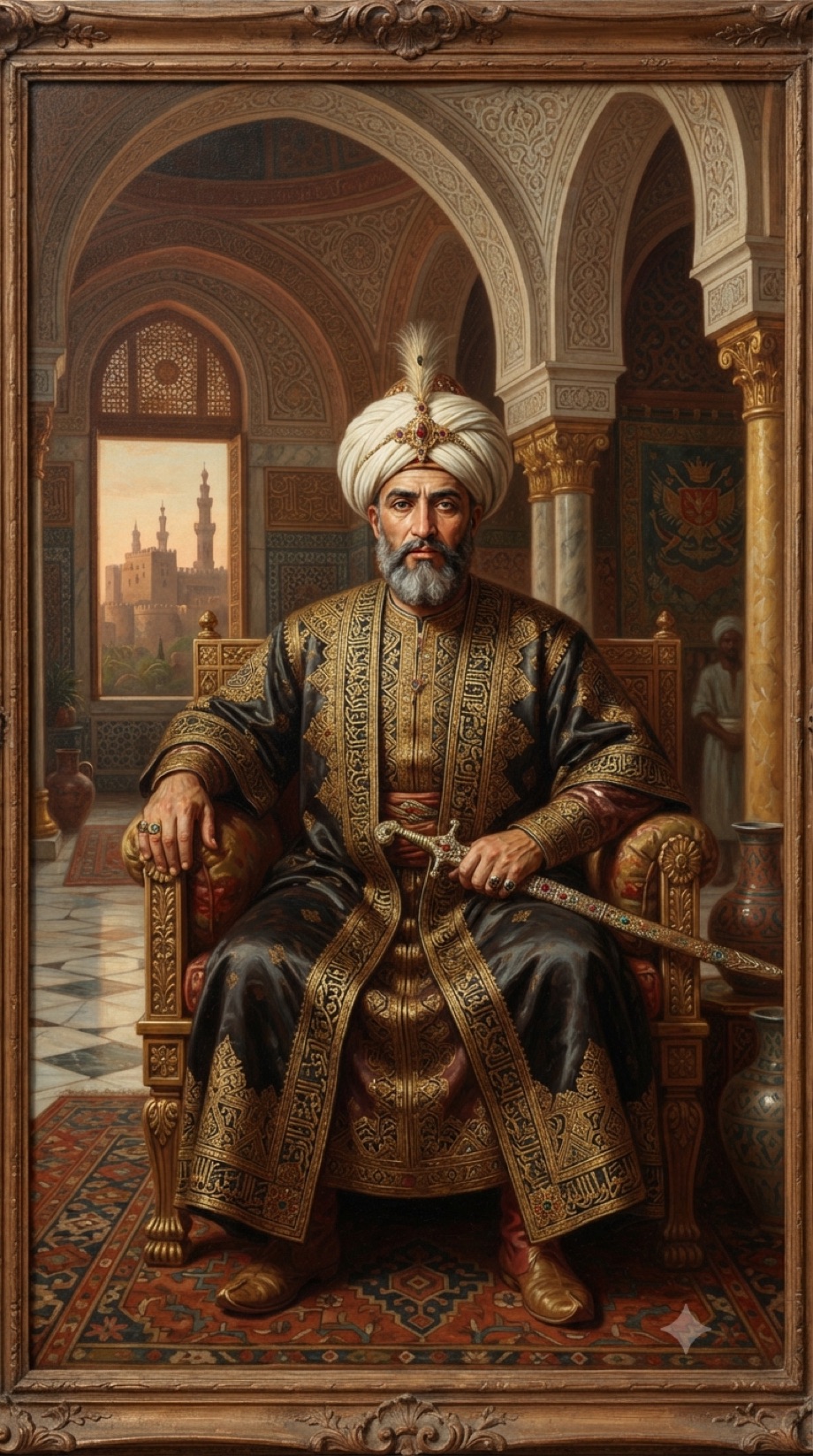
AI-assisted Portrait of Qalawun
The Man Who Built to Last
He was bought as a boy for a thousand dinars, and the price became his name: al-Alfi, the thousand-dinar man, because a Kipchak slave who cost that much was expected to be worth it. He was — but not where a Mamluk's worth was usually measured, in the charge and the sword. His comrade Baibars was the great conqueror of their generation, the lion who smashed Mongols and Crusaders and built a war-state out of terror and speed. When Baibars died in 1277 he left that state to weak sons, and it began at once to come apart. Where Baibars had conquered, Qalawun did the harder and quieter thing. He institutionalized.
Taking the throne in 1279, he ruled Egypt for eleven years and turned a warlord's conquests into a hereditary state. He crushed a great Ilkhanid invasion at Homs in 1281, ground the Crusader remnant down to the sea, took the wealthy County of Tripoli in 1289, and was preparing the siege of Acre when death took him. He wove a web of treaties across the Mediterranean, raised in Cairo one of the medieval world's greatest hospitals, and founded a dynasty — the Qalawunids — that would hold Egypt for the better part of a century, the most durable line the Mamluk system ever produced. He is the ESTJ not as commander but as consolidator: the administrator who inherits a revolution and makes it permanent.
Qalawun is the ESTJ in its architect's form: Te that governs by system, treaty, and institution rather than by inspiration, anchored in Si's instinct for continuity — a man who completed and cemented what a greater conqueror began, and built every structure of his reign, from a hospital to a dynasty, to outlast him.
Government by System
Te — dominant
Dominant Te runs the world by procedure and result, and Qalawun's reign reads like a manual of it. His war was administrative before it was heroic. At the Second Battle of Homs in 1281 he broke the full weight of an Ilkhanid army not by a reckless charge but by holding his order, absorbing the Mongol shock on his wings, and committing his reserve at the decisive moment — the victory of a man who thought in units and lines of supply. He ground the Crusader remnant down the same way, not by one dramatic assault but by a patient reduction, fortress by fortress, until Tripoli fell in 1289 and Acre lay open. He organized the end of the Crusader states the way a good administrator closes a ledger.
Off the battlefield the Te is even clearer, because Qalawun governed by contract. He wove a lattice of treaties — with the Byzantine emperor, Genoa, the crown of Aragon, the surviving Crusader lords, even Rudolph of Habsburg far off in Germany — each a stabilizing clause in the structure of his realm. Where Baibars had projected power by menace, Qalawun projected it by agreement, pinning his frontiers down with paper so his armies could face the one enemy that mattered. And he rebuilt the machine itself, reorganizing the army with a new elite corps and settling the succession by design rather than the usual scramble of emirs. He measured his reign not in conquests but in working institutions — the surest sign of a mind for which effectiveness, not glory, is the point.
The Instinct for Continuity
Si — auxiliary
Auxiliary Si is the memory that steadies the Te administrator — the conviction that what has been built must be preserved and handed on intact. In Qalawun it takes its grandest form in the founding of a dynasty. The Mamluk system was designed to defeat inheritance: sultans were ex-slaves, and power was meant to pass to the strongest soldier, not the eldest son. Baibars had tried to found a line and failed within months of his death; Qalawun succeeded where the greater man could not, grooming his sons and arranging the state around the succession until the Qalawunid dynasty — his descendants, including his son al-Nasir Muhammad — ruled Egypt for roughly a century. That is Si's deepest wish made real: not a blaze of conquest but an unbroken thread of continuity across generations.
The same instinct raised his monuments in stone. Between 1284 and 1285 he built the great Qalawun complex on Cairo's Bayn al-Qasrayn — a madrasa, a domed mausoleum for himself and his line, and the famous Mansuri hospital. These were not vanity projects but institutions in masonry, foundations endowed to run in perpetuity. Si builds for permanence, and Qalawun built things meant to function long after he was gone; seven centuries later, much of the complex still stands. Even his stewardship of the realm carries the stamp — he did not reimagine the state Baibars left him but conserved and strengthened it, the careful heir who knows the hardest thing is not to seize a thing but to keep it.
The Web of Alliances
Ne — tertiary
Tertiary Ne gives the ESTJ a supple, opportunistic reach beyond the well-worn path — the capacity to spot a useful angle, an unlikely partner, and fold it into the plan. In Qalawun it never runs the show, but it makes his diplomacy strikingly wide. A more rigid administrator would have dealt only with the immediate neighbors; Qalawun cast the net far, to the Byzantine court, the Italian maritime republics, Aragon in the west, and improbably to Rudolph of Habsburg in the Holy Roman Empire. He grasped that a distant treaty could shape a near frontier — that the way to isolate the Crusaders and the Mongols was to make friends of everyone who might otherwise supply them.
It is Ne in the service of Te: not speculation for its own sake but a scan for the option that strengthens the structure. He was flexible about means while unbending about ends, improvising the deal each situation demanded toward the single fixed aim of a secure and durable Egypt. The tertiary function widens the toolkit; the dominant one still decides what the tools are for.
The Hospital That Healed the Poor
Fi — inferior
Inferior Fi is the private value the instrumental mind rarely voices — the buried sense of what is right, surfacing not in speeches but in a single telling deed. Qalawun was a hard man in a hard trade, an ex-slave who clawed to the throne over the bodies of Baibars's heirs and spent his reign in war. He did not moralize. But the Mansuri hospital — the bimaristan at the heart of his Cairo complex — is where that buried function speaks.
It was one of the greatest hospitals of the medieval world, and its founding charter did something remarkable: it treated rich and poor alike, free of charge, turning no one away, and even gave patients money on discharge so they need not return to work before they had healed. Here the Te administrator who built for continuity built also for compassion, and made that, too, into an institution: not sentiment worn on the sleeve but a value converted into a working system, endowed to do quietly, forever, the good the man himself had little time to do by hand.
Why ESTJ Over ENTJ or ISTJ
Why not ENTJ?
The ENTJ case is tempting — and it is precisely how his comrade Baibars reads: a Te–Ni visionary who reimagined what a Mamluk sultan could be and drove toward a single transforming future. Qalawun was the other thing. His genius was steadiness and continuity, completing and cementing the state Baibars founded rather than conceiving a new one, anchoring every decision in the proven and the durable. That is Te–Si, the builder's pairing, not Te–Ni, the visionary's. He built to last, not to reimagine.
Why not ISTJ?
Qalawun has the ISTJ's reverence for continuity and system, but he was no withdrawn functionary administering from the archive. He was an outward-facing commander who won pitched battles in person, a diplomat who worked half the Mediterranean's courts, a dynasty-founder who seized a throne over rivals. The ISTJ's Si leads and its Te serves; in Qalawun the order reverses — extraverted Te sets the agenda, and Si supplies the ballast.
The distinction that fixes the type is the one between the conqueror and the consolidator. Baibars is the ENTJ who imagines and imposes; Qalawun is the ESTJ who inherits and endures — his Te governing by treaty and institution, his Si demanding that everything he built be built to outlast him. That marriage of outward command and conservative permanence is the ESTJ, and it is the whole shape of Qalawun's reign.
Connected Figures
Further Reading
- From Slave to Sultan: The Career of al-Mansur Qalawun and the Consolidation of Mamluk Rule — Linda S. NorthrupThe standard scholarly study of Qalawun's life and reign — thorough on the administration, the dynasty, and the making of the Mamluk state.
- Mongols and Mamluks: The Mamluk-Ilkhanid War, 1260–1281 — Reuven Amitai-PreissThe authoritative account of the Mamluk-Mongol struggle, including the Second Battle of Homs that sealed Qalawun's eastern frontier.
- The Middle East in the Middle Ages: The Early Mamluk Sultanate, 1250–1382 — Robert IrwinThe best single-volume history of the early Mamluk regime — essential context for how a slave-soldier state produced rulers like Qalawun.
- Cairo of the Mamluks: A History of the Architecture and its Culture — Doris Behrens-AbouseifThe definitive study of Mamluk building, with a full treatment of the Qalawun complex and the great Mansuri hospital.
