 Historical Figure MBTI
#549 · 4-26-26 · The Mamluk Sultanate
al-Ashraf Khalil
Sultan of Egypt · Conqueror of Acre · Ender of the Crusades
c. 1260 — 1293
10 min read
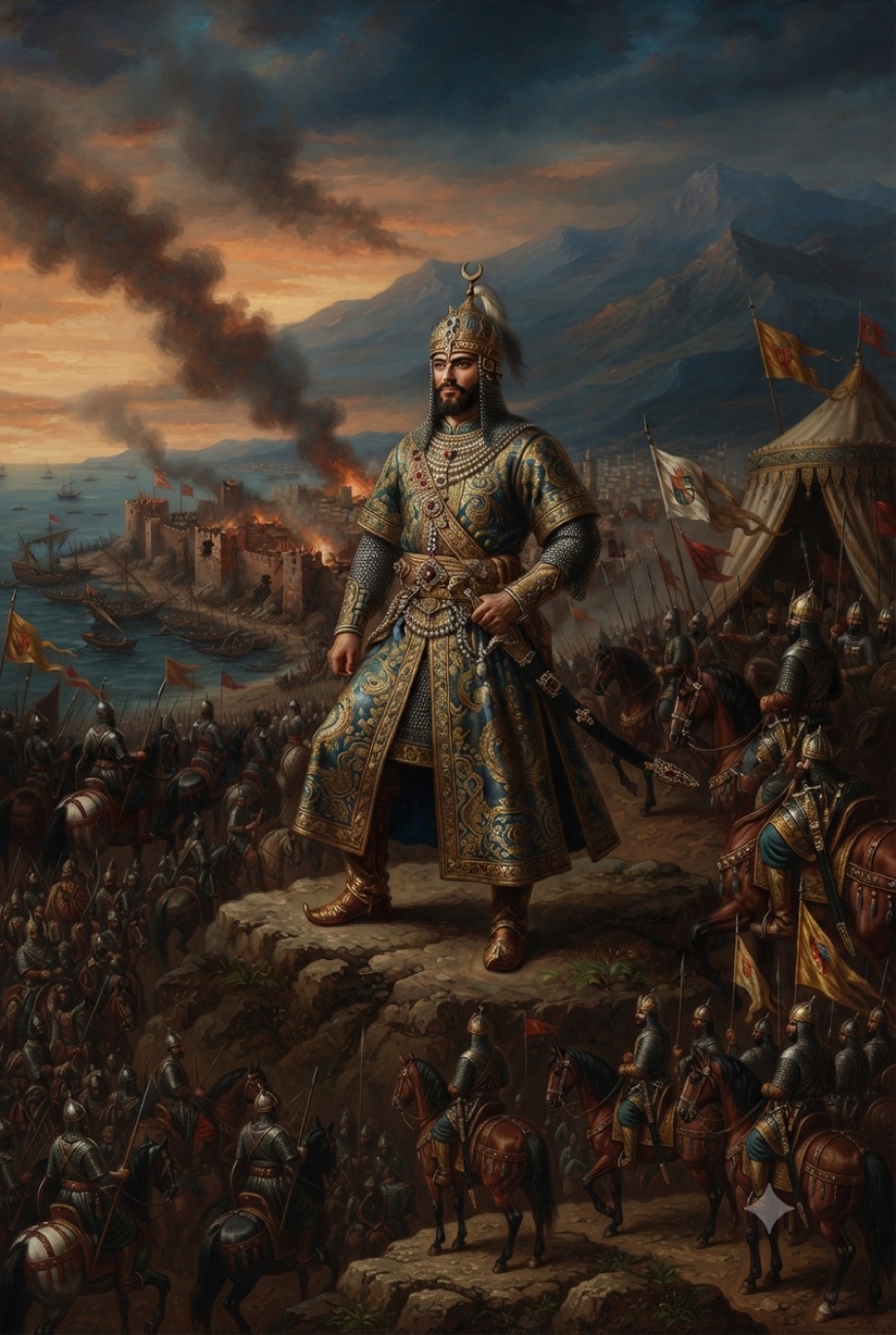
AI-assisted Portrait of al-Ashraf Khalil
The Man Who Finished the Crusades
He inherited a war and won it in a single, spectacular stroke. When his father Qalawun died in 1290, the old sultan had already assembled the army and the pretext for the great campaign against Acre — the last and greatest of the Crusader strongholds on the Syrian coast, the fortress-port that had defied Islam for a century. A cautious heir might have paused to consolidate his throne. al-Ashraf Khalil did the opposite. He pressed the campaign home at once, marched the whole strength of the Mamluk state to the walls, and in the spring of 1291 broke Acre in a storm of assault so total that it ended nearly two hundred years of Latin Christian rule in the Holy Land. The remaining ports — Tyre, Sidon, Beirut, Tortosa, Athlit — fell or were abandoned within weeks. He is, quite literally, the man who finished the Crusades.
He was young, proud, and hungry for the decisive blow, and he found the greatest one available to a sultan of his age and threw everything at it. Acre made him. He followed it with the reduction of the Armenian fortress of Qal'at al-Rum in 1292 and was already planning war against the Ilkhanid Mongols when, in 1293, his own emirs — the seasoned men of his father's establishment whom he had bullied and sidelined — cut him down while he was out hawking. He conquered the unconquerable and could not survive his own court. The reign is a study in one thing done brilliantly and everything around it neglected.
Khalil is the ESTP as conqueror-opportunist: Se seizing the one great, glittering moment with overwhelming force and personal daring, welded to a soldier's cold tactical Ti — the mind built to storm a wall, not to manage the men behind it.
The Storm of Acre
Se — dominant
Dominant Se lives for the decisive, physical, present-tense act — the moment when overwhelming force is applied to a single object and the situation resolves. Acre is that impulse written on the largest possible scale. Khalil did not besiege the city so much as hurl the entire apparatus of the Mamluk state at it: siege engines with names that survived in the chronicles, a colossal army, sappers mining beneath the towers, and a personal presence at the walls that drove the assault forward through weeks of brutal, grinding attack. When the great towers were undermined and the breaches opened, he sent his men in wave after wave until the defense collapsed. It was not elegant. It was irresistible — force concentrated on the one prize until the prize broke.
What makes it Se rather than mere ambition is the appetite for the tangible, glorious thing itself. Acre was the object every warrior of the age dreamed of and none had taken; it was the great physical trophy of the moment, and Khalil wanted it in his hand. He was not building toward it over a lifetime, as a strategist plots a campaign of decades. He seized the ripe moment his father had left him and pressed with total intensity while the window was open. The same reflex carried him the next year to Qal'at al-Rum, the Armenian fortress on the Euphrates: another wall, another storm, another commander who preferred to be present at the assault than absent behind a map.
This is the ESTP sultan's signature and his limit at once. Se is magnificent when there is a wall to break and a real enemy in front of it. It has far less to say when the enemy is behind you — a faction of aging emirs, a court of grudges, the slow attrition of loyalty. Khalil could take the greatest fortress in the Levant and could not read the room of his own tent.
The Soldier's Logic
Ti — auxiliary
Se supplies the nerve; auxiliary Ti supplies the technical intelligence that makes the nerve deadly. Khalil was not a reckless brawler — the fall of Acre was an engineering problem solved with real competence. The coordination of mines and mangonels, the reading of where a curtain wall was weakest, the timing of the general assault to the moment the towers were compromised: this is the hard, impersonal, means-to-ends logic of a man who understands how a fortress actually comes apart. Ti is the framework beneath the fury, the cold internal calculus of leverage and structural failure.
It is a tactician's logic, though, not a statesman's. Ti in the ESTP is tuned to the problem in front of it — this wall, this assault, this enemy line — and solves it with clean, ruthless precision. It is far less interested in the abstract systems a Te administrator builds to run a realm for decades: the patient management of a bureaucracy, the balancing of factions, the institutions that survive their founder. Khalil could work out how to break Acre. He never bothered to work out how to keep the loyalty of the emirs whose swords had broken it for him, because that was a different kind of problem and not one his mind reached for.
The Glory and the Grudge
Fe — tertiary
Tertiary Fe in the ESTP shows up as a hunger for acclaim and a talent for the grand public gesture — and, in its unhealthy expression, as a clumsiness with the actual feelings of the people who matter most. Khalil had the appetite in full. Acre was not only a conquest; it was theater, the young sultan claiming the single most celebrated victory in living memory, the applause of the whole Islamic world, the glory his father had prepared but not lived to seize. He wanted to be seen to have done the great thing. That craving for the resounding, admired deed is Fe reaching outward for the crowd's roar.
But tertiary Fe is thin where it counts, and Khalil's was disastrously so. The men he needed were the senior emirs of his father's military establishment — proud, powerful veterans who expected to be courted, flattered, and bound to the throne by the ordinary arts of a ruler who reads his subordinates. Khalil, high-handed and impatient, did the reverse. He alienated them, overrode them, made them feel their standing slipping. He could play to the vast anonymous audience of the umma and could not manage the dozen dangerous men in his own council. The public performance was magnificent; the intimate political feeling-work that actually keeps a sultan alive he simply did not do.
The Blind Spot Behind the Throne
Ni — inferior
Inferior Ni is the ESTP's weakest faculty — the long, dark foresight that asks where all this is tending, who will resent it, what shape the future takes if you keep on as you are. It is the sense that reads the slow-building conspiracy, the grudge that has not yet drawn its knife, the consequence three moves away. Khalil, all present-tense daring and appetite, was nearly blind here, and it killed him.
The pattern is grimly legible. He had spent his short reign making enemies of the very men who held armed power under him, and he seems never to have registered the danger accumulating behind his back — never to have felt the future closing in. In 1293, a conspiracy of his own emirs, led by Baydara, struck him down while he was out hunting and hawking, off his guard, at ease, exactly the unwary posture of a man who does not see the trap because he has never been in the habit of imagining one. The conqueror of Acre was murdered by the establishment he had failed to read.
It is the classic undoing of the type in a lethal age. The functions that took the greatest fortress in the world — the storm, the nerve, the tactical eye — are exactly the functions that do not warn you about the quiet men in your own tent. Khalil mastered the wall in front of him and never saw the future behind him.
Why ESTP Over ESTJ
Why not ESTJ?
The ESTJ is the methodical administrator — the builder who thinks in institutions, secures the succession, manages his subordinates, and constructs a war-state to run for decades. That describes Khalil's father Qalawun exactly, and it is precisely what Khalil was not. He inherited a ready-made campaign and threw everything at the single spectacular prize, then was destroyed by the court politics he never troubled to manage. An ESTJ would have courted the emirs and built the machine; Khalil chased the glorious decisive blow and let the machine turn on him. That is Se–Ti seizing the moment, not Te–Si building the institution.
The comparison is really a family portrait. Qalawun was the patient state-builder who spent years assembling the army, the alliances, and the plan — the Te administrator who prepared a conquest he would not live to make. Khalil was the impatient conqueror who inherited that preparation and cashed it in one dazzling season, then squandered everything his father had built around it because the slow, unglamorous work of holding a court together bored and eluded him. The son could win the war the father could only plan; the father could keep the throne the son could only seize. The difference between them is the difference between Te–Si and Se–Ti — and it is why one died old in his bed a legend and the other died young on a hunting field with a knife in him.
Connected Figures
Further Reading
- Acre 1291: Bloody Sunset of the Crusader States — David NicolleA focused military account of the siege Khalil pressed home — the assault, the engines, and the fall of the last great Crusader stronghold.
- From Slave to Sultan: The Career of al-Manṣūr Qalāwūn — Linda S. NorthrupThe standard study of Qalawun's reign — the war-state and the Acre campaign that Khalil inherited and completed.
- The Middle East in the Middle Ages: The Early Mamluk Sultanate, 1250–1382 — Robert IrwinThe best political history of the early Mamluk sultanate — essential for the court, the emirs, and the factional violence that killed Khalil.
- The Age of the Crusades: The Near East from the Eleventh Century to 1517 — P. M. HoltA magisterial survey placing the fall of Acre within the long arc of Crusader and Muslim states in the region.
