 Historical Figure MBTI
#568 · 4-29-26 · The Ottoman Zenith
Zaganos Pasha
Grand Vizier · The Hawk of the Conquest · Commander at the Walls
c. 1400 — 1469
5 min read
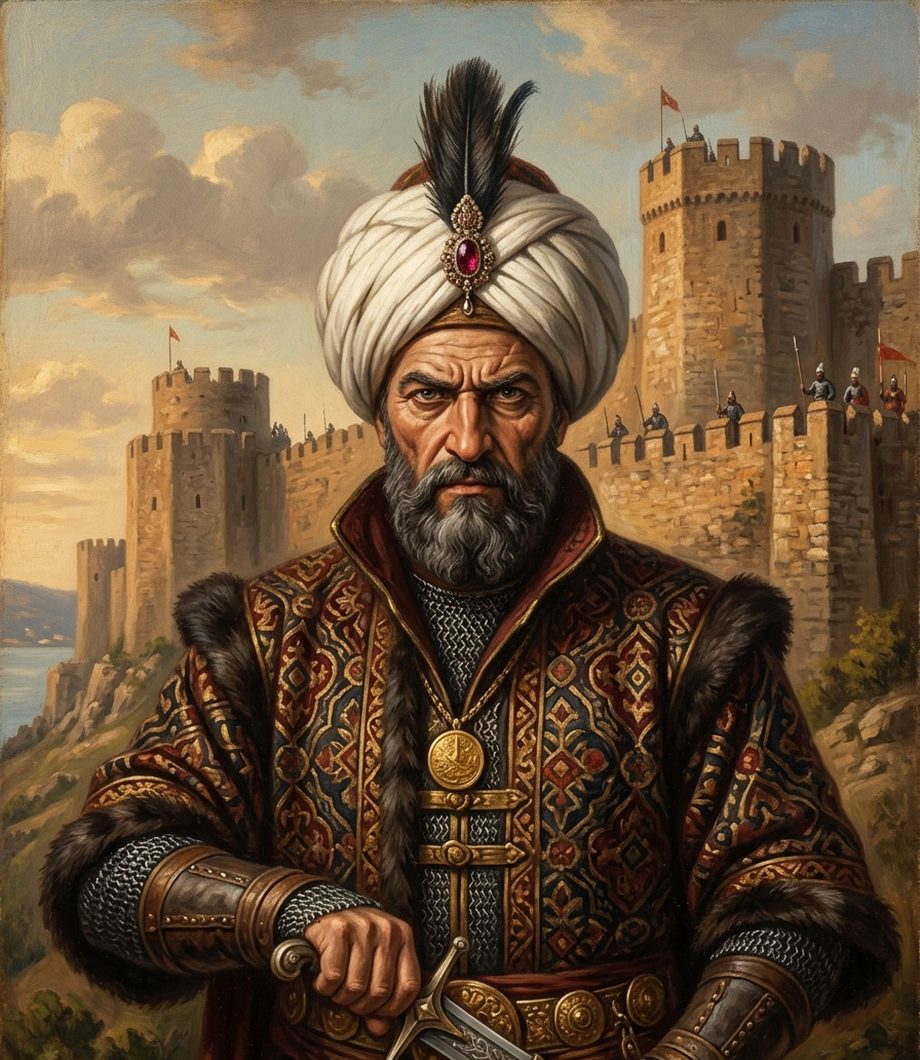
AI-assisted Portrait of Zaganos Pasha
The Slave Who Battered the Wall
He entered the empire as plunder. Taken as a boy from a Christian family — Albanian or Greek, the records disagree — under the devshirme, the levy that harvested the sons of the sultan's subjects and remade them as his slaves, Zaganos rose through the palace school into the highest reaches of Ottoman power. By 1453 he was the loudest voice at the ear of a young sultan, urging him to attempt the thing the graybeards swore was impossible: storm the walls of Constantinople, which had turned back a thousand years of armies.
He never conceived that conquest, and never pretended to. He was the man who made it happen — who commanded troops at the walls and stiffened the sultan's nerve each time the assault stalled. Where the old grand vizier Çandarlı Halil Pasha counseled patience, Zaganos counseled the hammer. He is the ESTJ as the state's enforcer: the self-made man of action who told the young sultan exactly what he wanted to hear, and then delivered it.
Zaganos is the ESTJ in its purest instrumental form: Te's hard, commanding drive to execute — to move armies, drag ships overland, batter down walls — welded to Si's absolute loyalty to the machine that made him. He did not dream the conquest. He delivered it.
The Road the Ships Rode
Te — dominant
Dominant Te organizes force toward a result, and Zaganos's result in the spring of 1453 was singular: the wall must fall. He held command on the Pera and Galata side of the siege lines, marshaling men and guns across the Golden Horn. His was not the temperament that admired a fortification — it was the temperament that measured it, priced it, and set about reducing it to rubble.
The signature act of Ottoman engineering that broke the siege bears his stamp. The Byzantines had sealed the mouth of the Golden Horn with a great iron chain. Rather than force it, the Ottomans went over the land: a greased-log road was built across the hills behind Galata, and in a single astonishing night some seventy ships were hauled overland and lowered into the harbour behind the boom, turning the city's undefended flank into a front. Whether the concept was his or the sultan's, the delivery was the Te art Zaganos embodied — logistics wielded as a weapon, an impossible haul solved by sheer organized will. And he pushed hardest exactly when others faltered: when the war council wavered, he was the hawk who argued for the general storm, for spending what had to be spent to take the wall — the refusal to abandon an objective once committed that is Te at its most relentless.
A Creature of the New Machine
Si — auxiliary
Auxiliary Si anchors Te inside an institution, and Zaganos was the product of the most systematic institution of his age. The slave-administration of the Ottoman state took Christian boys, converted and drilled them, and forged from them a governing class owned body and soul by the throne — men whose loyalty ran not to a bloodline but to the office and the sultan who held it. Zaganos was the archetype of this new elite. The old Turkish nobility served by right of blood; Zaganos served by right of making, and that made him more reliable to Mehmed, not less.
This is why he and Çandarlı Halil were natural enemies. Halil spoke for the cautious hereditary establishment and doubted the wisdom of hurling the empire against the greatest walls in Christendom; Zaganos was the sultan's own creature, and championed the war precisely because it was the sultan's will. His Si is not nostalgia for a lost past — it is unbending fidelity to the chain of command that had lifted a captured boy to the summit of an empire. He trusted the machine because the machine had made him.
The Hawk's Gambit
Ne — tertiary
Tertiary Ne gives the ESTJ enforcer a flash of tactical invention — the readiness to reach for the unconventional workaround when the straight line is blocked, always in service of a fixed aim rather than in place of one. Confronted with a fortress that had defied every attacker for a millennium, Zaganos did not conclude it was impossible; he pressed for the audacious solution — the fleet carried over dry land, the reframing of a stalled siege as a problem with an answer.
But this improvisation never wandered into vision. It was Ne kept on a short leash by Te and Si — the creativity of the field commander, not the strategist: how to take the wall, never why the wall must be taken.
Why ESTJ Over ENTJ
Why not ENTJ?
The ENTJ is the architect — the commander whose drive is harnessed to a Ni vision of the future that others execute. That describes Mehmed, not Zaganos. Mehmed dreamed the world-empire and the Roman inheritance; he supplied the why. Zaganos supplied the how — the will, the muscle, the refusal to quit the wall. He took a goal already fixed by his master and battered it into fact: a Te–Si executor, not a Te–Ni visionary.
The distinction is the difference between the man who sees the future and the man who builds it with his hands. Zaganos was never the author of the conquest; he was its instrument, and a magnificent one — the hawk who championed the plan and the commander who held his sector until the city fell. The sultan conceived, and his slave-born enforcer delivered. That is the ESTJ's incomparable gift — not the idea, but its execution.
Connected Figures
Further Reading
- Mehmed the Conqueror and His Time — Franz BabingerThe classic biography of Mehmed II and his court; the fullest portrait of Zaganos and the hawkish faction that drove the conquest.
- The Ottoman Empire: The Classical Age, 1300–1600 — Halil İnalcıkThe standard account of the devshirme and the slave-administration that produced men like Zaganos and remade the Ottoman ruling class.
- 1453: The Holy War for Constantinople and the Clash of Islam and the West — Roger CrowleyA vivid narrative of the siege — the ship-haul over Galata, the war councils, and the final assault Zaganos championed.
