 Historical Figure MBTI
#569 · 4-29-26 · The Ottoman Zenith
Orban
Master Founder · Maker of the Great Bombard · The Cannon That Broke the Walls
d. 1453
6 min read
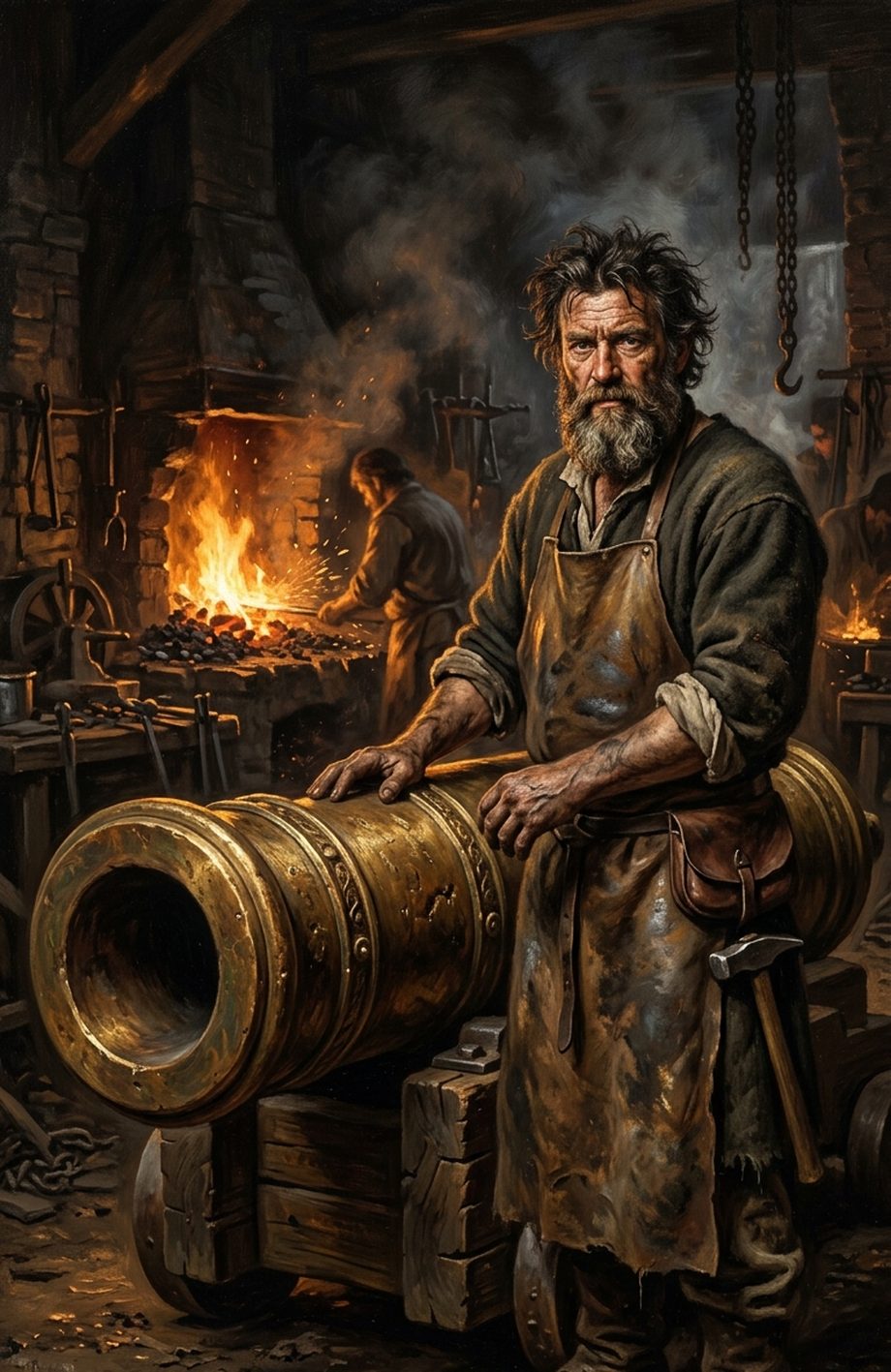
AI-assisted Portrait of Orban
The Man Who Cast the End of an Empire
He was loyal to the work, never to the cause. Orban — a cannon-founder, Hungarian or perhaps a Saxon out of Transylvania, his origins as smoke-obscured as the foundry he worked in — belonged to no empire and no faith that could not meet his price. He was a master of the new gunpowder artillery at the exact moment the world was learning what it could do, and he understood, better than any prince, that a wall was only a problem in physics. Given bronze, saltpetre, and a patron with an open purse, he would solve it.
The irony that hangs over his name is that he first offered his art to the wrong side. He went to Constantine XI, the last emperor of a thousand-year Byzantium, and proposed to arm the Theodosian walls that had turned back every besieger for a millennium. But the empire was bankrupt, unable to meet his fee or supply his metal, so the craftsman shrugged and carried his skill across the lines to the young sultan Mehmed II, who wanted exactly one thing in the world and would fund it without limit. The engineer whose craft would end the empire had very nearly built its salvation instead. It was never about the empire. It was about the gun.
Orban is the ISTP as pure master-technician: Ti's obsessive command of metallurgy and ballistics wedded to Se's hands-on mastery of the foundry and the pour — a mercenary craftsman loyal to the work itself, indifferent to which empire his masterpiece served or destroyed.
The Physics of a Monstrous Gun
Ti — dominant
Dominant Ti builds a private, ruthless model of how a thing actually works and then trusts that model over any authority. Orban's model was the cannon, and he had followed its internal logic further than any man alive. He knew the alloy of the bronze, the taper of the bore, the mathematics that tied the charge of powder to the weight of the stone and the thickness of a wall a mile away. When he told Mehmed his great gun could shatter the Theodosian ramparts, he was not boasting; he had done the reasoning and believed the reasoning, because the reasoning was his.
The proof was the "Basilica" — a bombard some twenty-seven feet long that threw stone balls of roughly six hundred pounds, its roar reported for miles across the Bosporus. Nothing that size had been cast before; there was no procedure to follow, only a problem to be solved from first principles. Orban solved it, and then he built a whole train of lesser giants around it. Over seven weeks his guns did what no army had managed in a thousand years: they pounded the walls of Constantinople into rubble. That is Ti's signature triumph — not the application of a known method, but the mastery of a system nobody had yet mapped.
The Foundry and the Pour
Se — auxiliary
Ti supplied the theory, but a cannon is not cast in the mind. It is cast in a pit of molten bronze that can kill everyone standing near it, and Orban was a hands-on master of that physical reality. Auxiliary Se gave him command of the foundry itself: the heat of the furnace, the timing of the pour, the cooling of a bronze mass so vast that a flaw in the metal meant weeks of labor lost or men dead. He did not merely design the Basilica; he stood over the crucible and made it, reading the material through his hands and his eyes as it went.
The same Se ran through the siege. He was present at the guns, managing the ponderous business of hauling, laying, loading, and firing a weapon that took hours to reload and threatened its own crew every time it spoke. And it is exactly here that Se's appetite for the edge shows its danger: Orban pushed the great gun past what the bronze could bear. It cracked under the sheer violence of its own discharge and had to be bound and repaired mid-siege. He was a man who trusted the immediate feedback of the material and drove it to the limit — the mastery and the recklessness of the same tactile intelligence.
The Gun for Hire
Ni — tertiary
Tertiary Ni is faint in Orban, but it flickers in the one strategic intuition that governed his whole career: he grasped, earlier than the princes he served, that gunpowder had changed the meaning of a wall forever. For a thousand years the Theodosian ramparts had been the definition of the impregnable. Orban looked at them and saw an obsolete idea — a fortification built for a world that no longer existed. That single glimpse of where warfare was heading was worth more than any army, and he sold it to the one man who would act on it.
But Ni never rose to govern him, and that is the tell of the type. He read the future of siegecraft yet stayed indifferent to the future of empires: it did not matter to him whether his insight raised the crescent or the cross over Constantinople. The strategist's gift lived in the craftsman's hands, but it never became a loyalty or a cause — only a service, rendered to whoever could pay.
Why ISTP Over ISTJ
Why not ISTJ?
The ISTJ is the obvious near-miss: a sober technical specialist, meticulous with material and method. But the ISTJ is loyal to an institution and works by established procedure, and Orban was neither. He had no institution — he sold his skill to whoever bid highest, defecting from a Christian empire to its Muslim conqueror without a backward glance. And he followed no established procedure, because none existed for a gun that size; he improvised at the edge of the possible. He even pushed his masterpiece past its safe limits until it cracked. That is Ti innovation and Se risk, not Si procedure and institutional loyalty.
The distinction is the whole man. An ISTJ founder would have served one crown faithfully and cast within known tolerances; Orban was a freelance problem-solver who treated the wall of Constantinople as an engineering puzzle and its empire as beside the point. His allegiance ran to the craft and to the patron who would let him practice it without limit — the ISTP's pure devotion to mastering the work, unencumbered by the question of what the work was for.
Connected Figures
Further Reading
- 1453: The Holy War for Constantinople and the Clash of Islam and the West — Roger CrowleyThe most vivid modern narrative of the siege — superb on Orban, the casting of the Basilica, and the bombardment of the walls.
- The Fall of Constantinople 1453 — Steven RuncimanThe classic scholarly account of the city's last days, careful and authoritative on the sources for Orban's guns and death.
- The Ottoman Empire: The Classical Age, 1300–1600 — Halil İnalcıkThe standard history of the rising Ottoman state, placing Mehmed's artillery revolution within the empire at its zenith.
