 Historical Figure MBTI
#803 · 6-12-26 · The American Civil War
Hannibal Hamlin
The Vice President Who Got Dropped
1809–1891
3 min read
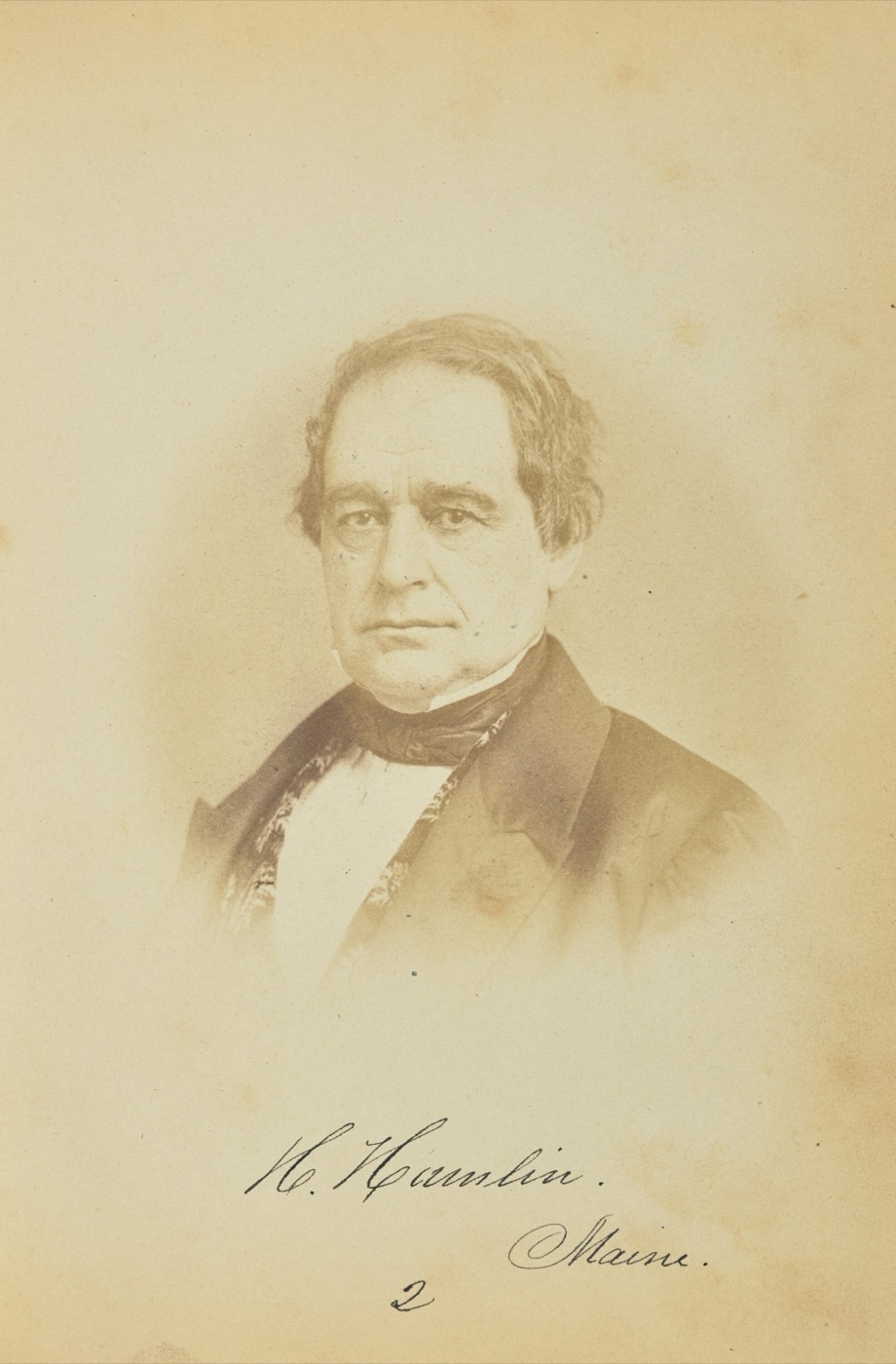
Portrait of Hannibal Hamlin
A Balance on the Ticket, a Vacancy in the Job
Hannibal Hamlin spent three decades making himself useful in exactly the way New England Republicans wanted a Maine man to be useful — steady, procedural, unspectacular. He had come up as a Democrat, won election after election to the state legislature, the House, and the Senate, and served a brief stint as governor, all without ever becoming the kind of figure who set the terms of a debate rather than showed up reliably to cast a vote in it. When the new Republican Party needed a former Democrat from the Northeast to balance its ticket behind a Midwestern moderate in 1860, Hamlin fit the specification precisely. He had broken with his old party over slavery, he carried Maine, and he asked for nothing in return.
That was the whole of the job, and it was also the problem. The nineteenth-century vice presidency carried no real function — no cabinet seat with weight behind it, no standing invitation into Lincoln's actual deliberations, nothing but the gavel of the Senate and the wait. Hamlin, a man who had always measured his worth in tasks completed, found himself with almost none to complete. He grew restless enough that he left Washington partway through the war to drill with the Maine Coast Guard, glad of any labor that produced a visible result.
Hamlin was ISTJ to the bone — a man built for steady accumulation of duty, stranded in an office that offered him none.
The Verdict
Hamlin's dominant Si shows most clearly in the shape of his career before 1860 — decades of incremental, faithful service in the legislature and the Senate, building a record through consistency rather than any single dramatic stroke. He was the party's dependable hand, not its visionary, and he seems to have been entirely comfortable in that role as long as it came with real work attached. His auxiliary Te gave that discipline a practical, results-oriented edge: he did not merely endure the grind of office, he wanted it to produce something, which is precisely why the vice presidency chafed at him so badly. A ceremonial post with no output to manage was, for a Si-Te profile, close to a contradiction in terms.
His break with the Democratic Party over slavery reads as tertiary Fi rather than any appetite for reinvention — a quiet, firmly held conviction that eventually overrode decades of party loyalty, expressed not as public passion but as a single hard decision made once and then simply lived with. Inferior Ne shows in the negative space of his biography: no restless pursuit of new possibilities, no reveling in the ambiguity of an undefined office. Instead, when the vice presidency handed him unstructured time, Hamlin's answer was to go find something concrete to do with his hands.
Connected Figures
Further Reading
- Hannibal Hamlin of Maine: Lincoln's First Vice-President — H. Draper HuntThe standard biography
- Team of Rivals: The Political Genius of Abraham Lincoln — Doris Kearns GoodwinContext on the 1860 ticket and Lincoln's cabinet
- Lincoln — David Herbert DonaldGeneral biography covering the 1860 nomination and Hamlin's marginalization
- Lincoln's Sanctuary: Abraham Lincoln and the Soldiers' Home — Matthew PinskerOn the wartime Washington in which Hamlin worked
