 Historical Figure MBTI
#804 · 6-13-26 · The American Civil War
Jefferson Davis
The Reluctant President of a Doomed Nation
1808–1889
6 min read
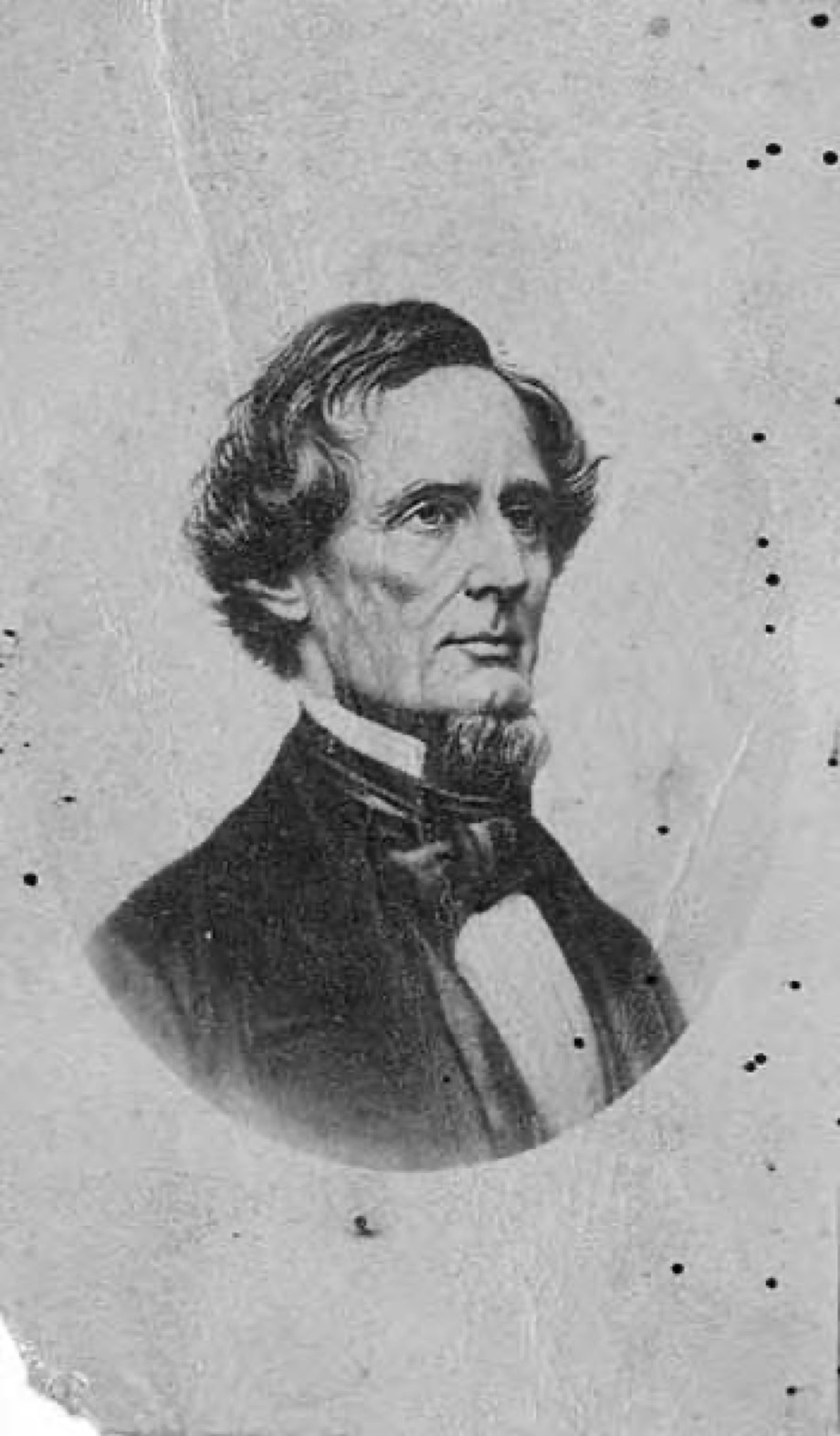
Portrait of Jefferson Davis
The Man Who Wanted a Regiment
In January 1861 Jefferson Davis rose in the United States Senate to announce Mississippi's withdrawal with the punctilious sorrow of a man closing out a ledger; he had opposed secession as a tactic for years. When the Montgomery convention made him provisional president the next month, the news reached him in his rose garden at Brierfield, and Varina wrote that he read the telegram like a man hearing a sentence of death. He had wanted a field command. He got the job of improvising a nation out of nothing.
He was not the wrong man for lack of ability — West Point class of 1828, a hero of Buena Vista, one of the best Secretaries of War the country ever had. He was superb at running an institution that already existed; at fifty-two he was asked to invent one, under blockade, with governors who thought sovereignty meant they could ignore him. He answered the only way his mind knew how: by the book — constitutional propriety in a republic founded on constitutional rupture, rigid chains of command he could not stop reaching down through, a ledger of slights. The result was an ISTJ fighting a revolutionary war with the temperament of a peacetime bureau chief.
Davis was an ISTJ handed a job that punished every one of his strengths: dominant Si gave him a president who governed by precedent in a country that had none.
Governing a New Nation Out of an Old Rulebook
Introverted Sensing runs on stored precedent: what the procedure is, what worked before, what the regulation says. Davis ran the Confederate government almost exactly as he had run the United States War Department a decade earlier — same bureau structure, same paperwork discipline, same insistence that requisitions move through channels. In a government improvised in eight weeks, he reproduced the filing system he had left.
It went further than administration. He treated the Confederate Constitution — a near-copy of the federal one — as binding scripture. When Governor Joseph E. Brown of Georgia gutted conscription by exempting thousands of state officials, Davis answered with legal arguments and messages to Congress rather than seizing the power a revolutionary executive would have taken. He had built a rebellion, then insisted on conducting it with impeccable procedural manners.
The same instinct wrecked his war. He organized the South into fixed territorial departments, each general responsible for his own ground — a scheme that works as a filing system does and as a war does not, leaving troops idle while the neighboring department collapsed. His feud with Joseph E. Johnston began over a procedural point, Johnston's rank in the 1861 seniority list, and never moved past it: Johnston wanted latitude to trade ground for time, Davis wanted plans submitted and correspondence answered. They were arguing over whether a war is a problem to solve or a system to operate correctly.
The Best Secretary of War the Union Ever Had
Whatever else is true of Davis, he was not incompetent, and auxiliary Te is why. From 1853 to 1857 he ran the War Department with a thoroughness his successors inherited gratefully: he pushed the army from smoothbore to rifled arms, revised the tactics manual, added four regiments to the regular establishment, and ordered the surveys that mapped the routes the country would actually build.
The same instinct ran Brierfield, worked alongside his elder brother Joseph's Hurricane, where the enslaved people were made to hold courts of their own to try offenses — an arrangement Davis called orderly, and worth naming for what it was: correct forms applied where no form could make things correct. He was as systematic about himself — exact hours, neuralgia and a failing eye endured without comment, a Richmond schedule that ran past midnight.
As president he never stopped being a department head, unable to delegate what he believed he could do properly himself — and he believed that about nearly everything. Where he trusted a subordinate — Judah Benjamin, who moved through three cabinet posts, or Robert E. Lee, left alone with a freedom granted no one else — the machine ran. Where he did not, the work came back onto the most overloaded desk on the continent.
A Thin Skin Under a Stiff Coat
Tertiary Fi in an ISTJ shows up as a private code of honor — deeply felt, rarely spoken, disastrously easy to wound. Davis did not argue with critics so much as absorb them as insults and file them permanently. Robert Toombs, passed over for the presidency and then for command, became a permanent enemy; fire-eaters like Robert Barnwell Rhett, who wanted someone more radical than this cautious former Unionist, found their letters unanswered. His vice president, Alexander Stephens, drifted into open opposition and sulked in Georgia; Davis made no effort to win him back.
The Johnston quarrel is the clearest case. Johnston's 1861 letter protesting his place in the seniority list accused Davis of injuring his honor; Davis called its language unbecoming and never forgave it, and two men the Confederacy could not spare spent the war unable to trust each other. The reverse case is Braxton Bragg, a friend since Buena Vista, sustained atop the Army of Tennessee through near-mutiny by his own corps commanders — loyalty as principle, held past the evidence.
Fi also explains the reluctance. Davis did not campaign for the presidency and never learned to perform it: few speeches, no courted press, self-promotion beneath a gentleman. Duty was accepted rather than sought, and having accepted it he could not conceive of laying it down. Only with Varina did the interior open at all.
The Improvisation He Could Not Perform
Inferior Ne is the blind spot: the alternative nobody put on the list, the plan with no precedent. Founding a country is almost entirely that work, and Davis was worst at exactly it. Survival depended on improvisations he could not authorize in time — a government cotton monopoly before the blockade tightened, a national command structure, an early willingness to arm the enslaved men on whose labor the edifice rested. Each was proposed; each met the objection that it was irregular, or unconstitutional, or not how such things were done.
Where Ne did surface it came as anxiety rather than insight: he was sure the enemy's next blow would fall where his imagination placed it, and sure into 1863 that European recognition was one victory away. The real improvisers unnerved him. Lee's audacity he tolerated because it produced results and because Lee explained himself in writing; Johnston's, unexplained, he read as insubordination.
The summer of 1863 exposed the pattern whole. With Vicksburg besieged and the west cracking, the Confederacy needed one decision about where to spend the last of its offensive strength; Davis weighed the arguments and could not force a choice against Lee's confidence. The army went north into Pennsylvania while Pemberton's garrison starved on the Mississippi, and both ended in the same July week — the work of a mind that could judge any plan set before it and generate none itself.
Why ISTJ Over ESTJ
Why not ESTJ?
The administrative record tempts an ESTJ reading; the temperament refuses it. A Te-dominant asserts outward and early, while Davis was reserved to the point of coldness and had to be handed the presidency rather than take it. His woundedness was private and grudge-shaped rather than performative — an ESTJ has the fight in the open and moves on; Davis stopped answering the letters. The competence is auxiliary Te serving dominant Si, not the reverse.
Why not ISTP?
ISTP would make him a tinkerer reading the immediate situation and improvising against it — Se-Ti, the temperament of the field commander he wished he had been. He was the opposite: stiff, formal, precedent-bound, unable to abandon a plan correct on paper because the ground had changed.
What makes Davis legible as an ISTJ is that his virtues and his failures are one trait seen from two sides. The precision that made him a first-rate Secretary of War made him a micromanaging president; the loyalty that kept faith with Bragg kept a failing general in command; the scruple that refused to make him a dictator also refused the Confederacy the authority it needed to survive its own governors.
Connected Figures
Further Reading
- Jefferson Davis, American — William J. Cooper Jr.The standard modern biography — sympathetic to the man, unsparing about the president, and the best account of how his prior career shaped his war.
- Jefferson Davis: The Man and His Hour — William C. DavisFuller on the personal temperament: the grudges, the illnesses, the inability to work with men he had once fallen out with.
- The Confederate Nation: 1861–1865 — Emory M. ThomasThe institutional story — how a revolution built on state sovereignty tried and failed to become a centralized wartime state.
- Jefferson Davis, Confederate President — Herman Hattaway and Richard E. BeringerA focused study of Davis's actual conduct of office: cabinet, congress, command structure, and the departmental system.
- A Diary from Dixie — Mary Boykin ChesnutRichmond society observed from the inside, including the drawing-room verdicts on Davis, Varina, and the generals.
