 Historical Figure MBTI
4 min read
#149 · 3-17-26 · The Young Republic of USA
John C. Calhoun
Not the loudest voice. But the one that refused to bend.
1782 — 1850
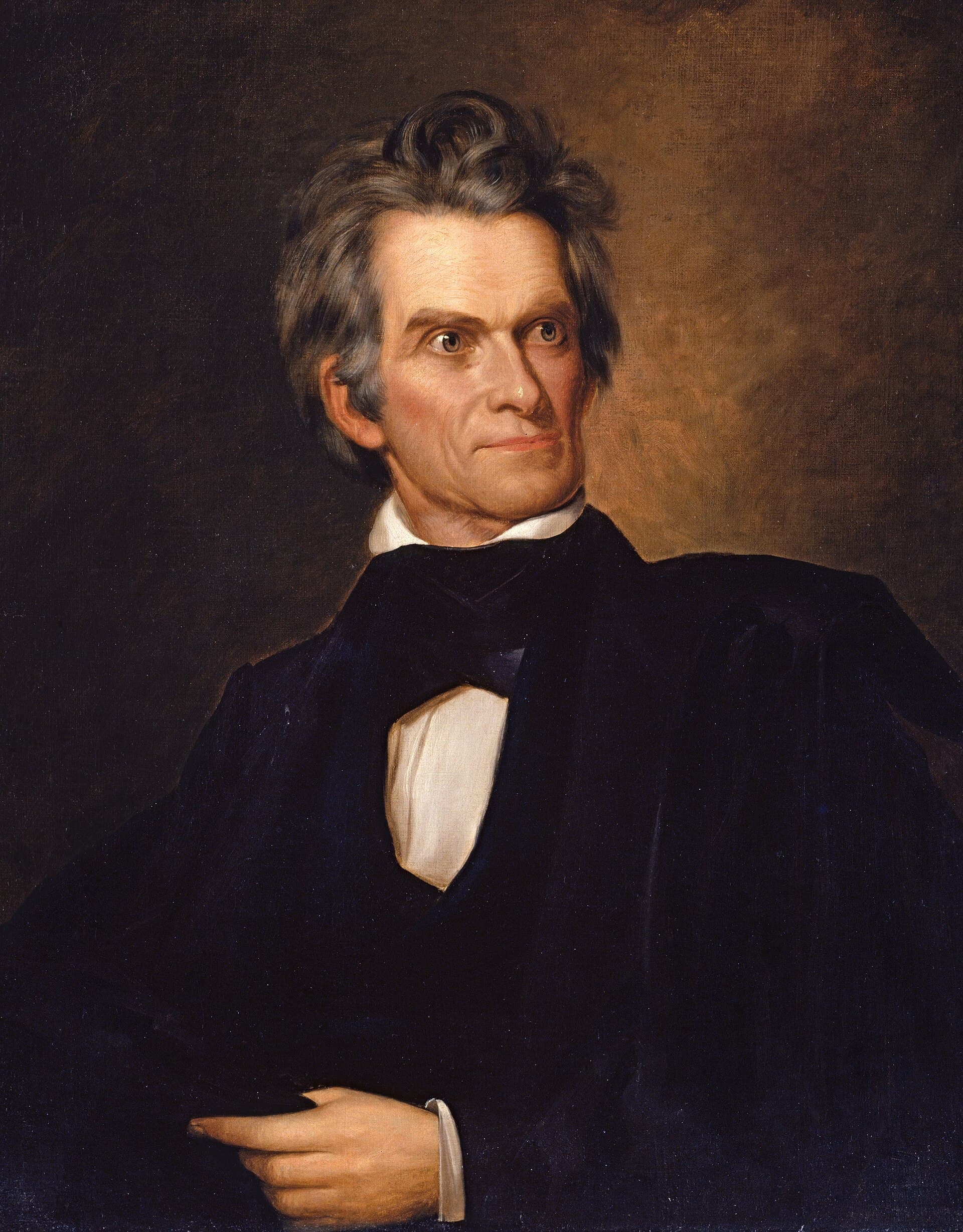
Portrait of John C. Calhoun
The System of Sovereignty
John C. Calhoun did not argue to persuade.
He argued to define.
Born in 1782 in South Carolina, Calhoun emerged as one of the most intellectually formidable—and controversial—figures of early American political life. Where others engaged politics as negotiation or performance, Calhoun approached it as a problem of structure: what is power, where does it reside, and how should it be constrained?
His mind did not move outward toward people. It moved inward toward systems.
Over time, his thinking crystallized into a coherent, rigid framework—most notably his doctrine of nullification and the concept of the "concurrent majority." These were not reactive positions, but the output of a deeply internalized vision of how political order must function.
Calhoun was not navigating the system. He was attempting to redefine its architecture.
The Psychological Verdict
John C. Calhoun is sometimes typed as INTP due to his intellectualism, or ENTJ due to his political influence. But a closer look at how his ideas formed and solidified suggests a different pattern.
His cognition reflects long-range conceptual synthesis, internally driven vision, and structured execution—hallmarks of Ni–Te, not Ti exploration or Se-driven leadership.
He was likely an INTJ.
Ni — Dominant
Calhoun's thinking was fundamentally convergent. He did not explore ideas for their own sake—he distilled them. His work consistently moves toward singular, unified principles: sovereignty, balance of power, structural equilibrium.
Over time, his ideas became more refined, more compressed, and more certain. This is classic Ni: not generating possibilities, but narrowing them into one internally coherent model of reality.
His doctrine of nullification was not an improvisation—it was the culmination of years of conceptual development.
Te — Auxiliary
Calhoun did not keep his ideas abstract. He translated them into political doctrine, speeches, and policy positions—applying his internal vision to the external world with clarity and force. His arguments were structured, systematic, and often uncompromising.
This reflects Te: organizing external reality according to an internal framework, prioritizing logical consistency and implementation over consensus.
Fi — Tertiary
Beneath his structured reasoning was a quiet but firm value system. Calhoun's positions were not merely intellectual—they were deeply held. There is a sense of internal conviction that does not rely on external validation.
He did not adjust his views to maintain social harmony; he held them, even as they became increasingly polarizing. This suggests tertiary Fi: personal values present, but expressed through firmness rather than outward emotionality.
Se — Inferior
Calhoun was not a man of the moment. He did not thrive in improvisation, charisma, or real-time engagement. Compared to contemporaries like Jackson or Clay, his presence was more restrained, more deliberate, less reactive.
When engaging externally, it was in service of his internal model—not in response to immediate circumstances. This reflects inferior Se: engagement with reality, but not immersion in it.
Why not INTP or ENTJ?
Ni over Ti–Ne (not INTP)
INTPs lead with Ti, exploring ideas in an open-ended, iterative way. Calhoun does not read this way. His thinking was not exploratory—it was directional. He moved toward conclusions, not endless refinement. His ideas became more fixed over time, not more flexible. This is not Ti–Ne. This is Ni–Te.
Ni over Te–Ni (not ENTJ)
ENTJs lead with Te, acting decisively in the external world and organizing systems from the outside in. Calhoun's process appears reversed. He began with an internal vision, developed it extensively, and then applied it outward. His influence came less from direct command and more from the strength and coherence of his ideas. This is not Te–Ni. This is Ni–Te.
Connected Figures
Further Reading
- John C. Calhoun: American Portrait — Margaret L. CoitPulitzer Prize-winning biography; the most readable single-volume life of Calhoun.
- John C. Calhoun and the Price of Union — John NivenA careful political biography tracing his evolution from nationalist to secessionist theorist.
- A Disquisition on Government — John C. CalhounCalhoun's own systematic political philosophy — the clearest expression of his concurrent-majority doctrine.
- The Political Theory of John C. Calhoun — August O. SpainAcademic analysis of the intellectual structure behind nullification and states' rights.
