 Historical Figure MBTI
4 min read
#147 · 3-17-26 · The Young Republic of USA
Martin Van Buren
Not the loudest voice. But the one who knew where the room would move next.
1782 — 1862
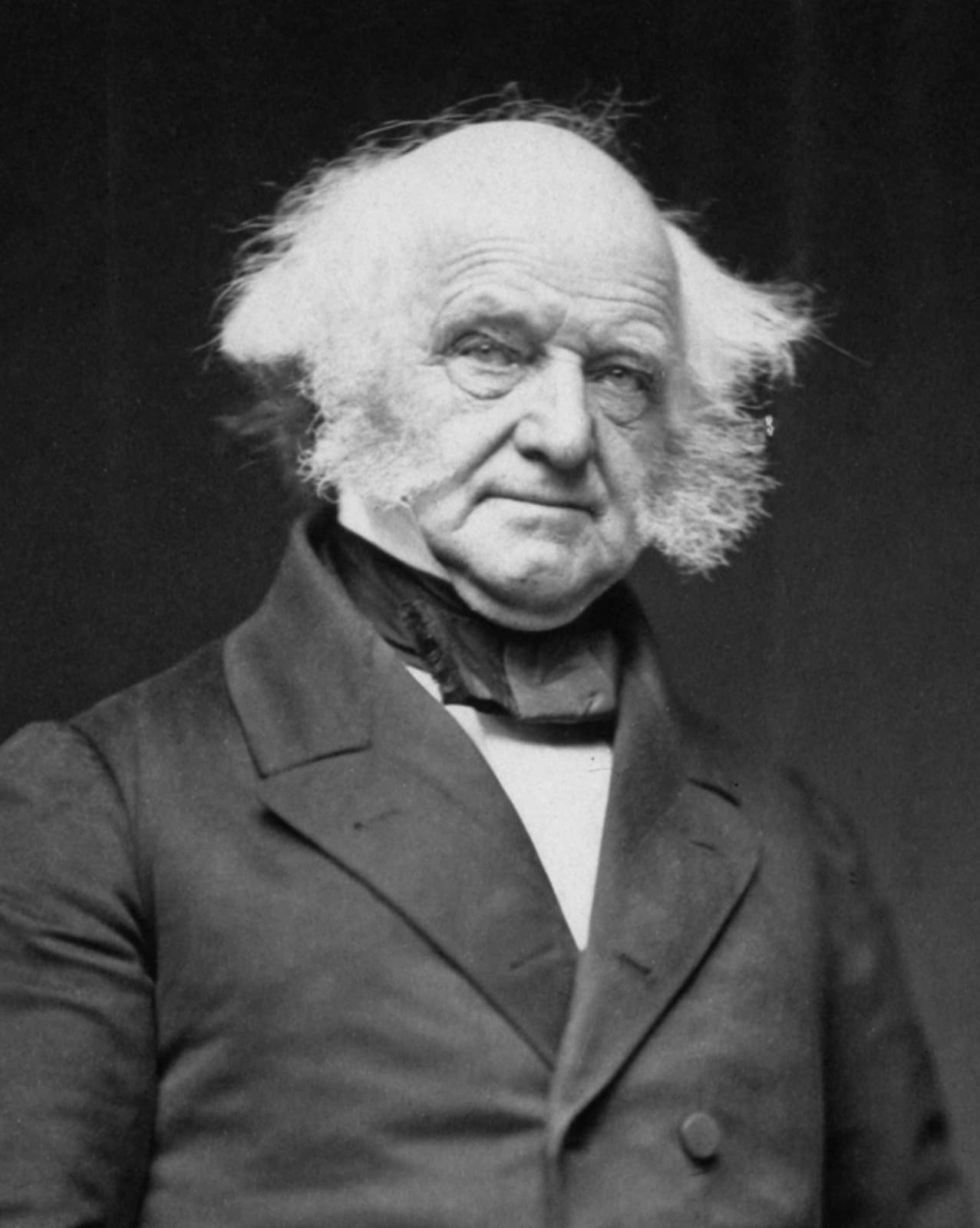
Portrait of Martin Van Buren
The Little Magician
Martin Van Buren was rarely the loudest man in the room.
But he was often the most difficult to outmaneuver.
Born in 1782 in Kinderhook, New York, Van Buren grew up in a Dutch-speaking, tavern-centered world—an environment defined not by isolation, but by constant conversation. Politics, negotiation, and personality flowed through the room as naturally as drink. It was here that he learned to listen, to read people, to adapt in real time.
He would carry that instinct with him for life.
Unlike many of his contemporaries, Van Buren did not project dominance through force or moral authority. He projected something subtler—ease, wit, and an almost disarming sociability. He could move between factions, soften tensions, and reframe disagreements without appearing to impose himself. This quality earned him two telling nicknames: "The Little Magician" and, more quietly, "the Fox."
Both captured the same underlying truth.
He did not overpower systems. He navigated them.
The Psychological Verdict
Martin Van Buren is often typed as ISFJ or ISFP due to his diplomatic demeanor, and sometimes INFJ for his strategic influence. But these interpretations focus on surface presentation rather than underlying cognition.
A closer look suggests something different: his strength was not in preserving structures or following a singular vision, but in adapting to shifting dynamics—rearranging people, incentives, and systems with remarkable flexibility.
He was likely an ENTP.
Ne — Dominant
Van Buren's defining trait was his ability to see multiple pathways within a system. He did not treat politics as fixed. He treated it as fluid—something that could be reshaped depending on how its parts were arranged.
His role in developing the modern party system reflects a mind that could imagine new configurations and bring them into alignment. He was constantly adjusting, recalibrating, and exploring alternatives—not randomly, but in response to changing conditions.
This is Ne at scale: dynamic, situational, and possibility-oriented.
Ti — Auxiliary
Underlying this adaptability was a precise internal logic. Van Buren approached politics less as a moral battlefield and more as a system to be understood. He paid attention to incentives, relationships, and structural consistency—what would hold, what would break, what would stabilize over time.
His decisions reflect internal coherence rather than external enforcement. He wasn't imposing order (Te); he was understanding how order emerges.
Fe — Tertiary
Van Buren's social presence was not incidental—it was instrumental. He was widely regarded as personable, witty, and easy to engage with. He knew how to maintain relationships, smooth over conflict, and keep alliances intact without drawing unnecessary attention to himself.
This Fe is not dominant, but it is refined—supporting his ability to move fluidly through complex social environments.
Si — Inferior
Despite working within established institutions, Van Buren was not bound by tradition. His contributions were transformative. Rather than preserving the existing political order, he restructured it—introducing new forms of coordination that would outlast his own career.
Stability, for him, was not inherited. It was constructed.
Why not ISFJ, ISFP, or INFJ?
Ne over Si–Fe (not ISFJ)
ISFJs lead with Si–Fe—they preserve, maintain, and uphold continuity. Van Buren did not preserve the system. He redesigned it. His approach was not rooted in what had worked before, but in what could work better given current conditions. That forward-facing adaptability is incompatible with dominant Si.
Ne over Fi–Se (not ISFP)
ISFP suggests a values-driven, identity-centered approach. Van Buren does not read this way. He was not expressing personal authenticity or acting from deeply individualized convictions. Instead, he was aligning external systems—prioritizing functionality over self-expression. This is not Fi–Se.
Ne over Ni (not INFJ)
INFJs lead with Ni, converging toward a singular vision. Van Buren remained flexible. He did not narrow possibilities into one ideological path. He kept multiple pathways open, adjusting as circumstances changed. His strength was not in prediction, but in navigation.
Connected Figures
Further Reading
- Martin Van Buren and the Making of the Democratic Party — Robert V. ReminiThe definitive account of how Van Buren engineered the Jacksonian coalition and invented the modern party system.
- The Fox at Bay: Martin Van Buren and the Presidency, 1837–1841 — Major L. WilsonA close study of Van Buren's single term — his handling of the Panic of 1837 and the strains of governing.
- American Lion: Andrew Jackson in the White House — Jon MeachamPulitzer Prize-winning biography of Jackson that illuminates Van Buren's indispensable role in the Jacksonian era.
- The Age of Jackson — Arthur M. Schlesinger Jr.The classic Pulitzer-winning survey of the Jacksonian democracy in which Van Buren was the chief architect.
