 Historical Figure MBTI
#817 · 6-14-26 · The American Civil War
Harriet Beecher Stowe
The Novelist Who Started a War, Allegedly
1811–1896
7 min read
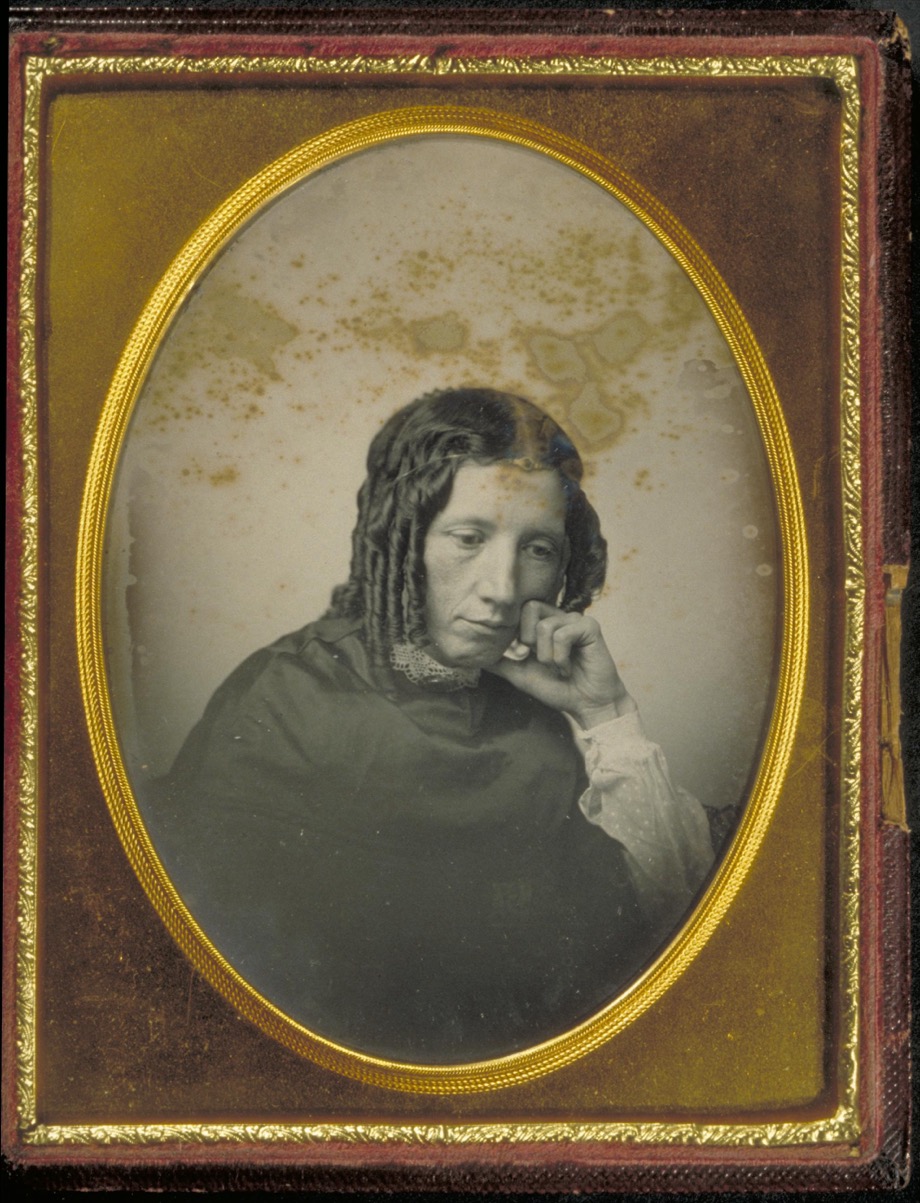
Portrait of Harriet Beecher Stowe
A Grief Turned Into a Weapon
In July 1849, cholera came up the Ohio River into Cincinnati, and Harriet Beecher Stowe watched her eighteen-month-old son Samuel Charles die of it. She was thirty-eight — daughter of the most famous preacher in America, wife of an underpaid seminary professor, mother of six, author of nothing anyone would remember. What she took from that summer was not a doctrine. “It was at his dying bed and at his grave,” she wrote, “that I learned what a poor slave mother may feel when her child is torn away from her.” She had lived for years within sight of Kentucky and it had all remained information. Now it was feeling, and feeling in her was never inert.
Two and a half years later Uncle Tom’s Cabin began running in the antislavery paper The National Era. It was to last three or four weeks; it ran ten months. As a book in 1852 it sold three hundred thousand American copies in a year. What she produced was not an argument — every argument had already been made by better-trained minds. It was a set of people: Eliza on the ice, Tom under Legree, Eva, Topsy. Readers who had never given slavery ten consecutive minutes could not afterward stop seeing them.
Stowe is the archive’s clearest case of conviction as literary technology: an INFP who could not build a movement, but who could take one unbearable private feeling and refract it through a hundred imagined lives until a nation felt it too. She was not the architect of abolition. She was its nervous system.
She never organized anything. She simply made it impossible for several million people to go on not feeling what she felt.
Fi — The Thing She Could Not Un-Feel
Dominant introverted feeling is not warmth or sentimentality, though Stowe has been accused of both. It is a private register of what is intolerable, answerable to no authority outside itself. She grew up surrounded by authorities — Lyman Beecher’s pulpit, her brother Henry Ward’s, her sister Catharine’s schools — and her great act owed almost nothing to any of them. The Beechers argued slavery. Harriet convicted herself of it, alone, over a dead child.
Her account of the book’s composition is pure Fi: the death of Uncle Tom, she said, arrived whole during communion at the Brunswick chapel in early 1851, and she wrote it down in tears afterward, insisting ever after that she had not composed the novel so much as received it. Whatever one makes of the theology, the psychology is legible — the authority was interior and felt rather than reasoned, which is why she could not defend it in the register her critics demanded.
It explains her indifference to timing, too. She published just after the Fugitive Slave Act had made Northern moderates eager to drop the subject, and her preface asks not for a policy but for readers to “feel right” — the only thing she knew how to ask.
Ne — One Conviction, a Hundred Faces
Conviction alone produces a tract. What made Stowe dangerous was the auxiliary that scattered her single feeling into people who were not her. Uncle Tom’s Cabin works by proliferation: the pious slave and the mixed-race runaway, the kindly Shelbys and the languid St. Clare, Ophelia’s Northern squeamishness beside Legree’s Northern birth. Her slaveholders are charming, her New Englanders complicit, and her most radical character a fugitive who wants a gun rather than a hymn.
That branching is why the book outran every pamphlet in circulation. A tract gives a reader one place to stand; Stowe gave a dozen, so that whoever they were — churchgoer, mother, merchant with Southern accounts — some door was open. And the serial overran its planned length by months because new figures kept arriving and she followed them.
The rest of her career reads the same way: a second slavery novel in Dred (1856), New England village fiction, travel letters, domestic advice, religious essays, a self-inflicted scandal over Byron’s marriage. Not a plan — a mind that kept finding new things worth being interested in.
Si — The Kitchen as Battlefield
The tertiary is the function critics underrate, because it looks like furniture. The novel is built out of remembered domestic texture: the business of a hearth, the hymn sung over work, the way a mother packs a bundle in the dark. She wrote for women who knew those rooms from the inside, in the one vocabulary that could not be waved away — this is your kitchen, and here is what the law does inside it.
The Si is stored rather than invented. Cincinnati gave her eighteen years across the river from Kentucky: one visit to a plantation there, fugitive accounts arriving through Lane Seminary, auction notices in the local press. That is why A Key to Uncle Tom’s Cabin (1853) was possible at all — she matched her scenes to advertisements, statutes, and testimony, and showed that the details critics called libel had been in front of her the whole time.
It shows too in her instinctive religiosity — the Beecher revivalist cadence, the hymn tags, the deathbed set pieces — remembered feeling in fixed liturgical shape, and in 1852 the most efficient delivery system for moral shock American culture possessed.
Te — The Footnotes She Should Never Have Had to Write
The inferior surfaces under attack, and Stowe was attacked at once: Southern reviewers called the novel a fabrication, and a subgenre of “anti-Tom” answer novels appeared within two years. She spent most of 1853 on the Key — hundreds of pages of statutes, runaway advertisements, and court decisions marshalled against her own fiction. A real feat of evidence, and unmistakably amateur Te: exhaustive rather than selective, piling up proof because she could not bear to be thought a liar.
The same weakness governs her handling of machinery. She took a flat royalty with no thought for dramatic rights and lost a fortune to the unlicensed “Tom shows” that played for half a century in versions she detested and could not stop. Her ventures into organized politics — the 1853 address of the women of England, the Liberian colonization sympathies that drew justified impatience from Frederick Douglass — show a woman reaching for levers she did not understand.
It shows most in the ending. Having spent five hundred pages making slavery unbearable, she could offer as remedy only right feeling and the emigration of her surviving Black characters to Africa — the weakest pages she ever wrote, and ones she spent years quietly walking back. She could detonate a national conscience. She could not draw the map of what to do on Tuesday.
Why INFP Over INFJ
Why not INFJ?
The INFJ reading tempts because the effect was so enormous, and enormous effects invite the assumption of a plan. But dominant Ni wants one unified vision of how a thing ends, held for years and steered toward. Stowe had no theory of emancipation at all: the book branches into contradictory lives rather than converging on a thesis, its remedy is incoherent, and by her own account she did not design it — she saw Tom’s death, wrote it down, and followed the serial for ten months. That is Ne serving Fi, not Ni.
Why not ISFJ?
The domestic detail and the Beecher religiosity can read as ISFJ, and the sentimental novel was a genre of duty. But ISFJ conserves — it preserves a tradition and discharges obligations to it. Stowe did the opposite: she took the household virtues her culture claimed to hold and turned them into a charge against the law, the churches that tolerated it, and her own father’s gradualism. The Si is the material, not the motive.
The failure settles the type as firmly as the success. A strategist would have kept the dramatic rights and spent a decade converting fame into leverage — the way William Lloyd Garrison converted a newspaper into a movement. Stowe did none of it. One unbearable feeling, an imagination that could dress it in a hundred bodies, a memory stocked with domestic texture, and almost no capacity to manage what the book set in motion: Fi, Ne, Si, Te, in that order.
Connected Figures
Further Reading
- Uncle Tom's Cabin; or, Life Among the Lowly — Harriet Beecher StoweThe 1852 novel itself — still the fastest way to see how the sentimental machinery actually works.
- A Key to Uncle Tom's Cabin — Harriet Beecher StoweHer 1853 documentary answer to the charge of fabrication: statutes, advertisements, and testimony matched against her fiction chapter by chapter.
- Harriet Beecher Stowe: A Life — Joan D. HedrickThe standard modern biography, Pulitzer-winning, strong on the Beecher household and the Cincinnati years.
- Mightier than the Sword: Uncle Tom's Cabin and the Battle for America — David S. ReynoldsTraces the book's cultural detonation, including the unauthorized stage versions that outlived and distorted it.
