 Historical Figure MBTI
3 min read
#45 · 2-16-26 · The Roman Republic
Julius Caesar
General · Reformer · Dictator · The Man Who Centralized Rome Around Himself
100 BCE — 44 BCE
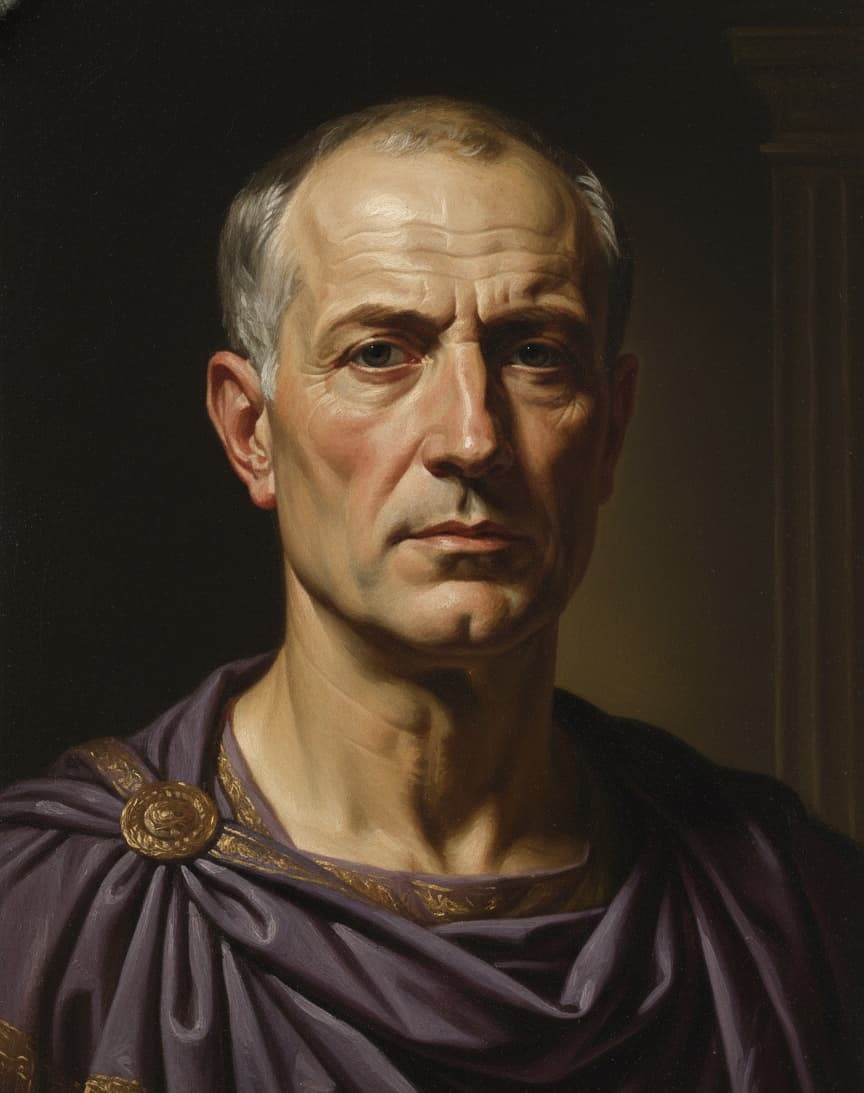
AI-assisted Portrait of Julius Caesar.
The Architect of Collapse
Born in 100 BCE into a patrician but politically unstable Roman family, Julius Caesar came of age in a Republic already straining under its own expansion. Rome had conquered the Mediterranean. But it had not redesigned its institutions to govern it. Caesar saw that gap clearly.
His career was not merely a march of victories across Gaul. It was a steady consolidation of authority — political, military, symbolic — into a single center. He is often mistyped as INTJ — the cold strategist operating from behind the curtain. But Caesar did not remain behind the curtain. He stepped forward and assumed command publicly, repeatedly, decisively. The evidence aligns strongly with ENTJ.
He did not drift into dictatorship. He engineered inevitability.
Te — Dominant
Caesar's instinct was structural reorganization. When institutions obstructed him, he did not retreat into reflection. He moved to reconfigure them. Senate gridlocked? Bypass it. Provinces mismanaged? Centralize oversight. Calendar chaotic? Reform it into the Julian calendar. Political rivals consolidating power? Cross the Rubicon.
The crossing of the Rubicon was not poetic impulsivity. It was decisive execution. Te-dominant leaders assess leverage, choose a direction, and act irreversibly when necessary. Caesar's campaigns and political maneuvers follow that pattern.
Ni — Auxiliary
Beneath his execution lay a coherent trajectory. Caesar understood that Rome could not remain an oligarchic Republic while governing an empire of its size. His reforms — expansion of citizenship, reorganization of debt, redistribution of land — all point toward centralization.
He saw the direction history was moving. And he positioned himself at its center. Ni in service of Te does not hesitate once the pattern crystallizes. Caesar rarely hesitated.
Se — Tertiary
Caesar was physically resilient and present on campaign. He endured long marches, engaged directly with troops, and cultivated personal loyalty through shared experience. Even his famed clemency after civil war victories reflects controlled dominance. He pardoned enemies not from softness, but from strength. Mercy became a consolidation tool.
Fi — Inferior
Caesar was capable of attachment, but rarely emotionally exposed. He formed bonds — notably with Mark Antony and with Cleopatra VII Philopator — yet he did not dissolve into them. Rome remained primary. He curated his image carefully, writing his own Commentaries to shape historical memory. He did not seek emotional validation. He sought permanence.
Why Not INTJ?
Why not INTJ?
The INTJ case emphasizes Caesar's strategic foresight and long-term vision. But INTJs tend to operate indirectly until conditions are fully aligned. They influence systems from strategic distance. Caesar did not maintain distance. He stepped into visible command, accumulated titles, and centralized authority openly. He did not wait for history to bend. He bent it himself. His energy reads extroverted — outward-facing, institution-restructuring, power-assuming. Vision alone does not define Ni dominance. Execution defines Te dominance. In Caesar, execution comes first.
The Roman Triangle
Within the Roman power triangle, the contrast clarifies the type. Cleopatra (ENTJ) matched him in executive sovereignty. Their partnership reads like strategic parity — two rulers aligning for mutual advantage.
Meanwhile, Mark Antony (ESFP) embodied loyalty and immersion. Where Caesar consolidated structure, Antony amplified emotion.
Caesar stood at the center of the storm. Not reacting. Reorganizing.
Connected Figures
Further Reading
- Caesar: Life of a Colossus — Adrian GoldsworthyThe definitive modern biography — authoritative on the military campaigns and political maneuvering alike.
- Rubicon: The Last Years of the Roman Republic — Tom HollandA gripping narrative of the Republic's final decades, with Caesar at its center.
- The Gallic War — Julius CaesarCaesar's own account of his campaigns — indispensable primary source and self-conscious act of image management.
- Caesar — Christian MeierA rigorous scholarly biography that situates Caesar within the structural crisis of the late Republic.
