 Historical Figure MBTI
4 min read
#52 · 2-18-26 · The Tang Dynasty
Li Bai
Poet of the Moon · Drifter of the High Tang
701 — 762
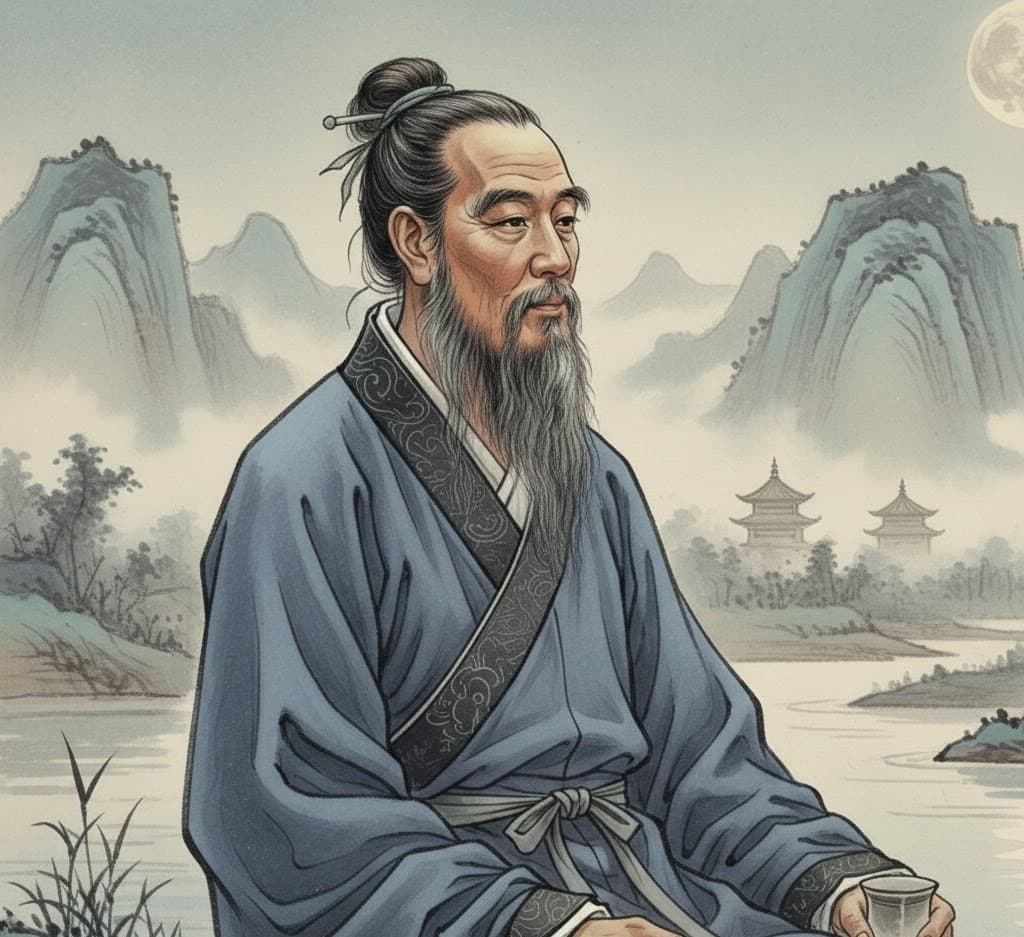
AI-assisted Portrait of Li Bai.
The Immortal Who Refused to Stay Still
Born in 701 during the height of the Tang dynasty's cultural brilliance, Li Bai did not climb the system — he wandered beyond it. He never passed the imperial examinations. He never secured stable bureaucratic rank. Instead, he traveled. Mountains, rivers, taverns, patrons' estates, brief moments at court — and then departure again.
His poetry celebrates wine, friendship, transcendence, solitude, the moon as companion. He writes as someone intoxicated not merely by alcohol, but by possibility. Contemporaries called him "the Immortal Banished from Heaven." That nickname alone tells you how he felt to others: luminous, uncontained, almost too expansive for ordinary structures.
While sometimes mistyped as INFP due to his romanticism or as ESFP due to his indulgent imagery, Li Bai's creativity was not inwardly brooding — it was outwardly expansive. He did not retreat into a private moral world. He radiated one. His cognitive pattern aligns with ENFP.
He was not a system-builder. Not a reformer. Not a bureaucrat. He was expansion itself.
Ne — Dominant
Li Bai's poetry leaps. Moon becomes mirror. Shadow becomes companion. Wine becomes liberation. Exile becomes transcendence. His imagery constantly expands rather than compresses. He does not distill reality into a single symbolic thesis (Ni). He proliferates possibility.
Even socially, his life reflects Ne movement — forming connections quickly, traveling widely, moving from patron to patron, city to city. He lived in openness. Not containment.
Fi — Auxiliary
His loyalty was personal, not institutional. When he rejected bureaucratic conformity, it did not read as strategic calculation. It felt values-based. He would rather remain free than compromise authenticity.
His poems center on his emotional experience — longing, friendship, joy, melancholy — without moralizing society at large. That is Fi intimacy, not Fe obligation. He writes from the inside outward.
Te — Tertiary
Li Bai briefly entered the Tang court under Emperor Xuanzong of Tang — and failed to thrive there. Court politics requires sustained Te navigation: hierarchy management, strategic restraint, calculated alliance-building. Li Bai did not optimize for survival. He did not maneuver carefully. His tertiary Te appears in flashes of competence, but not in sustained execution.
Si — Inferior
Stability did not anchor him. Routine, institutional life, bureaucratic rhythm — these confined him. His poetry often romanticizes departure rather than preservation. Inferior Si in ENFPs can manifest as resistance to rootedness — a constant pull toward new horizons rather than settled tradition. Li Bai drifted not because he lacked depth, but because staying still felt smaller than possibility.
Why Not INFP?
Why not INFP?
INFP creativity tends to feel more internally sealed, more private, more contained within a carefully guarded value system. Li Bai, by contrast, was socially luminous. He impressed patrons, captivated peers, left vivid personal impressions. His imagination spills outward. It interacts. It performs. It connects. That outward intuitive energy suggests Ne dominance.
The High Tang Triangle
Placed beside his famous contemporaries, Li Bai represents the explosive, outward energy of the era:
- • Li Bai: expansion, spontaneity, emotional radiance (Ne–Fi)
- • Du Fu: moral compression, collective weight (Ni–Fe)
- • Wang Wei: distilled perception, cool structural quiet (Ni–Te)
One wandered. One mourned. One subtracted. Where Du Fu became conscience and Wang Wei became a lens, Li Bai remained the banished immortal — pure Ne-fire defying the gravity of the court.
Connected Figures
Further Reading
- The Selected Poems of Li Po — trans. David HintonThe finest English rendering of Li Bai's verse — spare, kinetic, and true to the originals' movement.
- Li Po and Tu Fu — Arthur Cooper (Penguin Classics)Illuminating paired translations that bring out the complementary temperaments of the two great Tang poets.
- The Banished Immortal — Ha JinA literary biography by a novelist — the most vivid account of Li Bai's wandering life and the legend he built around himself.
- The Columbia Book of Chinese Poetry — ed. Burton WatsonEssential anthology providing the full Tang context in which Li Bai and his contemporaries wrote.
