 Historical Figure MBTI
4 min read
#54 · 2-18-26 · The Tang Dynasty
Wang Wei
Poet · Painter · Musician · The "Poet Buddha" as a Cool INTJ
699 — 759
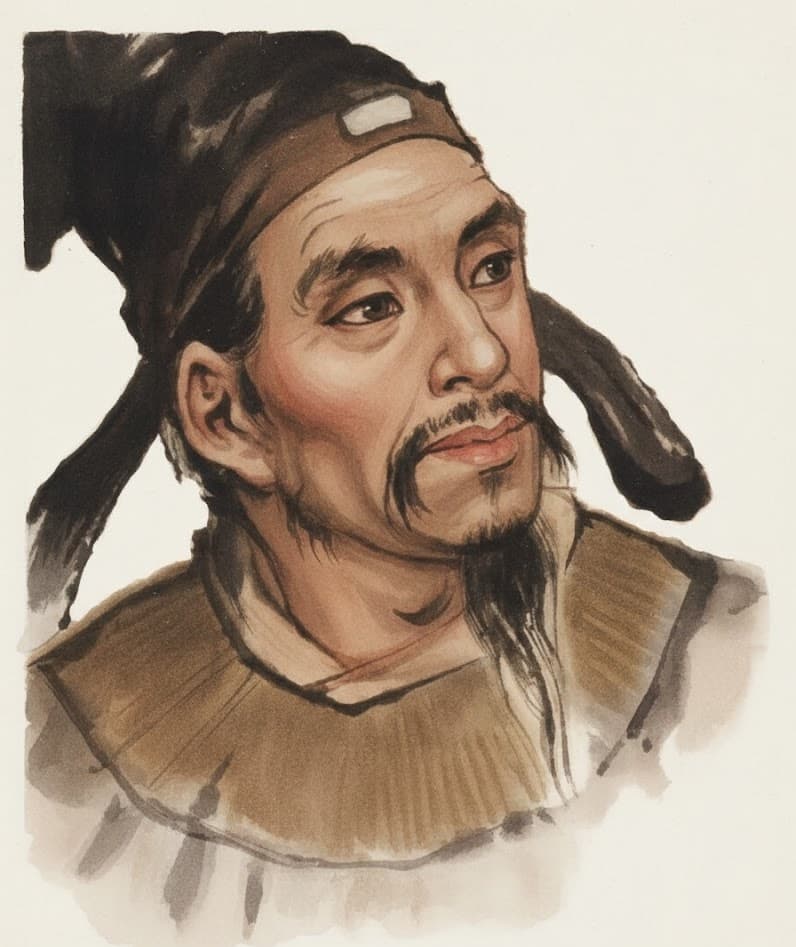
AI-assisted Portrait of Wang Wei.
The Man People Called "Poet Buddha"
Wang Wei is famous for stillness — so famous that later readers nicknamed him 詩佛, "Poet Buddha." But that title can be misleading if we treat it like a personality verdict. "Poet Buddha" describes the spiritual temperature of his art — its emptiness, restraint, and Zen-like subtraction — not necessarily a warm, relational (Fe) style.
What makes Wang Wei so type-revealing is that his calm isn't soft. It's cool. Not emotionally pleading like Du Fu. Not radiant and expansive like Li Bai. More like an architect removing every unnecessary beam until the structure holds itself up.
Wang Wei passed the jinshi exam young and entered official life early — meaning he had the discipline to master rigid classical constraints and the patience to play the long game. He later chose retreat as refinement, not as failure. His signature quality — compression and control — appears across poetry, painting, and music alike. One governing aesthetic principle expressed repeatedly. That internal coherence strongly supports INTJ.
Wang Wei didn't write to move the crowd. He wrote to make reality sufficient.
Ni — Dominant
Wang Wei consistently reduces experience into distilled, structured perception. His landscapes aren't just scenery; they're models of consciousness: presence/absence, light/echo, motion/stillness. He is not exploring possibilities (Ne). He is compressing reality into a final, minimal form (Ni).
Take 《鹿柴》:
空山不见人,
但闻人语响。
返景入深林,
复照青苔上。
Empty mountain — no one is seen.
Only the echo of voices is heard.
Returning light enters the deep forest,
And shines again on the green moss.
He doesn't tell you how to feel. He doesn't moralize. He places perception like objects on a table, then walks away. That is not the "collective conscience" voice. It's the perceptual engineer voice.
Te — Auxiliary
Te here doesn't look like conquering the court. It looks like mastering the exam system early, functioning within bureaucracy, and navigating political danger without melodrama. During the An Lushan chaos, he was captured and coerced into rebel administration, then later defended himself and survived the aftermath. That is external calibration — not impulsive moral martyrdom, not chaotic rebellion.
His earlier career was supported by his patron and friend Zhang Jiuling, a fellow INTJ. Their connection reflects a shared cognitive affinity — a preference for long-range structural clarity over the shifting winds of court politics.
Fi — Tertiary
His personal devotion shows up as contained commitment rather than public emotional display. Accounts say he never remarried after his wife's death. That reads like quiet, internal steadfastness — values held privately, not performed socially.
Se — Inferior
His sensory imagery is precise, but never indulgent. Even when he writes the moon and water, it feels curated. From 《山居秋暝》:
明月松间照,清泉石上流。
Bright moonlight shines between the pines; clear spring water runs over stone.
It's not sensory intoxication. It's disciplined noticing — Se serving a Ni design.
Why Not INFJ?
Why not INFJ?
Compare Wang Wei to Du Fu: Du Fu begins with a broken empire and bleeds outward into the collective. Wang Wei begins with an empty mountain and removes the collective entirely. Du Fu's Ni is moral gravity (Ni–Fe). Wang Wei's Ni is aesthetic architecture (Ni–Te). If Du Fu is a witness, Wang Wei is a lens. Calling him 詩佛 makes sense historically — he was deeply influenced by Buddhism and practiced meditation. But Chan-flavored minimalism is not automatically INFJ. Wang Wei's "Buddhist" feeling is often impersonal — less like compassionate moral address, more like ontological clarity.
The High Tang Triangle
Placed beside his famous contemporaries:
- • Li Bai: expansion, spontaneity, emotional radiance (Ne–Fi)
- • Du Fu: moral compression, collective weight (Ni–Fe)
- • Wang Wei: distilled perception, cool structural quiet (Ni–Te)
One wandered. One mourned. One subtracted.
Connected Figures
Further Reading
- The Poetry of Wang Wei: New Translations and Commentary — Pauline YuThe definitive English scholarly edition — close readings of the Wang Chuan collection and his regulated verse.
- Wang Wei — Marsha L. WagnerA focused critical study of Wang Wei's life and poetry in the Twayne World Authors series.
- The Great Age of Chinese Poetry: The High T'ang — Stephen OwenPlaces Wang Wei within the full literary landscape of the High Tang alongside Li Bai, Du Fu, and their contemporaries.
- Hiding the Universe: Poems by Wang Wei — Wai-lim Yip (trans.)A bilingual edition that foregrounds Wang Wei's visual-spatial compression and Buddhist aesthetic.
