 Historical Figure MBTI
#1169 · 8-27-26 · The Three Kingdoms
Ma Chao
The Tiger of the West · Scourge of Cao Cao at Tong Pass · The Last Warlord to Kneel
176 — 222
5 min read
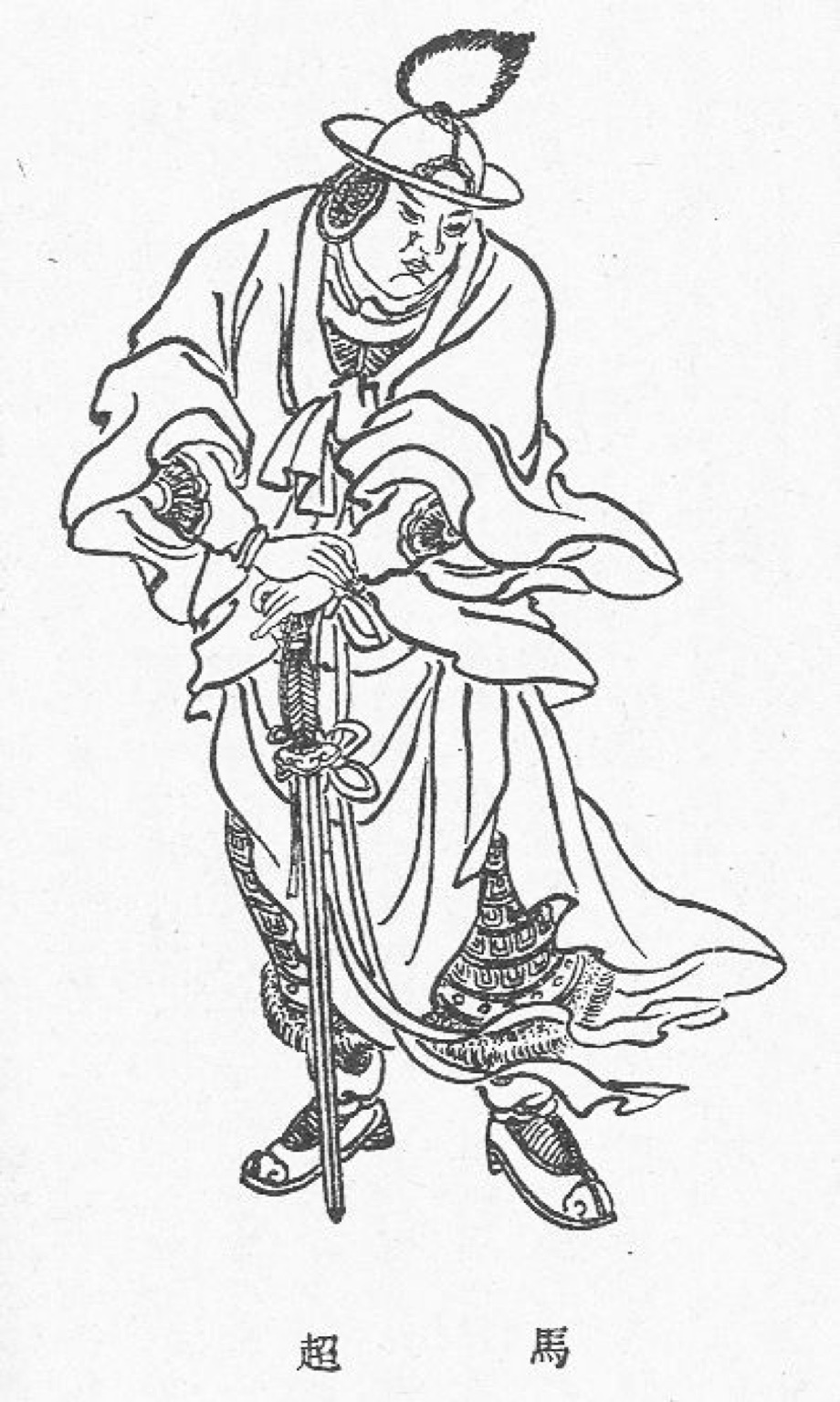
Portrait of Ma Chao
The Rider Who Nearly Caught Cao Cao
In 211, on the flat ground west of Tong Pass, a young cavalry commander from the Tibetan frontier came close enough to killing the most powerful man in China that Cao Cao is said to have torn off his own red robe and hacked away his beard mid-retreat, terrified the silhouette would draw another charge. That commander was Ma Chao, son of the Liang Province warlord Ma Teng. Where other men of the era built power through patient administration, marriage alliances, or long study of the classics, Ma Chao built his through the raw, immediate fact of his presence on a horse with a spear in his hand.
He led the western coalition against Cao Cao not as a strategist but as its spearhead, and when it broke apart — undone by Cao Cao's deliberate sowing of suspicion between Ma Chao and his ally Han Sui, not by force of arms — Ma Chao had no fallback. His father and the rest of his family, held hostage in the capital, were executed in reprisal. He spent the years that followed as a fighting man without a country, drifting through the service of the Di tribes, then Zhang Lu, before finally kneeling to Liu Bei in 214. Even that submission was made of the same material as his rebellion — his army's mere appearance outside Chengdu's walls did more to break Liu Zhang's will than any siege.
Ma Chao is an ESTP whose dominant Se never met a cause it could not overpower and never found one it could keep.
The Spear That Made the Legend
Ma Chao's Se is the western frontier's hard, unsentimental version, forged among the Qiang horsemen and Di tribesmen of Liang Province long before he raised a coalition. He fought at the front of his own charges rather than directing them from a hill, and the chronicles remember him almost entirely through single, vivid physical moments: the lance that nearly reached Cao Cao, the beard cut off in panic, the robe discarded so a fleeing warlord could not be picked from the crowd.
That same instinct explains why his greatest contribution to Liu Bei's cause was not a plan but a presence. When Ma Chao's battered army appeared outside Chengdu in 214, Liu Zhang surrendered within days — not because Ma Chao besieged it, but because everyone inside already knew what that name meant on a battlefield. Ma Chao's entire career, rise and fall alike, is the record of a man who never learned to build anything that would outlast the moment his sword was drawn.
A Coalition He Could Ride Into But Not Hold Together
Ma Chao's auxiliary Ti shows up less in grand strategy than in the blunt calculus of a battlefield commander — he understood terrain, timing, and the mechanics of a cavalry charge with real precision. But Ti in the auxiliary seat rarely extends to reading people, and it was people, not ground, that undid the western coalition. Cao Cao needed only a letter with suspicious erasures to convince Ma Chao that his ally Han Sui was negotiating a betrayal — a trick that worked because Ma Chao had no comparable talent for parsing motive the way he parsed a field of battle.
The same gap recurs after his defection to Liu Bei: he proves reliably useful as a battlefield asset and is rewarded with impressive titles, but never again sits at the center of decision-making the way Zhuge Liang or Fa Zheng did. His logic was real, but it was a soldier's logic — sound on ground he could see, thin on ground he could not.
The Reputation That Outran the Man
What tertiary Fe gave Ma Chao was not warmth but weight — the ability to command loyalty and fear alike without charming anyone individually. His name alone functioned as social currency: it rallied the western tribes to his father's coalition, kept a defeated army fighting on his behalf for years after Tong Pass, and eventually persuaded a besieged city to open its gates rather than face him. That is Fe operating at a distance — a reputation curated and projected outward, not a set of close relationships tended from within.
Tellingly, this same function never gave him the one thing he actually needed: a stable place inside someone else's hierarchy. Under Liu Bei he held real rank and public honor, but the intimate trust reserved for men like Guan Yu or Fa Zheng never extended to him. He died in 222 at forty-seven, a titled general of Shu who had spent his best years as a legend and his last as a name on a roster — Fe built him an image the court could use, but never the belonging he lost the day his father was executed.
Why ESTP Over ESFP
Why not ESFP?
ESFP charisma is warm and social — built on rapport, performance, personal charm. Ma Chao's fame rests on none of that. What made him legendary was martial ferocity and the terror his name provoked, not likability: the cavalry charge at Tong Pass, the beard cut off in a panicked flight, an army whose reputation for savagery did the negotiating outside Chengdu's walls. His tertiary function reads as fear and loyalty commanded across distance, not the intimate, in-the-room sociability an ESFP runs on.
ESTP fits because everything durable about Ma Chao is Se in the driver's seat, backed by a Ti that could read a battlefield but never a room of rivals. He is remembered for what his body did in a single afternoon at Tong Pass, not for any plan he laid or any court he charmed — a man built entirely for the moment of contact, and undone the instant that moment passed.
Connected Figures
Further Reading
- Records of the Three Kingdoms — Chen ShouThe primary source for Ma Chao's biography, the Tong Pass campaign, and his later service under Liu Bei.
- Fire over Luoyang: A History of the Later Han Dynasty 23-220 AD — Rafe de CrespignySituates Ma Teng and Ma Chao within the collapse of Han authority on the western frontier.
- A Biographical Dictionary of Later Han, Three Kingdoms and Jin — Rafe de CrespignyReference entries cross-checking dates, titles, and the fate of the Ma family hostages.
