 Historical Figure MBTI
#1168 · 8-27-26 · The Three Kingdoms
Fa Zheng
The Ruthless Strategist · Architect of Liu Bei's Conquest of Yi Province · The One Man Zhuge Liang Feared to Cross
176 — 220
7 min read
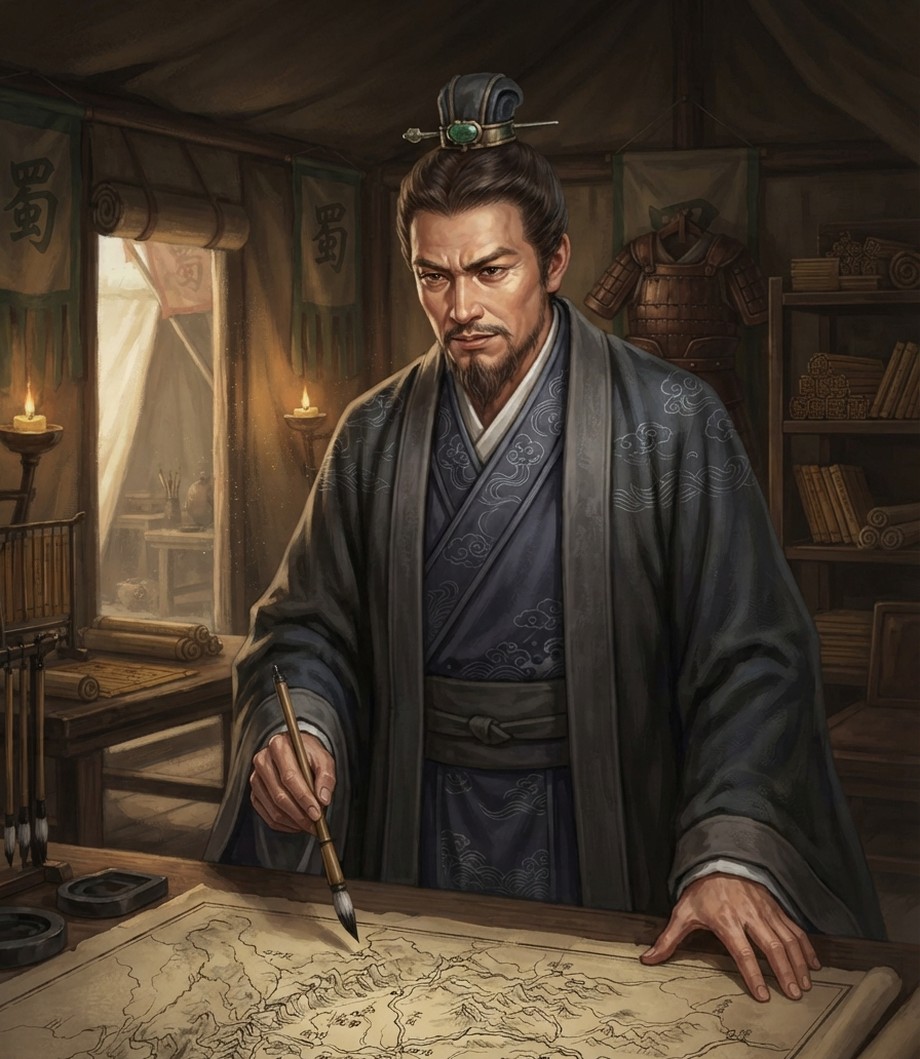
AI-assisted Portrait of Fa Zheng
The Man Who Sold His Own Governor
Fa Zheng began his career serving Liu Zhang, the governor of Yi Province, and spent years watching him fail to be a governor at all — indecisive, easily managed, sitting on one of the richest provinces in China as sharper men circled it. Most advisors in that position nurse the grievance quietly. Fa Zheng acted on it: he became the secret architect of the invitation that brought Liu Bei into Sichuan, and when Liu Bei turned on his host, Fa Zheng defected openly and helped dismantle the province he had once served, piece by piece, until it belonged to someone else.
That is not the profile of a man ruled by loyalty or private conscience. It is the profile of a ENTJ, someone who reads a structure of power, judges it unfit, and moves — decisively, immediately, without much interest in how the move looks. Fa Zheng's gift was never subtlety of feeling; it was subtlety of leverage. He spent his whole career finding the load-bearing weakness in an enemy's position and putting his weight exactly there — at Yi Province's gates, and later at Mount Dingjun, where he engineered the ambush that took the head of one of Cao Cao's ablest generals and handed Liu Bei a kingdom.
Fa Zheng's dominant Te didn't wait for the right moment — it manufactured one, then bet everything on it.
The General Who Betrayed His First Lord
Liu Zhang was, by every account, a man who could not use the province he governed. Fa Zheng did the arithmetic that Liu Zhang never did — a rich, defensible territory in the hands of a weak administrator was an opportunity, not a tragedy — and set about correcting the mismatch. He was one of the men who quietly urged Liu Bei's invitation into Yi Province, and when war broke out between host and guest, Fa Zheng chose the guest, supplying Liu Bei with the local knowledge and political cover that turned an invasion into a conquest. There is no record of him agonizing over the choice. There is only the outcome: Liu Zhang lost his province, and Fa Zheng became one of the men who ran it.
The clearest demonstration of that same Te came years later at Mount Dingjun, in 219. Fa Zheng devised the plan that lured Xiahou Yuan, Cao Cao's veteran general, into repairing a burned palisade under Liu Bei's guns — a position Xiahou Yuan should never have exposed himself to defend, and did anyway, because Fa Zheng understood exactly which provocation a disciplined, dutiful commander could not ignore. Xiahou Yuan died there, and Hanzhong fell, and Liu Bei was able to crown himself King of Hanzhong on the strength of one strategist's read of a rival general's temperament.
Liu Bei himself gave Fa Zheng credit no one else received: after an earlier defeat that Fa Zheng had warned him against, Liu Bei said flatly that only Fa Zheng's counsel could have stopped him from making the mistake. That is Te at its most consequential — not clever advice offered and sometimes taken, but a track record specific enough that the decision-maker learns to fear ignoring it.
Reading the Man Behind the Army
What made Fa Zheng dangerous wasn't tactics in the narrow sense — it was his feel for the long, unspoken pattern in an opponent's behavior. He didn't just know that Xiahou Yuan was competent; he understood the shape of Xiahou Yuan's discipline well enough to predict the specific trap that discipline would walk into. That is Ni working in service of Te — a strategist projecting forward from a rival's known character to the single decision that character would be unable to avoid, and then building an entire campaign around forcing that decision.
The same instinct shaped his read of Liu Bei. Zhuge Liang, who had every reason to consider himself Liu Bei's indispensable advisor, said openly that Fa Zheng was the one man whose counsel could have restrained Liu Bei from his worst impulses — a striking admission from a rival strategist, and a sign that Fa Zheng's influence operated on a register Zhuge Liang's own patient, principled counsel didn't reach. Ni gave Fa Zheng the pattern; Te gave him the nerve to act on it before the pattern finished playing out. It is why he is remembered less as a builder of institutions, the way Zhuge Liang is, and more as the man who read a specific rival, a specific weakness, a specific moment — and struck.
Old Scores, Settled in Full
Once Fa Zheng held real power under Liu Bei, he used it to punish the people who had slighted him in his lean years — men who had once refused him a meal, once dismissed him as beneath notice — with an evenness of memory that reads less like statecraft than personal accounting. That is inferior Fi: not the values-driven idealism a dominant Fi user would show, but feeling surfacing late, unfiltered, and settled through the blunt instrument of Te rather than examined or forgiven.
It embarrassed some of his colleagues, and Zhuge Liang, by his own account, chose to let it pass rather than confront him — a decision that says as much about how essential Fa Zheng had become as it does about the strategist's temper. He never learned to hold a grudge quietly. He simply waited until he had the authority to close the account, and then he closed it.
Why ENTJ Over INTJ
Why not INTJ?
An INTJ strategist wins through patient architecture — long-range planning, institution-building, influence exercised quietly over years. That is Zhuge Liang's mode, not Fa Zheng's. Fa Zheng's decisive acts were immediate and outward: an overnight defection, a battlefield trap sprung in a single engagement, a personal vendetta settled the moment he had the power to settle it. Zhuge Liang himself said only Fa Zheng could restrain Liu Bei's worst impulses — a description of forceful, in-the-room influence, not the quiet, dominant-Ni architecture an INTJ would be remembered for.
The distinction is really about where the force is applied. An INTJ builds a structure and lets its logic compound over time; an ENTJ walks into the room and changes the outcome that day. Fa Zheng never had the years, or the temperament, for the former — his entire career is a string of single decisive interventions, each one executed the moment the opportunity was legible, each one impossible to take back.
Connected Figures
Further Reading
- Records of the Three Kingdoms — Chen ShouThe primary source for Fa Zheng's biography, including the Yi Province defection and the Mount Dingjun campaign.
- Fire over Luoyang: A History of the Later Han Dynasty 23–220 AD — Rafe de CrespignySituates Fa Zheng's career within the collapse of Han authority in Sichuan.
- A Biographical Dictionary of Later Han, Three Kingdoms and Jin — Rafe de CrespignyReference entry cross-checking dates and offices held under Liu Zhang and Liu Bei.
