 Historical Figure MBTI
#1166 · 8-27-26 · The Three Kingdoms
Zhuge Liang
The Sleeping Dragon · Architect of Shu · The Loyalest Minister in Chinese History
181 — 234
10 min read
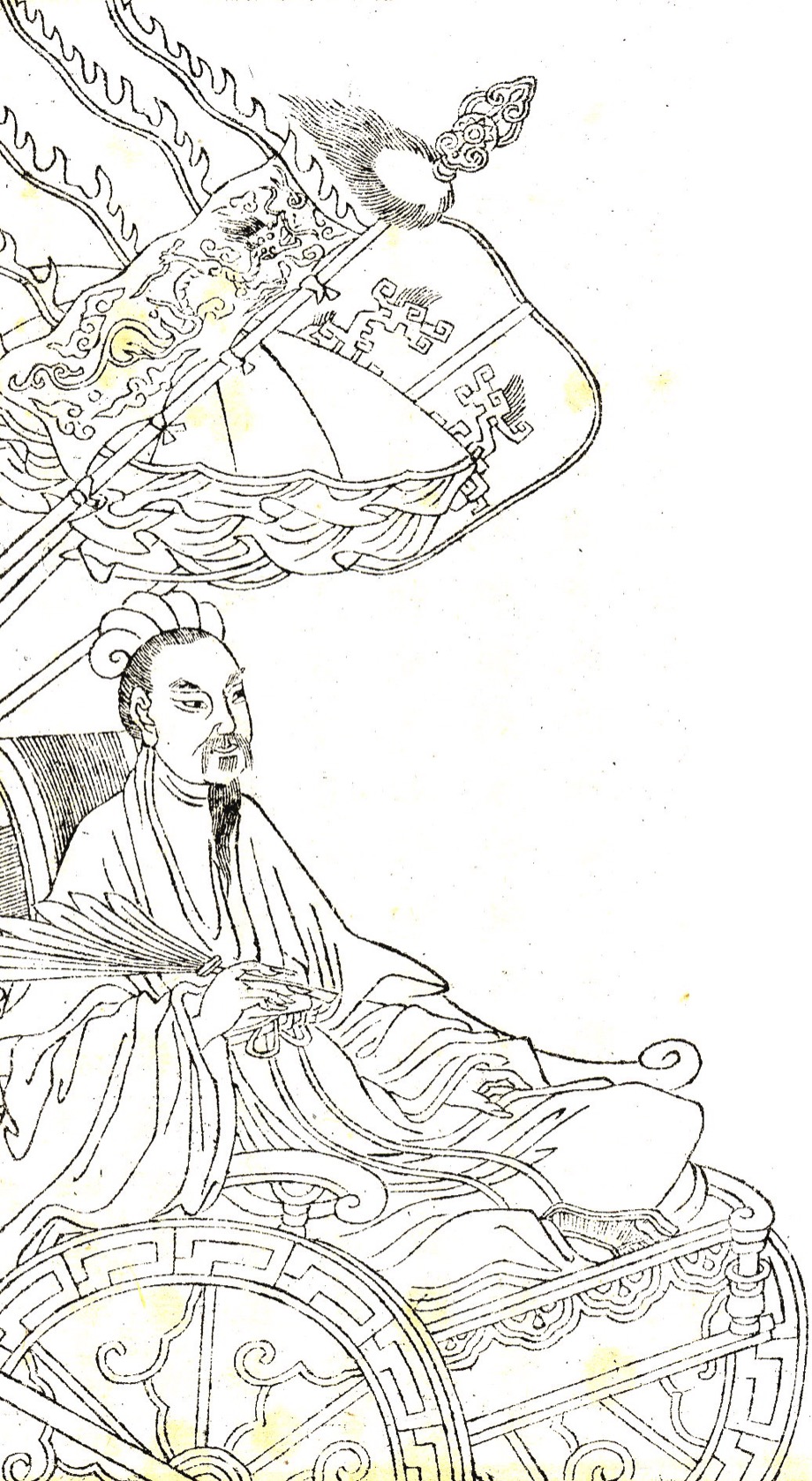
Portrait of Zhuge Liang
The Man Who Had to Be Asked Three Times
In the winter of 207 a defeated warlord rode out to a farm at Longzhong, near Xiangyang, to beg a favor from a farmer in his twenties. Liu Bei had been beaten out of every province he had ever held. The man he was calling on had no army, no office, and no reputation beyond a nickname his friends had given him — Wolong, the Sleeping Dragon. Liu Bei was turned away. He came back. He was turned away again. Only on the third visit did Zhuge Liang consent to receive him, and what he offered when he did was not a service but a map of the next twenty years.
The Longzhong Plan, as it came to be called, was one of the most audacious pieces of forecasting in Chinese history. Cao Cao held the north and could not be fought head-on; the Sun family held the Yangtze and should be allied with, not attacked; therefore Liu Bei should take Jing Province, then Yi Province in the west, hold the mountains, and wait for the north to fracture. Almost none of it existed yet. Liu Bei did not hold a single city named in the plan. Within a dozen years, most of it had happened — because the man who imagined it then spent the rest of his life dragging reality into alignment with the vision.
That is the whole architecture of Zhuge Liang: a single interior picture, formed early, held without revision, and then executed with a bureaucratic ferocity that eventually killed him. The three visits were not coyness. They were verification. He was a man who committed almost never and, having committed, could not stop.
Zhuge Liang is the purest Ni-Te engine in the Three Kingdoms — an INTJ whose dominant Introverted Intuition drew the map before the territory existed, and whose Extraverted Thinking spent twenty-seven years building the roads.
The Map Drawn Before the Territory
Dominant Introverted Intuition is not cleverness in the moment; it is the conviction that the shape of the future is already legible, and the refusal to act until that shape has resolved. Zhuge Liang's entire pre-207 life is Ni incubation. He farmed. He read. He compared himself, half-seriously, to the ancient ministers Guan Zhong and Yue Yi, and let a small circle of friends carry the comparison outward while he did nothing at all with it. Warlords were everywhere in Jing Province and hiring; he joined none of them. The vision was not yet attached to a vehicle, and Ni will sit in a thatched hut for years rather than attach it to the wrong one.
What he produced on the third visit shows why the waiting was not laziness. The Longzhong analysis is structural rather than tactical: it does not ask who can be defeated next season, it asks what the board must look like for a weak player to survive at all. Three powers, not two. A western mountain base that cannot be taken cheaply. An alliance with the Sun clan maintained as a permanent condition rather than a convenience. A year later that last clause was cashed in when Zhuge Liang went personally to the Sun court to argue the alliance that produced Red Cliffs — the battle that made the three-way split real. He was arguing for a diagram he had already drawn.
The tell of Ni, as opposed to mere planning, is what he did when the plan broke. Guan Yu lost Jing Province; Liu Bei destroyed his own army at Xiaoting avenging him; half the Longzhong Plan's premises died in five years. Zhuge Liang did not draw a new map. He kept the original objective — restore the Han, take the north — and simply accepted worse and worse odds in service of it, launching five expeditions out of a province that could not sustain them. Ni does not abandon the vision when the evidence turns; it pays more for it.
Government as a Single Man's Handwriting
After Liu Bei died at Baidicheng in 223, Zhuge Liang became chancellor to a seventeen-year-old heir with no aptitude for rule, and simply absorbed the state into himself. He standardized Shu's law code and applied it without exception to the powerful — Chen Shou's assessment is that his punishments were severe but that nobody resented them, because they were never arbitrary. He organized irrigation and agriculture in the Chengdu plain, including maintenance of the Dujiangyan works, with a permanent office and assigned labor. He drilled armies, standardized supply, and is credited with mechanical logistics work — the repeating crossbow and the "wooden ox" grain transports — aimed squarely at the one problem that decided every northern campaign: feeding troops across mountains.
Extraverted Thinking at this pitch is measurable in hours. He was famous — and criticized — for reviewing punishments of twenty strokes personally. Sima Yi, told by a Shu envoy that Zhuge Liang rose early, slept late, ate little, and handled every matter above a trivial threshold himself, drew the correct conclusion and said so: a man who works like that will not last long. The trait was not vanity. It was the Te conviction that a system is only as good as its enforcement, and that in a state as small and poor as Shu, any delegated slack was a leak the campaign could not afford.
It is worth noticing how little of this is glamorous. The novel remembers him for stratagems; the historical record remembers a chancellor who made a mountain province of roughly a million people generate the tax base, the grain, and the discipline to threaten an empire four times its size for six straight years. That is Te's real signature — not a clever ruse, but an institution that keeps producing after the clever man has gone to bed.
The Loyalty That Would Not Take the Offer
On his deathbed Liu Bei is recorded as telling Zhuge Liang that if the heir proved incapable, the chancellor should take the throne himself. Whatever the remark was — a genuine grant, a test, a piece of theater for the court — Zhuge Liang's answer settled the rest of his life. He wept, swore he would serve to the death, and then did exactly that for eleven years, ruling everything while never once taking the title, in the face of a sovereign whose incapacity was obvious to everyone including him.
Tertiary Introverted Feeling shows up in INTJs as a small, unnegotiable core of personal values that the vast Te apparatus is ultimately in service of — and Zhuge Liang wrote his down. The Chu Shi Biao, the memorial he submitted to Liu Shan before setting out north in 227, is one of the most read documents in the Chinese language precisely because it is not a strategic paper. It is a man telling a boy which officials are honest, why the previous dynasty fell, and that he himself was a commoner ploughing fields in Nanyang when the late emperor came to him three times, and has owed everything since. The register is intimate, faintly scolding, and entirely personal. Fi does not argue from consensus; it argues from a debt only the debtor can see.
That debt is also why the northern expeditions read as tragedy rather than ambition. He knew the arithmetic — Shu could not out-produce Wei, and every year of peace widened the gap. His answer was that sitting still was a slower death and a betrayal besides, and he spent his body on the only course his values permitted. He kept his estate deliberately modest, declaring to the throne that his family owned some mulberry trees and a little land and would need nothing more; when he died the inventory matched. Incorruptibility of that specificity is not policy. It is a private standard enforced against oneself.
A Body Spent, and a Wooden Effigy
Inferior Extraverted Sensing is the blind spot of the present tense: the immediate, physical, opportunistic layer that the visionary either ignores or overcorrects into. Zhuge Liang ignored it in the most literal way available — he ate almost nothing, slept badly, and worked until his health collapsed on campaign at the Wuzhang Plains in 234, dead at fifty-three with the war unfinished. The state he had built so carefully outlived him by less than thirty years, in part because no successor could carry a system designed to run through one man's hands.
The same weakness shows in the field. Wei Yan's proposal to take a small force through the Ziwu valley and seize Chang'an by surprise was exactly the kind of opportunistic gamble Se generates and Ni distrusts; Zhuge Liang refused it as too risky and kept to the methodical western route. Historians have argued the point for eighteen centuries. What is not arguable is the pattern: he consistently preferred the controlled, supply-secured advance over the sudden strike, and his campaigns failed not from disaster but from grain running out.
And yet the most famous act of his life is a piece of pure theater staged against a man he had read to the bottom. Dying, he arranged the retreat in advance; when the Shu army withdrew and Sima Yi pursued, it turned and beat its drums, and Sima Yi — who had spent years learning never to gamble against Zhuge Liang — pulled back rather than risk that the death was bait. A dead Zhuge scares off a living Zhongda, the locals said afterward, and Sima Yi reportedly laughed and agreed that he was good at predicting the living, not the dead. Even the last trick was Ni: the future modeled correctly, one move past his own death.
Why INTJ Over INTP
Why not INTP?
The recluse-scholar image invites a Ti-dominant reading, but the record refuses it. Zhuge Liang did not keep refining his theory of the war — he fixed the Longzhong Plan in 207 and then spent twenty-seven years building institutions to execute it: a law code, an irrigation regime, a standing army, a grain-transport system. Ti-dominants explore models and defer commitment; his commitment was total, public, and irreversible from the moment he accepted Liu Bei. The obsessive external ordering — reviewing minor punishments himself, auditing his own estate to the tree — is Te under pressure, not detached analysis. And the self-sacrificing loyalty to a lord he privately judged inadequate is Fi held as a vow, not Fe accommodation or Ti indifference.
The distinction matters because the popular Zhuge Liang — the fan-waving trickster of the novel, conjuring winds and borrowing arrows — is a much more Ti-flavored figure than the man Chen Shou recorded. Chen Shou's verdict was blunt: Zhuge Liang was a superlative administrator, the equal of the ancient ministers he compared himself to, and a merely competent field commander who never found the decisive battle. That is precisely the INTJ profile at scale. The vision was singular and early; the execution was systemic and grinding; the improvisation was the weakest part. He did not out-think Sima Yi so much as out-organize him, from a province that had no business fielding an army at all.
Connected Figures
Further Reading
- Records of the Three Kingdoms — Chen ShouThe primary source; its Shu chapters carry Chen Shou's famously double-edged verdict on Zhuge Liang as administrator and commander.
- Chu Shi Biao (Memorial on Setting Out for the Expedition) — Zhuge LiangHis own 227 memorial to Liu Shan — the document that fixed his reputation for loyalty in the Chinese canon.
- Fire over Luoyang: A History of the Later Han Dynasty — Rafe de CrespignyThe best modern English account of the collapse that produced Shu, Wei, and Wu.
- The Complete Art of War — Ralph D. SawyerContext on the Chinese strategic tradition Zhuge Liang inherited and worked within.
