 Historical Figure MBTI
#1156 · 8-25-26 · The Fall of the Han
Zhao Yun
The General Who Carried the Heir Out of Changban
d. 229 CE
8 min read
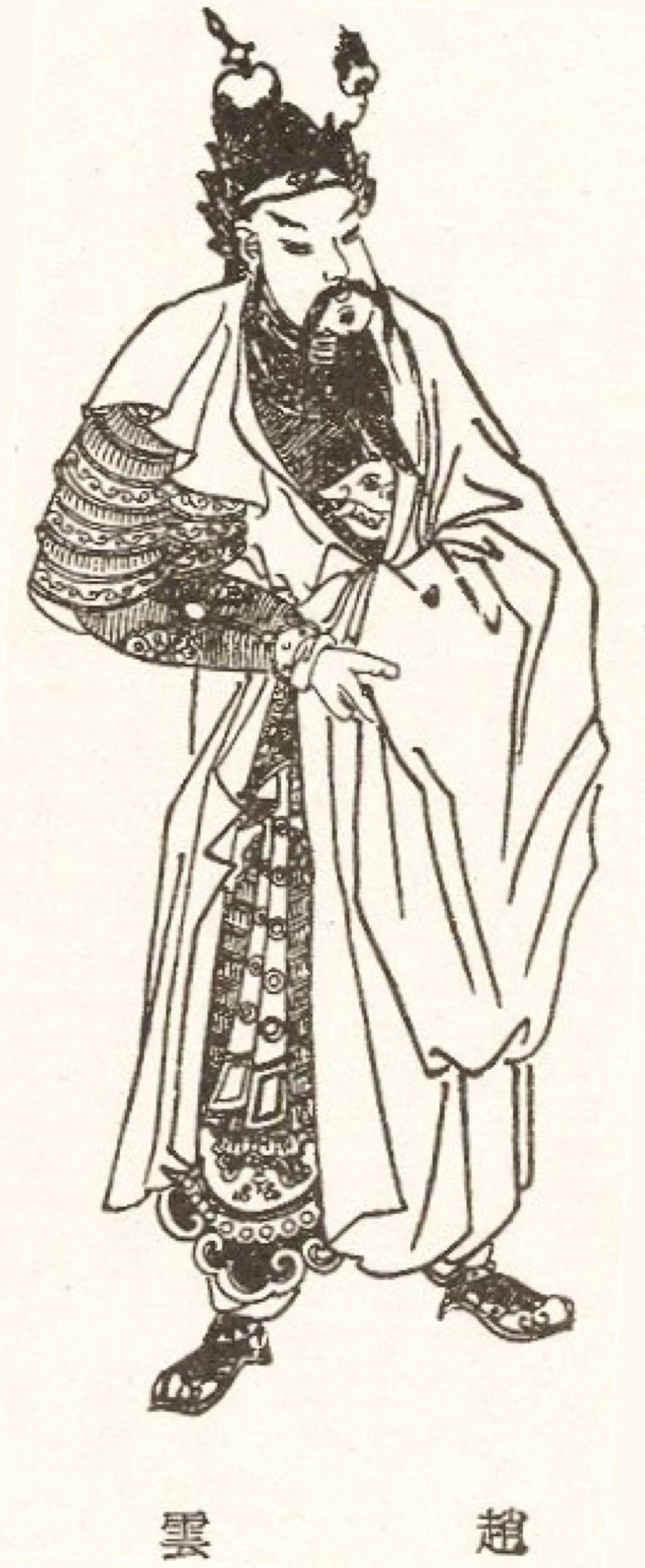
Portrait of Zhao Yun
The Man Who Rode Back
Most of what survives of Zhao Yun's life is a record of showing up. He was there under Gongsun Zan before Liu Bei had a kingdom, or an army, or much of anything but a claim and a following of the loyal and the desperate. He was there through the wandering years, the borrowed garrisons, the defeats that would have driven a more ambitious man to a better patron. And he was there at Changban in 208, when Cao Cao's cavalry caught Liu Bei's column in the open and turned an army into a stampede of refugees, soldiers, and baggage — everyone running the same direction, away.
Zhao Yun ran the other way. Somewhere in that collapsing column were Liu Bei's infant son, the future Liu Shan, and Lady Gan, one of Liu Bei's wives, both lost in the chaos with the enemy closing. Zhao Yun turned his horse back into the crowd and then into the advancing host itself, found them, and fought his way out again with the child carried against his body. It became, almost instantly, the single feat by which he would be remembered — treated by chroniclers and later by novelists as something bordering on superhuman. But read plainly, it is not a story about superhuman skill. It is a story about a man for whom the people under his protection were simply not negotiable, not even against an army.
What makes Zhao Yun's case for ISFJ more than a single dramatic episode is what came after — decades in which he never converted that legend into leverage. He didn't angle for titles his rescue had clearly earned him. And when Liu Bei, grieving Guan Yu and furious at Wu, proposed to burn the alliance and march east in revenge, Zhao Yun was one of the few men in the room willing to tell him it was a mistake — not out of defiance, but out of the same steady, protective loyalty that had sent him back into Changban. Both acts come from the same place: a mind organized around dependable care for concrete people, not around glory, precedent, or personal advancement.
Zhao Yun's life reads as a single argument for the same claim, made twice — once with a sword and once with a word: an ISFJ's dominant Si holds the mission steady no matter how the ground shifts underfoot.
The Column That Never Broke
Dominant Si shows itself less in any single decision than in what a person can be counted on to do the same way, under pressure, over and over. Zhao Yun's career is almost nothing but that pattern. He attached himself to Liu Bei early, before there was a kingdom to justify the choice, and he never wavered from it through the years of exile, borrowed territory, and repeated military disaster that would have given any purely opportunistic man cause to reconsider. Loyalty, for Zhao Yun, was not a bet on Liu Bei's eventual success — it was a commitment made once and simply kept, a fixed reference point that outside events did not get to renegotiate.
Changban is the clearest evidence of what that steadiness looks like under maximum stress. In the chaos of a routed army — no clear command, no organized retreat, enemy cavalry cutting through fleeing columns — most soldiers were making one calculation: survive, get clear, keep moving. Zhao Yun made a different one, and it was not improvised in the moment. It followed directly from a settled internal sense of duty: the infant heir and Lady Gan were his responsibility, and that responsibility did not lapse because the battle had gone catastrophically wrong. He rode back into the same disorder everyone else was fleeing because his internal compass, not the battlefield, was telling him where he needed to be.
That same Si groundedness explains his conspicuous refusal to cash in his own legend. Other generals of his caliber accumulated land, titles, and retinues; Zhao Yun by most accounts kept declining them, uncomfortable converting duty faithfully performed into personal enrichment. For a dominant-Si temperament, the value of an act lives in having done it reliably and rightly — not in what can be extracted from it afterward.
A Loyalty That Could Say No
Auxiliary Fe is what turns Zhao Yun's duty from a private code into something legibly aimed at other people's welfare — and nowhere is that clearer than in his response to Liu Bei's campaign against Wu. After Guan Yu's death, Liu Bei wanted vengeance, and most of the court either agreed or kept quiet. Zhao Yun did neither. Tradition holds he argued directly and respectfully against the war, on the grounds that Cao Wei, not Wu, remained Shu's real enemy, and that a campaign driven by personal grief would exhaust soldiers and resources for no strategic gain.
That is Fe reasoning in a fairly pure form: the argument is framed not around abstract principle or procedural correctness but around the concrete cost to the state's people — the soldiers who would fight and die, the kingdom left exposed to its actual rival. It is also, notably, an act of loyalty that risked friction with the very lord Zhao Yun had spent his life protecting. A purely obedient temperament stays silent when a request seems unwise. Zhao Yun spoke, because the value he was protecting — the wellbeing of the people under Liu Bei's rule and command — sat higher than simply agreeing with Liu Bei in the moment.
Liu Bei rejected the advice, and the resulting Yiling campaign ended in the disaster Zhao Yun had warned against — a defeat from which Shu never fully recovered. That he was proven right earned him no visible satisfaction; he served on faithfully into Zhuge Liang's later campaigns, the same steady presence, the objection folded back into ordinary duty rather than nursed as grievance.
The Quiet Calculation Underneath
Tertiary Ti in Zhao Yun shows up not as theorizing but as a private, internally consistent logic that surfaces only when he judges it necessary — most visibly in the Wu campaign objection. His argument wasn't a gut protest against violence or an emotional plea for peace; it was a coherent strategic case, structured around who the real threat was and what resources a war of vengeance would burn. He had clearly worked the logic through on his own terms before he ever brought it to Liu Bei.
The same understated analytical streak is visible in how he fought. Accounts of Changban describe a rescue that was frantic in circumstance but not in execution — a soldier reading the shifting shape of a collapsing battlefield accurately enough to find two specific people in it and calculate a path back out. That is Ti operating in service of Si and Fe rather than for its own sake: reasoning used quietly, as a tool to protect what he had already decided mattered, never displayed or argued for its own satisfaction.
What He Never Reached For
Inferior Ne explains the shape of Zhao Yun's absence from the record as much as his presence in it. He is not remembered for grand strategic gambits, unexpected alliances, or reimagining Shu's position in the wider contest among the three kingdoms — the kind of speculative, possibility-generating thinking that drove figures like Zhuge Liang. His one recorded venture into that register, the argument against the Wu campaign, was reactive rather than visionary: a course correction pointing back toward the plan already in motion, not a new one of his own devising.
He also never used his single most legendary moment to open new doors for himself — no bid for a larger command, no attempt to parlay Changban into political standing beyond what steady service already brought him. For an ISFJ, that unclaimed possibility is not a failure of ambition so much as simple disinterest: the alternatives Ne might have generated held little pull next to the plain, familiar, already-proven value of doing the job in front of him.
Why ISFJ Over ISTJ
Why not ISTJ?
An ISTJ reading of Zhao Yun would emphasize rigid procedural duty — a soldier following orders and precedent above all else. But his defining act is not procedural; it is deeply personal. He rides back into a routed army to save a specific child and a specific woman, not to uphold a rule about protecting the baggage train. His objection to the Wu campaign is likewise framed around care for the state's soldiers and people, not around a point of principle, precedent, or protocol. That warmth aimed outward at people, running underneath a quiet and steady exterior, is Fe auxiliary — not the more impersonal, structure-first Te an ISTJ would show in the same position.
The distinction matters because it is exactly what makes Zhao Yun's two signature acts cohere as one personality rather than two unrelated anecdotes. A rescue and a piece of unwelcome strategic advice look, on the surface, like different registers of behavior — one physical and urgent, one verbal and political. Read through Si-Fe, they are the same act twice: a steady, internalized sense of who depends on him, expressed once with a sword and once with a sentence Liu Bei did not want to hear.
Connected Figures
Further Reading
- A Biographical Dictionary of the Later Han to the Three Kingdoms — Rafe de CrespignyThe standard scholarly reference entry on Zhao Yun's career and campaigns.
- Sanguozhi (Records of the Three Kingdoms), Book of Shu — Chen ShouThe primary source biography underlying every later account of his life.
- Three Kingdoms — Moss Roberts (trans.)The classic novel that built the enduring legend of the Changban rescue.
