 Historical Figure MBTI
5 min read
#67 · 2-23-26 · The Civil Rights Movement
Malcolm X
The Reconstructor
1925 — 1965
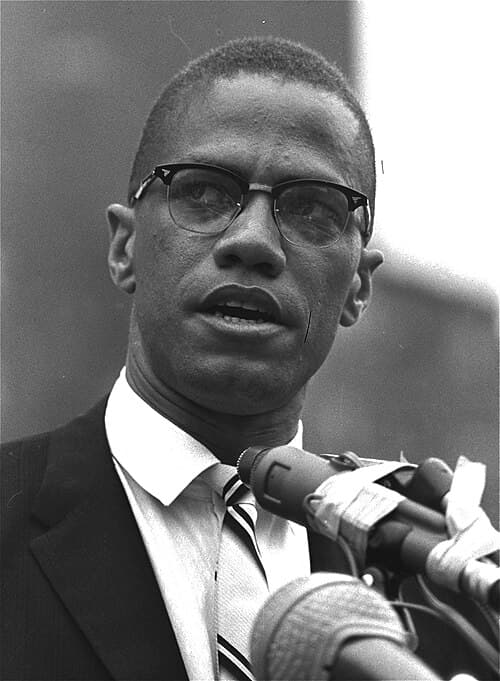
Historical Portrait of Malcolm X.
The Reconstructor
Born Malcolm Little in 1925, Malcolm X did not inherit stability; he inherited fracture. His father was killed under suspicious circumstances after repeated threats from white supremacists. His mother was institutionalized. His family was dismantled. By adolescence, he had learned that the system was not neutral — it was constructed.
Prison was his turning point. There, he educated himself obsessively — copying the dictionary word for word, devouring history, religion, philosophy. He rebuilt his vocabulary as he rebuilt his identity. Malcolm Little became Malcolm X, rejecting the surname he saw as a vestige of slavery. From that point forward, his life was defined by model-building and model-revision. Often mistaken for an ENFJ due to his commanding presence or for an ENTJ due to his rhetorical force, Malcolm's cognition reveals dominant Introverted Intuition (Ni) supported by Extraverted Thinking (Te) — the signature of INTJ. He did not lead by emotional synchronization. He led by ideological architecture.
He did not adjust to the room. He defined the frame.
Ni — Dominant
Malcolm consistently interpreted events as part of larger systemic patterns. He did not speak in isolated grievances; he spoke in structural analysis. Colonialism, slavery, racism, geopolitics — he synthesized them into a unified worldview.
Even his break from the Nation of Islam reflects Ni recalibration. Upon discovering corruption within its leadership, he did not preserve status or social harmony. He restructured his entire ideological framework. After pilgrimage to Mecca, his worldview expanded beyond racial absolutism into global human rights discourse. This was not emotional softening; it was model revision. Ni does not cling to ideology for comfort. It updates when the framework no longer fits reality. Malcolm updated.
Te — Auxiliary
His speaking style was surgical. He dismantled arguments step by step. He defined terms, exposed hypocrisy, and constructed counter-logic with precision. His rhetoric did not rely on soaring metaphor but on structural confrontation.
"By any means necessary" was not emotional provocation; it was strategic language. Malcolm understood power structures and believed autonomy required leverage. His advocacy emphasized discipline, economic independence, and institutional self-determination. He built organizations, reoriented platforms, and reframed Black struggle from civil rights to human rights. He moved from national rhetoric to international strategy, considering United Nations intervention and global alliances. This is strategic expansion, not social attunement. Te executes the vision Ni conceives.
Fi — Tertiary
Though externally firm, Malcolm's core was deeply principled. His break from the Nation of Islam was not pragmatic convenience; it was moral refusal. He could not maintain allegiance to a structure he deemed internally corrupt.
Fi appears in his unwavering sense of personal integrity and identity reclamation. He did not seek validation from dominant culture. He sought self-definition. His loyalty to his family was similarly principled and protective. In private life, he was described as gentle with his daughters, serious but affectionate, protective rather than domineering.
Se — Inferior
Malcolm's life was lived under threat — surveillance, violence, constant danger. Yet his decisions were rarely impulsive. He did not lash out physically; he articulated position.
Under stress, his rhetoric sharpened rather than scattered. Inferior Se in INTJs often manifests as heightened awareness of physical risk without recklessness. He knew he might be killed. He continued anyway. He did not chase sensation. He endured it.
Why Not ENTJ or ESTP?
Why not ENTJ?
Malcolm possessed the strategic force of a Te-user, but his primary orientation was decidedly internal. Unlike the typically more expansive and externally driven ENTJ, Malcolm's intimate accounts consistently reveal a man who was deeply introverted, preferring the quiet company of books and reflection over the performance of leadership. He moved inward to synthesize his vision (Ni) before projecting it. His evolution — marked by significant periods of isolation and self-directed education — reflects the INTJ's reliance on internal models rather than external social structures for validation. This is Ni–Te restructuring, not Te-led expansion.
Why not ESTP?
His early life as "Detroit Red" carried the kinetic energy of Extraverted Sensing, leading some to mistakenly view him as a purely sensory, opportunistic figure. However, the transition from Detroit Red to Malcolm X was characterized by an absolute rejection of sensory impulsivity in favor of structural ideological discipline. Where an ESTP finds life in the immediate flux of the environment, Malcolm found his purpose in the absolute, unchanging patterns of systemic analysis. His mature self was defined by the suppression of Se in service of a singular, all-encompassing vision (Ni).
The Dynamic with Betty Shabazz
His marriage to Betty Shabazz reveals a stabilizing counterbalance. Where Malcolm reconstructed ideology, Betty embodied moral steadiness. Their partnership was not built on theatrical charisma but on shared seriousness and disciplined conviction.
He was the sharpened blade. She was the enduring core. Malcolm X did not merely protest injustice. He deconstructed it — and rebuilt the framework through which it was understood.
Connected Figures
Further Reading
- The Autobiography of Malcolm X — Malcolm X with Alex HaleyThe foundational text — dictated in the final years of his life, it is at once memoir, political manifesto, and spiritual testament.
- Malcolm X: A Life of Reinvention — Manning MarableThe definitive modern biography; Marable draws on newly released FBI files and corrects several myths solidified by the Autobiography.
- By Any Means Necessary — Malcolm XSpeeches from the final year of his life, revealing his turn toward global human rights and away from racial separatism.
- The Death and Life of Malcolm X — Peter GoldmanA journalist's close account of Malcolm's last chapter — the break from the Nation, the founding of the OAAU, and the assassination.
