 Historical Figure MBTI
4 min read
#117 · 3-14-26 · The Founding Generation of USA
Martha Wayles Skelton Jefferson
Planter's Daughter · Musician · Emotional Center of Monticello
1748 — 1782
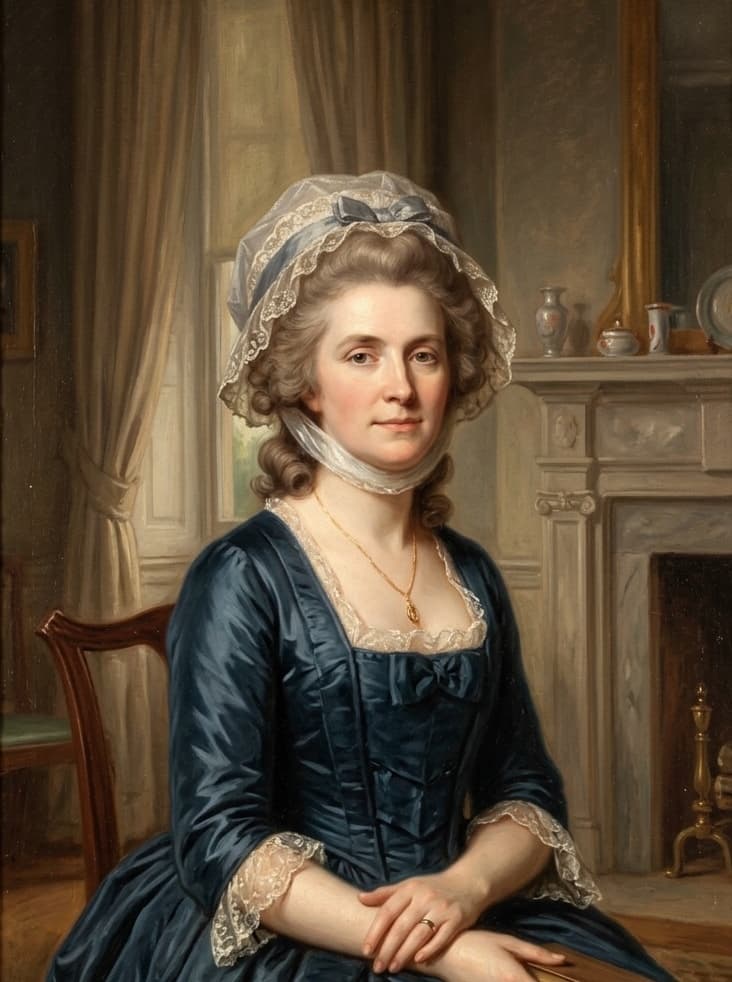
AI-Assisted Portrait of Martha Wayles Skelton Jefferson
The Quiet Heart of Monticello
Martha Wayles Skelton Jefferson doesn't arrive in history with declarations or philosophies. She arrives through presence — through music, through intimacy, through the subtle shaping of emotional space.
Born into a wealthy Virginia family, she was well-educated for her time, especially in the arts. She played the harpsichord, sang, and shared a deep musical bond with Thomas Jefferson. Their relationship wasn't built on debate or ideology — it was built on shared feeling.
She also came to Jefferson already knowing grief. Before him, she had been married to Bathurst Skelton, who died young. Her infant son from that marriage died too. She wasn't a sheltered woman encountering the world for the first time — she was someone who had already learned what loss costs, and chosen to love again anyway.
That distinction matters.
That's the ISFP in her — where Jefferson lived in abstraction, Martha lived in experience.
Love as Inner Truth
Martha's defining trait feels like introverted feeling (Fi) — a deeply personal, internal compass for love, loyalty, and meaning.
We see this most clearly in one moment: she asked Jefferson, on her deathbed, to never remarry.
That is not a social expectation. That is a personal value, expressed with quiet intensity.
Fi doesn't ask, what is expected? It asks, what feels true to me, even if it's irrational to others?
And Jefferson kept that promise for the rest of his life.
That kind of emotional imprint doesn't come from loudness. It comes from depth.
Living Through the Senses
Martha wasn't a public intellectual. She didn't write treatises or lead movements.
But she was vividly alive in the sensory world.
Music wasn't a hobby — it was a shared language between her and Jefferson. Imagine evenings at Monticello, the two of them playing duets, not to perform, but simply to feel something together.
That's extraverted sensing (Se) in its softer form: attunement to beauty, presence in the moment, emotional expression through physical mediums — sound, touch, atmosphere.
ISFPs don't always leave behind written legacies. They leave behind felt ones.
Quiet Devotion, Long Shadow
There's also a subtle thread of introverted intuition (Ni) — not as dominant vision, but as emotional foresight.
Her request that Jefferson never remarry carries a kind of future-awareness. Not strategic, not calculated — but deeply intuitive. A sense of what their bond meant, and how she wanted it preserved beyond her life.
It's not about control. It's about meaning lasting beyond presence.
A Life of Fragility and Intensity
Martha's life was marked by physical strain and loss. She bore six children, with only a few surviving to adulthood. Her health declined over time, and she died young, at 33.
But here's the thing about ISFPs: they don't always live long, loud lives. They live intense, meaningful ones, often concentrated into a smaller window.
Martha wasn't trying to shape the world. She was trying to love deeply within it.
Sally Hemings — The Half-Sister She Never Knew
There is a detail in Martha's story that history has been slow to confront: when her father John Wayles died in 1773, Martha inherited his estate. Among those she inherited was Betty Hemings — an enslaved woman with whom Wayles had fathered several children. One of them was Sally Hemings.
Sally was Martha's half-sister. They likely shared the same house. Sally was a child when Martha died; she was perhaps six years old when Jefferson sat at Martha's deathbed and made his promise never to remarry.
The relationship between Jefferson and Sally Hemings, which began years later, carries this shadow. Whatever it meant to Jefferson — comfort, contradiction, or something he never fully examined — it was bound up with the woman he had lost, through a connection Martha herself may not have fully understood.
An ISFP lives in the felt present. Martha could not have anticipated this. But the threads of her life extended further than she knew.
Why ISFP Over ISFJ
Why not ISFJ?
ISFJs are often defined by duty, structure, and social roles. While Martha fulfilled her role, what stands out isn't obligation — it's personal emotional depth. Her defining moments feel internally driven, not socially conditioned.
The difference is where the compass points. An ISFJ acts from a sense of what is owed — to family, to tradition, to the group. Martha acted from what she felt was true. That private, immovable sense of inner value is the mark of Fi, not Fe. She wasn't performing devotion. She was living it.
Connected Figures
Further Reading
- The Hemingses of Monticello: An American Family — Annette Gordon-ReedPulitzer Prize-winning history of the Hemings family, tracing the bonds that ran through Martha's inheritance.
- Thomas Jefferson: An Intimate History — Fawn M. BrodieA psychological portrait of Jefferson that gives Martha's influence substantial attention.
- Jefferson's Women — John B. BolesExamines the women in Jefferson's life, including Martha Wayles Skelton, with close attention to the household at Monticello.
