 Historical Figure MBTI
#273 · 3-25-26 · Catherinian Russia
Nikolai Zubov
Count · General · Conspirator · Suvorov's Son-in-Law
1763 — 1805
6 min read
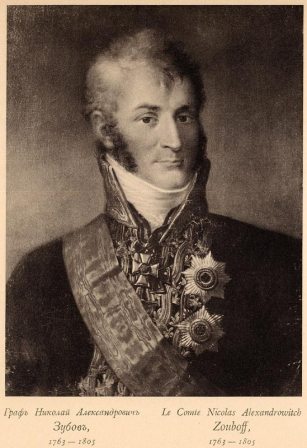
Portrait of Nikolai Zubov
The Colossus Who Struck the Tsar
They called him the Colossus. At six feet six inches — freakish in eighteenth-century Russia — Nikolai Alexandrovich Zubov moved through Catherine's court like a force of nature: physically overwhelming, socially magnetic, and possessed of a temper that could snap without warning. He rose through the Horse Guards by sheer physical presence before his younger brother Platon caught the Empress's eye and elevated the entire Zubov family into the inner circle of imperial favor.
Nikolai married Natalia Suvorova — the beloved only daughter of Field Marshal Alexander Suvorov — binding two of Russia's most formidable surnames. And on the night of March 11, 1801, he walked into the bedchamber of Tsar Paul I with a group of conspirators and struck the blow that would define him forever. Accounts differ on the precise details, but Nikolai was among the first to act, and Paul I did not survive the night.
Nikolai Zubov was an ESTP — the tactician who acts first and rationalizes afterward, at home in the physical world, lethal in a crisis, and constitutionally unable to plan for what comes next.
Se — The Body as Instrument
Dominant Extraverted Sensing makes a person immediately present in the physical world — alive to opportunity, most fully themselves when moving through space and acting on it. In Nikolai Zubov, this showed in his physique and his relationship to it. His height was not merely a fact about him; it was his primary instrument. He understood, instinctively, that a man who fills a doorframe does not need to argue. His gigantic stature, his physical strength, and his explosive temper taken together constitute a man who experiences the world as something to dominate through the body rather than the mind.
On the night of Paul I's assassination, Se was the function that moved him through the threshold of no-return. Conspiracies planned in drawing rooms have a way of dissolving when confronted with the actual body of a tsar in his bedroom. The Se-dominant acts. Nikolai was among the first. The world presented a situation, and he responded — not coldly, not strategically, but with the immediacy that was simply native to him.
Ti — The Tactician's Cold Accounting
Auxiliary Introverted Thinking is the ESTP's analytical complement — detached, map-making, attuned to leverage points. In Nikolai Zubov it appeared as political shrewdness beneath the brute-force exterior. He was not simply a thug elevated by his brother's luck. He had maneuvered within the Army with enough tactical skill to accumulate genuine rank and genuine enemies, which are often the same achievement measured from different angles.
His role in the conspiracy against Paul I required more than nerve. Count Pahlen, the mastermind, chose co-conspirators who could assess who was trustworthy, where the emperor was vulnerable, and how court power would rebalance after the act. Nikolai was chosen not merely for his willingness to be violent but for his ability to think through the structure of what they were attempting — and for his existing relationships with the parties who would need managing afterward.
Fe — Charm as Currency
Tertiary Extraverted Feeling in the ESTP is a social lubricant — present, sometimes genuinely warm, but always subordinate to sensation and tactical thinking. Nikolai Zubov was not without charm; Catherine's court demanded the ability to read a room and perform within it. But his Fe was instrumental rather than empathetic — a tool for building alliances and smoothing over the considerable friction his temper regularly generated. The conspiracy of 1801 was, among other things, an act of collective trust, and Nikolai's tertiary Fe was the part of him that could hold that trust long enough to see it through.
Ni — The Blind Spot After the Act
Inferior Introverted Intuition is the ESTP's great weakness — long-horizon vision that never develops easily in a type whose energies flow outward and into the immediate. For Nikolai Zubov, this showed in what came after Paul I's murder. The night of March 11, 1801 was tactically successful. But Alexander I, who had understood the conspiracy would take place, found himself unable to honor his implied debts to those who had made it happen — openly rewarding his father's murderers would have been politically untenable.
The conspirators were quietly sidelined. Nikolai Zubov died in 1805, only four years after the assassination — in relative disfavor, his fortunes diminished, his political influence spent. He had executed the act with precision and nerve. He had not thought clearly about what world he was building on the other side of it. The Colossus could fill a room and dominate a crisis. He could not see around corners.
Why ESTP Over ISTP
Why not ISTP?
The ISTP shares the Se–Ti axis but inverts the orientation: introverted first, physical second, socially reserved throughout. An ISTP would not have courted the visibility Nikolai cultivated — the conspicuous rise through court, the Zubov-Suvorov alliance, the willingness to be seen as a power broker. The ISTP's violence tends toward the quiet and the precise; Nikolai's was theatrical, impulsive, and tied to a physical presence that craved recognition. His temper needed a room to explode in. That is not the ISTP way.
Where the ISTP retreats into craft and self-sufficiency, the ESTP moves toward the crowd and the conflict. Nikolai Zubov needed the stage of Catherine's court — enormous, dangerous, and visible. His intelligence was real, but always in service of the body's ambitions rather than the mind's. ESTP.
Connected Figures
Further Reading
- Russia in the Age of Catherine the Great — Isabel de MadariagaThe authoritative account of Catherine's reign — the court culture, favorites, and factions that made the Zubovs possible.
- Catherine the Great: Life and Legend — John T. AlexanderA close biography that illuminates the inner circle of Catherine's final years and the political vacuum her death created.
- Suvorov — Philip LongworthThe standard English-language biography of Alexander Suvorov — Nikolai's father-in-law and the military colossus whose name Nikolai claimed by marriage.
