 Historical Figure MBTI
#986 · 7-20-26 · The Pacific War
Pappy Boyington
Fighter Ace · Black Sheep Squadron · Flamboyant Survivor
1912 — 1988
4 min read
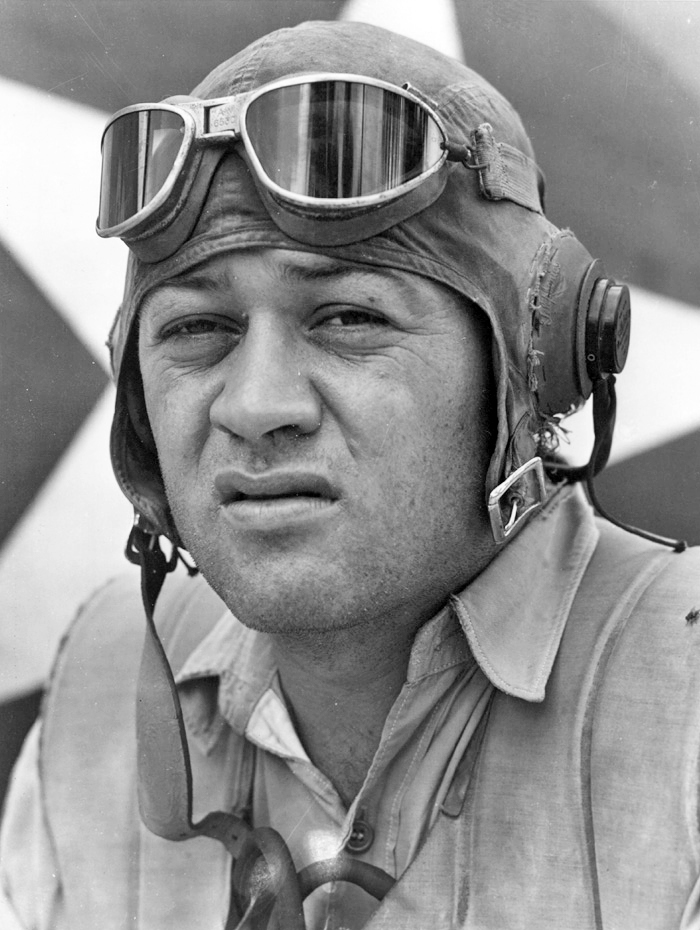
Portrait of Pappy Boyington
The Black Sheep's Ringleader
Gregory "Pappy" Boyington was, by his own cheerful admission, a difficult man to command. He drank too much, argued with superiors, and had already washed out of one assignment before he talked his way into leading a scratch squadron of misfits, rejects, and replacement pilots in the South Pacific — the "Black Sheep" of VMF-214. Under his loose, unmilitary discipline the squadron became one of the most successful fighter units of the war, and Boyington himself one of its highest-scoring aces, before he was shot down over Rabaul in January 1944 and spent the rest of the war as a Japanese prisoner.
He survived captivity, came home, and turned the whole story into "Baa Baa Black Sheep," a colorful, self-mythologizing memoir that later became a television show bearing his name. Nothing about Boyington's life reads as understated. He wanted the kills, wanted the reputation, and was perfectly happy to say so.
Boyington was ESFP through and through — a man whose dominant Se turned aerial combat into a stage he refused to leave.
Living for the Dogfight
Extraverted sensing made Boyington a natural in the cockpit and a liability nearly everywhere else. In the air he was fearless and immediate, diving into outnumbered engagements and racking up kills through sheer aggressive presence rather than cautious calculation. On the ground that same appetite for the vivid and the physical drove the drinking and rule-breaking that got him grounded more than once before the war even began.
He thrived entirely in the present moment of combat — the exact opposite of a man planning three moves ahead — and it was that same present-tense hunger that made captivity, with its enforced stillness, such a brutal ordeal for him.
Pride, Grievance, and Personal Glory
Boyington's auxiliary Fi is the engine behind his flamboyance. His memoir and his public persona were driven by intensely personal motivations — pride in his own record, resentment toward superiors he felt had wronged him, and a rebellious refusal to let anyone else define his worth. He kept score obsessively, both in kills and in grudges, and his postwar self-mythologizing was less calculated image management than an unfiltered expression of how he actually felt about his own story.
That personal, emotionally charged self-narration — glory and grievance both worn openly — is what gives his memoir its distinctive, unguarded voice, and it is squarely a feeling function turned toward his own experience rather than a cool tactical read of what would play well publicly.
Running a Squadron on Instinct, Not System
Boyington's tertiary Te appears in the practical, if unconventional, way he actually ran VMF-214 — assembling scattered replacement pilots into an effective unit and getting real results out of men nobody else wanted. But it was applied loosely and personally rather than through rigorous system; he led by presence and reputation more than procedure, and the squadron's discipline was famously relaxed even as its combat record was outstanding.
No Interest in the Long Game
Where Boyington's type struggled was with anything requiring patient, long-range self-management. His inferior Ni left him prone to repeating the same self-destructive patterns — drinking, conflict with authority, financial trouble — well after the war that made him famous had ended, unable to translate his wartime instincts into a stable, forward-looking postwar life.
Why ESFP Over ISFP
Why not ISFP?
An ISFP would share Boyington's Se-Fi core but turn it inward — quiet, personal, uninterested in an audience. Boyington instead narrated his own legend loudly and publicly, needing the crowd to witness his pride and his grievances both. That extraverted hunger for attention and stage — not just the physical daring itself — is what makes him an ESFP rather than his introverted cousin.
Boyington over ISFP comes down to volume. Both share the same inward values and love of the physical moment; only the ESFP needs an audience for it, telling and re-telling his own story until it became a television show.
Connected Figures
Further Reading
- Baa Baa Black Sheep — Gregory "Pappy" BoyingtonBoyington's own colorful, self-mythologizing memoir, the basis for the later television series.
- The Black Sheep: The Definitive Oral History of Marine Fighting Squadron 214 in World War II — Bruce GambleA more sourced, corrective account drawing on squadron members' own testimony.
- Black Sheep One: The Life of Gregory "Pappy" Boyington — Bruce GambleA full biography that separates Boyington's legend from the documented record.
