 Historical Figure MBTI
4 min read
#201 · 3-20-26 · Ancient Athens
Persaeus
The Realist in the King's Court
c. 306 – 243 BCE
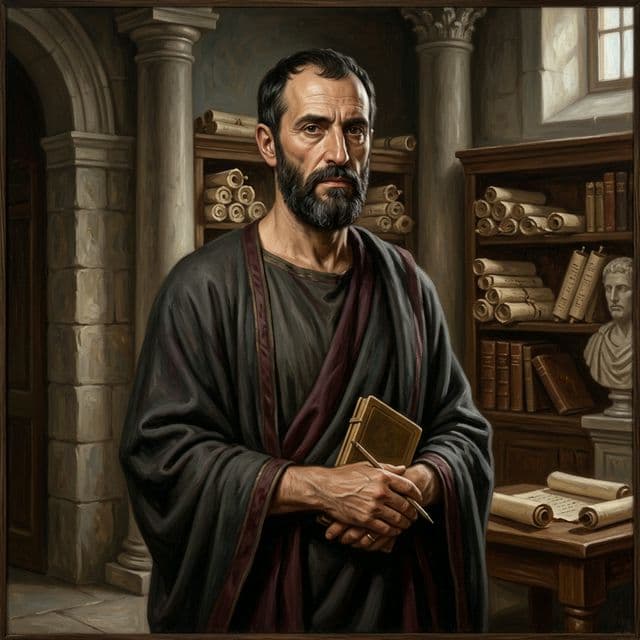
AI-assisted portrait of Persaeus
The Architecture of Administration
Persaeus did not seek philosophical abstraction; he sought the effective application of Stoicism to the structures of power. As the favorite student of Zeno, he was sent to the court of Antigonus II Gonatas to serve as a tutor and advisor. His journey was one of translating the ideals of the porch into the realities of the palace.
He operated with a focus on institutional order and the practical management of the state. His personality was oriented toward the concrete and the established, using his intellectual background to provide stable, objective guidance to a king navigating the complexities of Hellenistic politics.
Historical Context
Originally a slave of Zeno of Cittium, Persaeus was manumitted and became one of the leading figures of the early Stoic school. He lived in Pella at the Macedonian court, serving as the tutor to Antigonus’s son and later as the governor of Corinth. His military and administrative service to Macedon placed him at the center of the struggle for control of Greece, where he eventually died during the capture of Acrocorinth by Aratus of Sicyon.
The Psychological Verdict
Persaeus reads most clearly as ESTJ. He was a man driven by order, practical execution (Te), and the maintenance of established systems (Si), using his Stoic training to provide a reliable, objective framework for governance.
Te — Dominant
Persaeus’s primary mode was the organization of the external world. Whether as a court advisor or a governor, he focused on results, hierarchy, and the efficient operation of the system. He saw philosophy not as a private meditation, but as a public tool for the effective management of the state and the king’s household.
Si — Auxiliary
His orientation was toward the established and the reliable. He valued the traditions of the Stoic school and the structures of the Macedonian state. Auxiliary Si provided the sense of duty and the respect for precedent that made him a trusted proxy for Antigonus in some of the most critical military and administrative roles.
Ne — Tertiary
Despite his focus on order, he was capable of navigating the shifting possibilities of Hellenistic diplomacy. Tertiary Ne allowed him to see potential moves on the political chessboard, though he always anchored these insights in the practical realities of the here and now.
Fi — Inferior
Persaeus’s personal internal values were often subordinated to the demands of the state and his philosophical duties. His inferior Fi manifested in his absolute, almost self-sacrificial loyalty to the king and his teachings, prioritizing objective role and institutional survival over subjective personal expression.
The Stoic Who Governed
Persaeus was a student of Zeno of Citium — the founder of Stoicism — and one of several philosophers Zeno sent to advise Macedonian rulers. He ended up in the service of Antigonus II Gonatas, grandson of Antigonus the One-Eyed, as a trusted counselor and eventually governor of the Acrocorinth. He is a useful corrective to the image of the Hellenistic philosopher as a figure entirely detached from power: Persaeus took political appointments, governed a strategic citadel, and died in its defense. Stoicism in its early form was not a philosophy of withdrawal — that was Epicurus’s project. Stoicism was the philosophy of the person who acts in the world while remaining internally unmoved by it. Persaeus tested that proposition in practice, in a fortress, at the point of a sword. The evidence suggests he believed it.
Not the one who sat on the porch. But the one who carried the porch into the palace.
Connected Figures
Further Reading
- Hellenistic Philosophy: Stoics, Epicureans, Sceptics — A. A. LongThe standard scholarly introduction to the Hellenistic schools; covers the early Stoics including Persaeus's generation.
- The Stoics — F. H. SandbachA concise survey of Stoic philosophy from Zeno through the late period, placing court-philosophers like Persaeus in context.
- The Hellenistic Age: A History — Peter GreenBroad cultural and political history of the Macedonian successor kingdoms, including the Antigonid court Persaeus served.
