 Historical Figure MBTI
#896 · 6-30-26 · The American Civil War
Peter Doyle
Streetcar Conductor · Whitman's Companion
1843 — 1907
3 min read
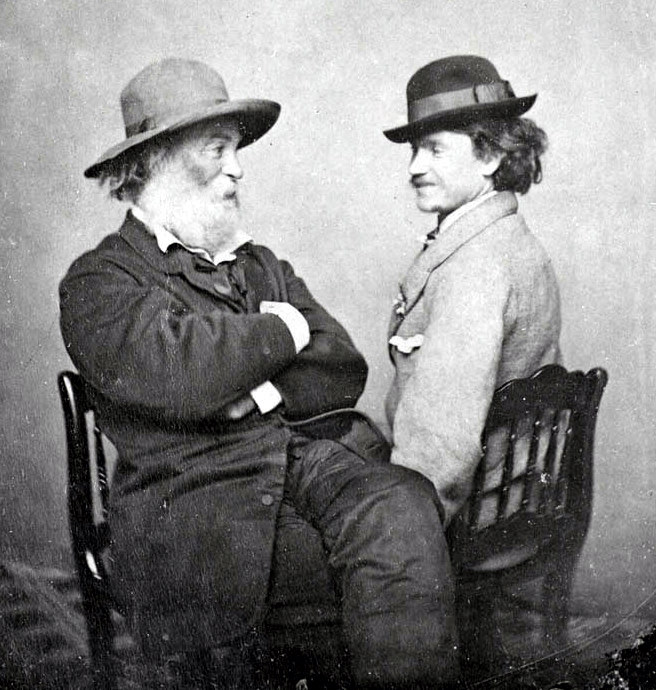
Portrait of Peter Doyle
The Conductor on the Washington Line
He was twenty-one when they met — a paroled Confederate boy, Irish-born, working the streetcars of a capital that had just finished burying its dead. Walt Whitman was in his mid-forties, already the self-declared poet of a continent, and by his own account it was the simplest kind of meeting: a stormy night, an empty car, a hand on a shoulder. "We understood each other in a moment," Whitman remembered decades later. Peter Doyle did not write poems. He did not, in any way biographers can trace, try to. What he did was stay — through fifteen-odd years of a friendship that ran alongside Whitman's most famous work, through the Calamus letters, through a stroke and the long Camden decline, into an old age spent giving interviews about a man the rest of the world was busy turning into a monument.
That asymmetry is the whole story, psychologically speaking. Whitman theorized their bond in verse and correspondence dense with cosmic ambition; Doyle simply lived it, in rooms, on shifts, over drinks, at a bedside. His late reminiscences — plain, unadorned, oddly moving — read less like testimony to greatness than like a man describing his friend. That is not a smaller kind of devotion. It may be the more honest one.
Doyle's gift was presence without performance — an ISFP's fidelity to what is actually in front of him, held for a lifetime against a poet's gift for turning everything, even love, into myth.
Psychological Verdict
Doyle typifies the ISFP with unusual clarity precisely because he left so little behind to complicate the picture. Introverted Feeling shows in the sheer privacy of his devotion — he never published, never theorized, never seemed to need the relationship explained or justified to anyone, least of all to history. What he offered Whitman was not an intellectual companionship; the two men's letters make no pretense of that. It was something more immediate — auxiliary Extraverted Sensing, the capacious present-tense attention of a man who was, by every account, simply good to be around: warm, physical, at ease with a hand on a knee or an arm around a shoulder, unbothered by the age and station and (eventually) fame that separated them.
Even his later usefulness to Whitman scholarship falls out of type. Doyle became, without trying, one of the richest primary sources on the poet's private life — not because he set out to record anything, but because when biographers finally came asking, he simply told them what he remembered, plainly, in the ordinary textures of a shared life rather than the mythologized ones Whitman had already spun for public consumption. Where the poet built a persona, Doyle offered a memory. That contrast — one man narrating his own legend, the other quietly confirming it happened — is as clean a study in Fi-Se versus a dominant intuitive's self-mythology as the archive holds.
Connected Figures
Further Reading
- Calamus: A Series of Letters Written During the Years 1868–1880 by Walt Whitman to a Young Friend (Peter Doyle) — Ed. Richard Maurice BuckeThe primary published correspondence between the two men.
- Walt Whitman's America: A Cultural Biography — David S. Reynolds1995 — situates the Doyle relationship within Whitman's broader life and milieu.
- "Peter Doyle" — Michael Lynch, Walt Whitman Quarterly ReviewScholarly entries assembling Doyle's biography and later reminiscences.
