 Historical Figure MBTI
4 min read
#196 · 3-20-26 · Ancient Athens
Phaedo
The Witness to the Soul's Immortality
c. 417 – 4th Century BCE
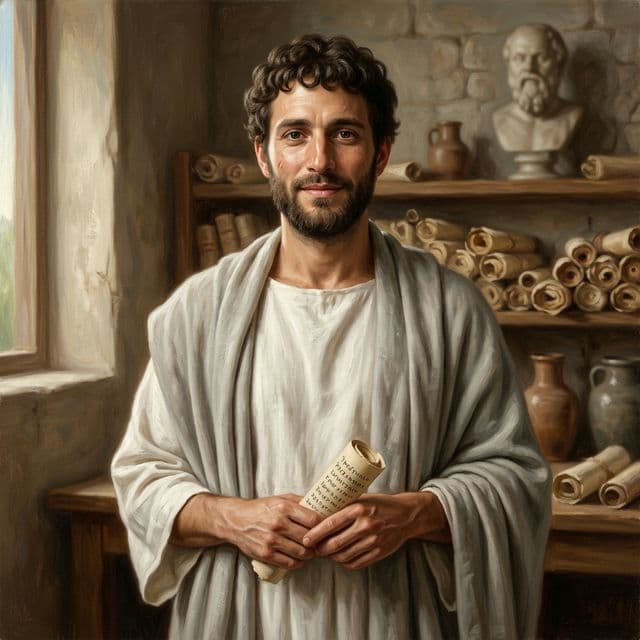
AI-assisted portrait of Phaedo
The Architecture of Transformation
Phaedo did not merely survive his trauma; he transmuted it into philosophy. Once a noble son of Elis who was enslaved and forced into prostitution in Athens, he was liberated by Socrates and became one of his most beloved students. His journey was a profound arc from the most visceral degradation to the height of intellectual and spiritual inquiry.
He lived as a bridge between the broken and the eternal, using his personal experience of suffering to anchor his search for the immutable soul. His personality was a crucible where the pain of the past was refined into the clarity of a vision that sought to understand what remains when everything else is stripped away.
Historical Context
Phaedo of Elis reached prominence as a member of the Socratic circle, famously serving as the primary narrator and namesake of Plato's dialogue on the death of Socrates. After Socrates’ execution, Phaedo returned to Elis and founded the Elian school of philosophy, which focused on ethics and the nature of the Good. His life represents the transformative power of Socratic presence during the turbulent end of the Athenian Golden Age.
The Psychological Verdict
Phaedo reads most clearly as INFJ. He was a figure of quiet depth and symbolic insight (Ni), dedicated to the collective moral growth of his community and the preservation of his mentor's legacy (Fe).
Ni — Dominant
Phaedo’s primary mode was the pursuit of the absolute. His interest lay in the unchanging truths that exist beyond the physical realm, a focus that allowed him to rise above his earlier physical enslavement. He saw the world as a secondary reflection of a higher, spiritual order, using his internal vision to find meaning in his own suffering.
Fe — Auxiliary
His dedication to his school and his role as a narrator in Plato's works show a strong auxiliary Fe. He was committed to sharing the Socratic vision and to building a philosophical community that could sustain the values of his mentor. He understood his own life's value through its service to the collective understanding of the Good.
Ti — Tertiary
Beneath his spiritual orientation lay a sharp, refining logic. His philosophical work at the Elian school involved the rigorous analysis of ethical concepts. Tertiary Ti allowed him to ground his Ni insights in a structured, internally consistent framework that could be taught and defended.
Se — Inferior
Phaedo’s early life was dominated by a brutal, forced engagement with the physical world (Se). His turn toward philosophy was a rejection of the sensory world's power over the soul. His inferior Se manifested in his eventual lifestyle of disciplined simplicity and his focus on the spiritual over the material.
The Beautiful Witness
Phaedo was a young man from Elis captured in war and sold into slavery in Athens, where he came to Socrates’s attention. Socrates reportedly arranged his manumission — the exact mechanism is unclear, but Phaedo was freed, became a devoted member of the circle, and was present at the execution in 399 BCE. Plato named his dialogue about the soul’s immortality after him — Phaedo — and cast him as the narrator of Socrates’s final hours. Whether this reflects Phaedo’s actual closeness to Socrates or Plato’s dramatic instinct is unknowable; both may be true. Phaedo later returned to Elis and founded a school, the Elian school, which produced a minor philosophical tradition. He is one of the few members of the Socratic circle who came from outside the Athenian aristocracy, which may be precisely why Plato chose him as his narrator: the one who had lost everything, been given it back by philosophy, and then watched philosophy’s teacher die. No other member of the circle had that arc.
Not the one who was broken by reality. But the one who saw through it to the soul.
Connected Figures
Further Reading
- Phaedo — Plato (trans. David Gallop)The primary ancient source: the dialogue named after him, in which Phaedo narrates Socrates's last hours and the arguments for the soul's immortality.
- The Death of Socrates — Romano GuardiniA close reading of Plato's four Socratic dialogues — Euthyphro, Apology, Crito, and Phaedo — examining the final days through a philosophical lens.
- Socrates: A Man for Our Times — Paul JohnsonAn accessible biography of Socrates that reconstructs the circle Phaedo belonged to and the world that produced the Phaedo dialogue.
- The Socratic Movement — Paul A. Vander Waerdt (ed.)Scholarly essays on the Socratics — including the minor figures like Phaedo who founded their own schools after 399 BCE.
