 Historical Figure MBTI
#482 · 4-16-26 · Plantagenet England
Piers Gaveston
Earl of Cornwall · Edward II's Beloved Favorite
c. 1284 — 1312
7 min read
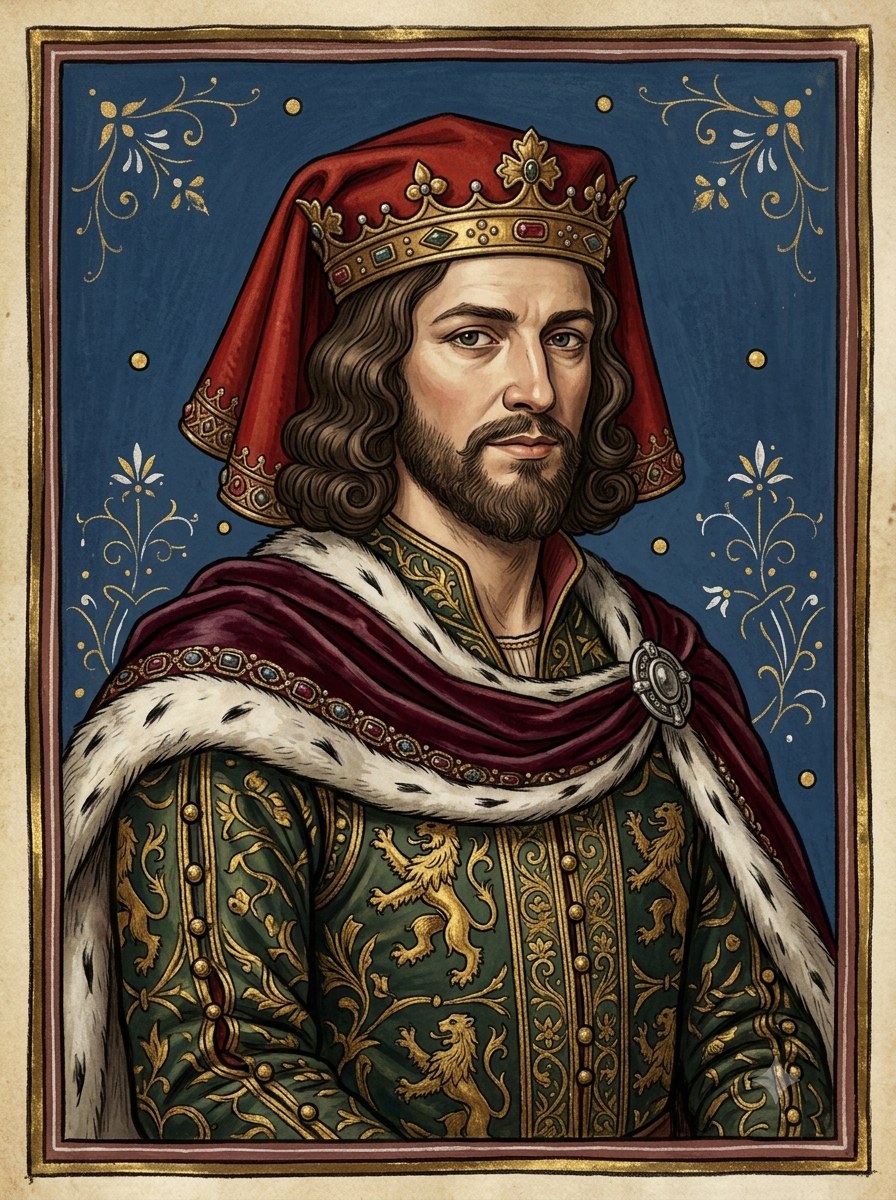
AI-assisted Portrait of Piers Gaveston
The Wit That Hanged Itself
He came out of Gascony with nothing but a sword arm and a tongue, and within a few years he was wearing an earldom that should have gone to a prince of the blood. Piers Gaveston was charming, quick, dazzling in the saddle and merciless in conversation—the kind of man who could empty a room of its dignity with a single nickname. He was also, almost certainly, the lover of the King of England, and he behaved as though that fact placed him beyond the reach of the men whose whole identity was their rank. It did not.
Edward II could deny him nothing. The king raised him to Earl of Cornwall—an unheard-of honor for a man of Gaveston's birth—and when the barons forced his exile, Edward simply waited and brought him home again. Gaveston repaid this devotion not with discretion but with theater: he gave England's proudest magnates cruel, sticky nicknames, unhorsed them at tournaments, and made the contempt of the throne into public spectacle. He was the ENTP in its most dangerous register—a mind too quick to stop itself, attached to a man who would never tell it to.
Gaveston was the ENTP whose wit outran his survival instinct—a brilliant, improvising tongue that could find the soft spot in any proud man and name it, wielded by someone who never once felt the weight of the order he was mocking until it closed around his neck.
The Tongue That Could Not Resist
Ne — dominant
Dominant Ne is an engine of association that runs without a brake. It sees the comic angle, the unexpected resemblance, the perfect cruel comparison—and it speaks before the cost has been counted. Gaveston's nicknames are pure Ne at play: the Earl of Warwick became “the Black Dog of Arden,” Thomas of Lancaster became “the Fiddler,” others were tagged “Burst-Belly” and “the Player.” Each name was a small act of irreverent genius, and each one stuck, because Ne does not merely insult—it finds the image that the whole court will repeat.
This is a mind delighted by the flouting of hierarchy. The proper response to England's great earls was deference; Gaveston's instinct was to play with them, to treat the sacred order of precedence as raw material for a joke. At the tournaments he did not merely win—he unhorsed the very men he had mocked, turning the lists into a running demonstration that the upstart could beat the bloodline at its own game. Ne is allergic to the fixed and the solemn, and nothing in fourteenth-century England was more fixed or more solemn than rank.
What makes it specifically Gaveston's and not merely the type in general is that he never deployed the wit toward an end. He was not building a faction or bargaining for advantage; he was simply unable to leave a good line unspoken. The gift that made him irresistible to the king was the same gift that made him incapable of self-preservation.
The Precision of the Insult
Ti — auxiliary
A nickname only wounds if it is true. Behind the showman's flourish sat auxiliary Ti—the cold analytic eye that took each proud lord apart and located exactly where the armor was thin. “The Black Dog of Arden” was not a random taunt; it fastened on Warwick's self-image and turned it into a snarling animal. “The Fiddler” reduced Lancaster, the richest and most self-important earl in the realm, to a hired entertainer. Ti is what separates a mere jester from a man whose jokes redraw the way the whole kingdom sees its grandees.
This is Ti in service of Ne rather than the reverse: the analysis is fast, instrumental, aimed at the comic kill rather than at any system of its own. Where a thinker leads with Ti, the logic builds a structure; in Gaveston it simply supplied the targeting, finding the one vulnerability that would make a line land and stick. He read men the way a duelist reads a stance—for the opening.
And he was almost always right, which was precisely the problem. A clumsy insult is forgotten; an accurate one is nursed for years. Gaveston's diagnoses were too good. Each one earned him an enemy who could never quite stop hearing it.
The Audience of One
Fe — tertiary
Tertiary Fe gives the ENTP a real charm and a real blind spot at the same time. Gaveston could read a room when he chose to—he held the king spellbound for years, and the chroniclers who hated him still concede that he was magnetic. There was warmth in the bond with Edward, a genuine intimacy that survived every exile. The performance at the tournaments, the eye for spectacle, the instinct for the grand gesture: all of it is Fe pressed into the service of display.
But tertiary Fe attends to the audience it cares about and ignores the rest. Edward adored him, and so Gaveston calibrated perfectly to Edward—and treated the collective feeling of the baronage, the thing a mature Fe would have read like weather, as beneath notice. He could feel the king's delight; he could not feel the room of humiliated lords curdling into a coalition. The favorite who charmed one man into giving him everything never registered that the same charm, turned to mockery, was teaching everyone else to want him dead.
The Weight He Could Not Feel
Si — inferior
Inferior Si is a blindness to the gravity of the established—to precedent, continuity, the slow accumulated weight of how things have always been done. For most of the men around Gaveston, the order of rank was not an opinion but the ground they stood on; an earldom carried centuries, and an upstart in one was a wound to the natural shape of the world. Gaveston could not feel any of this. To him the order was a stage set, brightly painted and weightless, there to be climbed on and laughed at.
So he kept doing the one thing that would kill him, because the danger never felt real. The barons exiled him once, twice, three times—and each return found him more flagrant, not more careful, as though the lesson of consequence simply would not take. A man with stronger Si would have read those exiles as the tightening they were. Gaveston read them as inconveniences the king would fix.
In June 1312 the tradition he had treated as a toy collected its debt. The Earl of Warwick—the Black Dog of Arden, the man whose nickname had bitten deepest—seized him, and the barons carried him to Blacklow Hill and struck off his head. The weight he had never been able to feel turned out to be heavy enough to end him.
Why ENTP Over ESTP
Why not ESTP?
The ESTP reads for the same reason Gaveston did—to find the advantage—but reaches for it physically and in the moment: the bold maneuver, the daring play, the in-the-flesh dominance. Gaveston's weapon was never his body but his tongue. He conquered by the clever read and the verbal flourish, by mockery and abstraction and the irreverent idea, and the unhorsings at the tournament were the punchline to the joke rather than the substance of it. An ESTP would have fought the men he humiliated; Gaveston only named them, which is the more ingenious cruelty and the more fatal one.
The verdict turns on what kind of power he reached for. The ESTP wins the room through presence and nerve; the ENTP wins it through wit, and then loses it the same way. Gaveston conquered by cleverness and died because cleverness makes enemies the body cannot fight—a dozen earls do not duel a man one at a time when his jokes have already taught them to hunt him together.
Connected Figures
Further Reading
- Piers Gaveston: Edward II's Adoptive Brother — Pierre ChaplaisThe provocative revisionist case that the bond was a sworn brotherhood-in-arms rather than simply a love affair — essential, if contested, reading.
- Piers Gaveston, Earl of Cornwall, 1307–1312 — J. S. HamiltonThe standard scholarly biography — careful on the patronage, the earldom, and the politics that destroyed him.
- Edward II: The Unconventional King — Seymour PhillipsThe definitive modern life of the king, indispensable for understanding the devotion that kept bringing Gaveston back.
