 Historical Figure MBTI
#483 · 4-16-26 · Plantagenet England
Hugh Despenser the Younger
Edward II's Favorite · The Grasping Co-Tyrant
c. 1287 — 1326
8 min read
AI-assisted Portrait of Hugh Despenser the Younger
The Favorite Who Wanted Everything
Edward II loved two men ruinously, and the second was far more dangerous than the first. Where Edward's earlier favorite, Piers Gaveston, was a charming, insolent companion who provoked the barons mostly by existing, Hugh Despenser the Younger was something colder: a methodical accumulator of land, money, and power who turned royal favor into a machine for expropriation. By 1322 he and his father, Hugh Despenser the Elder, had become the de facto rulers of England—a regime that lasted four years and ended with the king deposed and the son butchered in the marketplace at Hereford.
He was a Marcher lord by marriage, granted Glamorgan through his wife, and he used that foothold to wage a relentless campaign of acquisition across South Wales, swallowing the lands of neighbors by extortion, forced grants, false imprisonment, and—it was widely said—worse. He crushed the men who opposed him, monopolized access to the king, and reduced Edward to an instrument of his own greed. His enemies multiplied faster than he could destroy them, and one of them was the queen. That is the ENTJ turned predatory: command and acquisition pursued without limit and without conscience.
Despenser was the ENTJ stripped of every restraint—dominant Te as pure instrument of conquest, fused to a Ni vision of total control, building a power base that had no ceiling and therefore no stopping point until it collapsed and took the throne down with it.
The Engine of Acquisition
Te — dominant
Dominant Te organizes the world into assets, leverage, and obstacles, and then moves to control them. Despenser ran the kingdom the way a ruthless administrator runs an estate: he took the levers of royal government—the chancery, the exchequer, the king's own seal—and used them to enrich himself with bureaucratic precision. Grants were drafted, lands were seized under color of law, debts were manufactured, and the legal machinery of the crown became an instrument for transferring other men's property into his hands.
His campaign in Wales is the clearest case. Not content with Glamorgan, he coveted the whole of the southern March, and he pursued it by every available mechanism—forcing widows to surrender estates, imprisoning rivals until they signed, extorting bonds, and leaning on royal authority to make the seizures stick. When the Marcher lords rose against him in 1321 and forced his temporary exile, he came back within months and systematically destroyed them: their lands forfeited, their leaders hunted down, their rebellion turned into a windfall for the Despensers. This is Te at its most cold-blooded—not the building of an institution but the conversion of an entire realm into private holdings.
What distinguishes his Te from mere greed is its systematic quality. He did not grab at random; he built a structure of control, placing allies, eliminating threats, and reorganizing the flow of money and patronage so that everything ran through him. He made himself the indispensable node of English government—and a man who controls the machinery rarely imagines the machinery turning on him.
The Vision of Total Control
Ni — auxiliary
Auxiliary Ni gives Te a target and a horizon. Despenser was not a man scrambling for the next manor; he was building toward something—a consolidated power base in which he stood above every other subject, the king his creature and the apparatus of state his own. The Welsh accumulation was not opportunism but strategy: control of the March meant control of a militarized frontier, a private power bloc that no baron could match. He was assembling the pieces of a position from which he could not be dislodged.
That strategic singularity is what made him so much more formidable than Gaveston, and so much more hated. Gaveston wanted to be loved and resented; Despenser wanted to win, permanently. He read the board with cold clarity—who could be turned, who had to be broken, how to use the king's dependence to foreclose every check on his power. His grip on Edward was itself a long game: isolate the king from the barons, from the queen, from anyone who might offer an alternative, until royal authority and Despenser's ambition were indistinguishable.
But Ni in service of limitless ambition is also a kind of tunnel vision. He could see the architecture of domination he was building; he could not see that a base built entirely on extortion and fear leaves a man with no allies when the structure cracks—only creditors of vengeance. The vision had no endpoint at which he was finally safe, and so he kept taking, kept making enemies, until the most dangerous of them came back with an army.
The Taste for Seizure
Se — tertiary
Tertiary Se gave Despenser an appetite for the tangible exercise of power—not abstract influence but lands held, men jailed, opponents physically broken. He liked the concrete trophies of dominance: the castles, the seized estates, the bonds extracted under duress. There was a relish to his cruelty that went beyond cold calculation. The treatment of his enemies—the imprisonments, the reported torture of those who stood in his way, the rumored killing—suggests a man who enjoyed making power felt on the body, not merely recorded in a ledger.
His persecution of Queen Isabella shows the same tactile vindictiveness. He did not simply outmaneuver her politically; he seized her estates, cut her income, planted spies in her household, and separated her from her children—a campaign of concrete humiliations designed to be felt. Se reaches for the immediate and physical, and in Despenser it expressed itself as the will to make his enemies' powerlessness tangible and total.
The Missing Conscience
Fi — inferior
Inferior Fi is the ENTJ's blind spot—an underdeveloped inner compass that, in a healthier life, eventually whispers that not everything worth doing is worth having. In Despenser it seems barely to have spoken at all. He showed no evident principle that overrode his ambition, no line he would not cross, no loyalty that outweighed advantage. His attachment to the king was real enough, but it functioned as an instrument of his power rather than a check on it. He had values the way a creditor has debtors—something to be collected from others, not lived by himself.
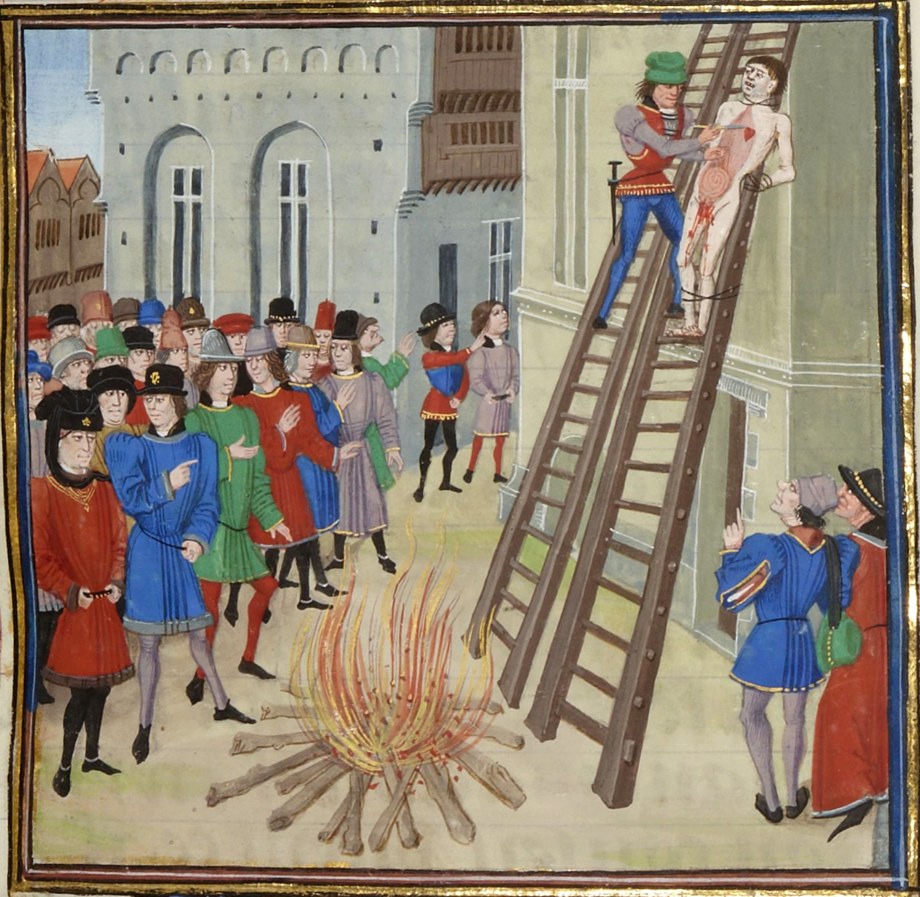
Where inferior Fi did finally surface, it surfaced as terror. Captured after Isabella and Mortimer's invasion, the man who had felt nothing for his victims is said to have refused food and water, trying to die before the executioners could reach him. The composure of the predator broke entirely. At Hereford he was dragged through the streets, hauled up a fifty-foot gallows, castrated, disembowelled, and quartered before a jeering crowd—a theatrical destruction calibrated to answer the years of humiliation he had inflicted. The man who recognized no value but his own won was forced, at the end, to feel the full weight of everything he had dismissed.
Why ENTJ Over ESTJ
Why not ESTJ?
The ESTJ is a dutiful administrator of an existing order—the steward who runs the office competently and respects the structure that grants him authority. That describes his father, Hugh Despenser the Elder, the practical organization man, far better than it describes the son. The Younger did not administer the realm; he re-engineered it around himself, restructuring the entire balance of power in England with cold strategic design. His ambition had no fixed institutional ceiling to respect, and a steward who knows his place does not try to become the unremovable master of the kingdom. That is auxiliary Ni driving Te, not the established-order loyalty of an ESTJ.
The distinction is between managing a system and conquering one. An ESTJ of comparable ruthlessness would have entrenched himself within the machinery of government and defended it; Despenser treated government as raw material to be reshaped into a vehicle for total personal dominance. His was a visionary, boundless ambition—the empire-builder's instinct to remake the structure rather than serve it. That limitless reach is precisely what destroyed him and his king: a steward stops when the job is done, but the ENTJ pursuing a vision of total control has no point at which the taking is finished.
Connected Figures
Further Reading
- Edward II — Seymour PhillipsThe definitive modern biography of the king — exhaustive and authoritative on the Despenser regime and its collapse.
- Edward II: The Unconventional King — Kathryn WarnerA vivid, sympathetic reassessment of Edward's reign that gives Despenser's tyranny and fall close, readable attention.
- The Greatest Traitor: The Life of Sir Roger Mortimer — Ian MortimerFollows the man who, with Isabella, brought the Despensers down — the best narrative of the 1326 invasion and its bloody aftermath.
