 Historical Figure MBTI
#484 · 4-16-26 · Plantagenet England
Hugh Despenser the Elder
Earl of Winchester · The Loyal Father
1261 — 1326
7 min read
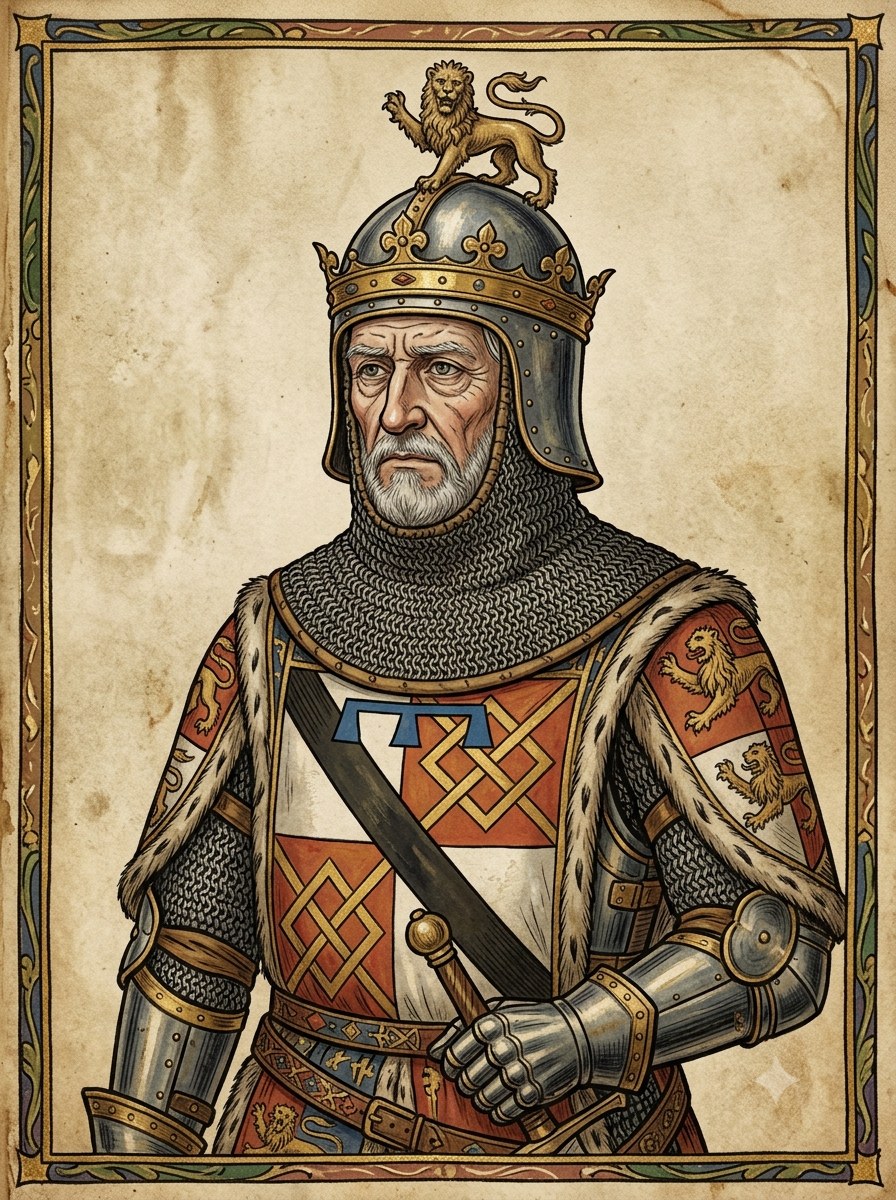
AI-assisted Portrait of Hugh Despenser the Elder
The Old Servant Who Outlived His Usefulness
For most of his long life, Hugh Despenser the Elder was the kind of man kings are grateful for: a capable soldier, a reliable administrator, an experienced courtier who could be sent to a battlefield or an embassy and trusted to do the job. Born in 1261, he served Edward I faithfully for decades — in Wales, in Scotland, in France, in Parliament — and when that hard old king died, the son inherited not only the crown but the father's most dependable servant.
That son was Edward II, and serving him was a far harder thing. The reign was a catastrophe of favourites, defeats, and noble revolt, and one magnate after another abandoned the king. Despenser the Elder did not. He gave Edward the same dutiful, competent, by-the-book service he had given the father — and for that loyalty he was raised to the earldom of Winchester in 1322, after the king broke the baronial opposition. With his ambitious son he became the dominant power in England in Edward's last years, and shared in both the wealth and the hatred that the Despenser name now attracted. When Queen Isabella and Roger Mortimer invaded in 1326, the realm fell apart in weeks. The sixty-five-year-old earl was taken at Bristol and hanged in his armour.
Despenser the Elder was the dutiful, conventional ESTJ royal servant — a man who served the established order with practiced competence, and was destroyed not by his own ambition but by his loyalty to a doomed king and a grasping son.
The Competent Hand
Te — dominant
What made Despenser valuable was the most ordinary kind of excellence: he got things done. Dominant Te is the executive function — it organises men, manages resources, and measures itself by results rather than ideals. For half a century Despenser was exactly that sort of instrument. He campaigned, he sat in councils, he carried out commissions, he held offices and discharged them. Edward I, no easy master, used him repeatedly because he could be relied on to deliver, and that reputation for practical competence was the whole foundation of the Despenser fortune.
Under the son, that same Te made him formidable rather than merely useful. With his heir he ran the machinery of an increasingly authoritarian crown — the appointments, the lands, the enforcement — and ran it effectively enough that the two of them became the unchallenged power in the realm. The hatred they drew was real, but so was the grip: this was government by men who understood administration as a lever and knew how to pull it. Te builds and holds power through control of the apparatus, and for a few years the Despensers controlled it almost completely.
The Servant of the Crown
Si — auxiliary
Auxiliary Si grounds the ESTJ in precedent, duty, and the settled order of things. It is the function of the man who knows how the institution is supposed to work and feels obligated to keep it working that way. In Despenser it shows most clearly in the one trait that defines him against almost every other magnate of the reign: his loyalty did not move. The barons of Edward II's England shifted with advantage, rebelled, reconciled, and rebelled again. Despenser served the crown as an obligation that predated and outlasted any single favourite or quarrel.
He had given his oath to the father and transferred it, intact, to the son — not because Edward II earned it but because that was what a king's man owed his king. It is a deeply conservative instinct, and in a competent reign it would have made him simply a model servant of the old school. In this reign it tied him to a sinking ship. Si keeps faith with what is established; Despenser kept faith with the established crown long past the point where faith was prudent, and that constancy was eventually indistinguishable from his doom.
The Limits of the Settled Mind
Ne — tertiary
Tertiary Ne gives the ESTJ a modest, occasional reach toward possibility — enough to see an opening and exploit it, but never the restless engine that drives an idea-builder. Despenser had this in its practical form. He and his son seized the opportunity Edward's weakness offered and built a dominance that more cautious men would not have dared to attempt. There was real opportunism in the rise: lands acquired, rivals displaced, a fortune assembled in the gap that the king's misrule left open.
But it was a follower's improvisation, not a visionary's. The grand, limitless ambition belonged to the son; the father read situations and pressed advantages within them. Weakly developed Ne also meant a poor sense of how the wider game might turn — the old earl backed an unsustainable position and never seems to have grasped how fast and how completely it could collapse. When Isabella landed, the possibilities he had failed to imagine arrived all at once.
Loyalty and Blood
Fi — inferior
Inferior Fi is the ESTJ's quietest and least examined dimension — a buried core of personal loyalty and conviction that the type rarely articulates but will, in the end, act on absolutely. Despenser's ran along two lines: fidelity to the crown and fidelity to his son. Both were unconditional, and neither was negotiable. He did not hedge his oath to a failing king, and he did not distance himself from a son whose conduct had made the family name a curse. The two loyalties were the deepest things in him, and they were the things that killed him.
Because inferior Fi is unguarded, it offers no instinct for self-protection when those attachments turn ruinous. A more calculating man might have abandoned Edward, or broken with the younger Hugh, when the regime began to fall. Despenser did neither. He stood with both to the end and was hanged in his armour at sixty-five for it — the values he never spoke proving stronger than any survival instinct his competence might have supplied.
Why ESTJ Over ENTJ
Why not ENTJ?
His son was the ENTJ — a boundlessly ambitious power-builder who tried to remake the realm around himself and seize everything within reach. The father was a different animal: a dutiful, conventional servant of the established crown, whose competence was placed at the order's disposal rather than turned to building an empire of his own. The rise was driven by the son's appetite; the old earl supplied steady Te administration in support of it, anchored by Si loyalty, not by a vision of personal dominion.
The distinction is one of motive. The ENTJ wants to own the system and bend it to a grand design; the ESTJ wants to serve it well and keep it running. Despenser the Elder served the crown faithfully across two reigns and rose by being indispensable to it — and his ruin came from loyalty and family, not from any limitless ambition of his own. His son tried to own the order. The father served it, and was hanged for the service.
Connected Figures
Further Reading
- Edward II — Seymour PhillipsThe definitive modern biography of the reign — the fullest scholarly account of how the Despensers rose and fell.
- Edward II: The Unconventional King — Kathryn WarnerAn accessible, evidence-led reassessment that gives the Despenser ascendancy and its collapse close attention.
- The Tyranny and Fall of Edward II — Natalie FrydeThe classic study of the regime's final years — the politics, the greed, and the 1326 invasion that destroyed it.
