 Historical Figure MBTI
#485 · 4-16-26 · Plantagenet England
Thomas of Lancaster
Earl of Lancaster · Edward II's Baronial Enemy
c. 1278 — 1322
8 min read
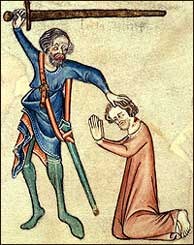
AI-assisted Portrait of Thomas of Lancaster
The Mightiest Subject in England
He held five earldoms, drew an income that rivalled the crown's, and could put more knights into the field than any man in the realm save the king himself. By blood Thomas of Lancaster was a Plantagenet prince — grandson of Henry III, nephew of Edward I, and first cousin to Edward II, the cousin he would spend his life opposing. For more than a decade after Edward's accession in 1307, Lancaster was the gravitational centre of baronial England: the man around whom opposition to a failing king naturally gathered, the great noble whose name alone made the throne tremble.
And he wasted nearly all of it. He had the wealth, the rank, the followers, and the grievance — everything but the capacity to govern. When he forced his way to power he ruled badly and feuded constantly; when he finally took up arms against the king, he was run to ground and beheaded in 1322, the first English prince of the blood executed in living memory. He is one of the archive's clearest studies in the difference between holding power and being able to use it.
Thomas of Lancaster is the ESTJ stripped of competence: all command and weight and insistence on his rights, none of the judgement that makes authority work. He wanted to be obeyed, defended the established order as he found it, and never grasped that power is a tool, not a possession.
Command by Weight
Te — dominant
Dominant Te is the drive to impose order on the external world — to organise men and resources, to assert authority, to make the structure conform to one's will. Lancaster expressed it in its rawest, most material form. He did not lead the baronial opposition by argument or vision; he led it by sheer mass. His five earldoms, his affinity of retainers, his castles and his rent-rolls were the argument. When he refused to attend a campaign or a parliament, the king's government simply stalled, because no royal initiative could move against the weight of the realm's greatest magnate sitting in opposition.
This is Te that mistakes the possession of leverage for the exercise of leadership. He helped drive through the Ordinances of 1311 — the reform programme that aimed to bind the king to baronial consent over war, finance, and patronage — and he was among the lords who seized the king's favourite Piers Gaveston and had him put to death in 1312. These were assertions of control: a structure built to cage the crown, a rival removed by force. Te wants the hierarchy to run on terms it sets, and Lancaster spent his career trying to make the king's hierarchy answer to him.
But Te-dominance without sound judgement curdles into bare domination. Once he had forced his way to the head of the council after 1314, Lancaster governed the realm as badly as Edward ever had — sulking on his estates, refusing cooperation, blocking business out of pride and self-interest while the Scots ravaged the north unanswered. He could command, but he could not administer; he could obstruct, but he could not build.
The Defender of Things As They Were
Si — auxiliary
Auxiliary Si grounds the ESTJ in precedent, custom, and the settled order of things. It supplies the conviction that established rights and traditional forms are not merely useful but correct — that the way things have always been done carries its own authority. In Lancaster this produced a rigid, almost reflexive conservatism. His opposition to Edward was never reformist in spirit; it was restorative. He was not trying to invent a new settlement so much as to enforce what he took to be the magnate's ancient and rightful place in the governance of the kingdom.
The Ordinances are the clearest expression of it. To Lancaster they were less a constitutional innovation than a fence around the old order — a written guarantee that the king could not govern through low-born favourites and private whim, that the great barons would advise and consent as custom said they should. He clung to the Ordinances long after circumstances changed, insisting on their letter, treating them as sacred precisely because they codified the form he believed in. Si does not improvise; it conserves, and Lancaster conserved his own privileges with the tenacity of a man defending holy writ.
That same rigidity made him politically brittle. A more flexible mind reads a shifting situation and bends; Lancaster met every change by retreating further into his rights and his grievances. He stood for the realm as it had been — for rank, precedent, and the dignity of his own enormous inheritance — and was constitutionally unable to bend toward anything new.
Scheming Without Strategy
Ne — tertiary
Tertiary Ne in an ESTJ is a weak and unreliable faculty: occasional flashes of alternatives and possibilities, used not to build a vision but to grasp at expedients when the established path runs out. Lancaster's political manoeuvring has exactly this character. He could sense an opening — the king weakened by the Scottish disaster at Bannockburn, the barons restless, the moment ripe to seize the council — and lunge at it. But he had no developed sense of where any of it was leading.
His most notorious gamble belongs here. In the years before his fall he appears to have opened secret dealings with the Scots, the very enemy he was nominally charged to repel, evidently hoping to use them as leverage against Edward. It was the improvisation of a man who had run out of legitimate moves — a flailing reach for any lever that might shift the board, with no thought for how treasonable correspondence with the realm's enemy would look when exposed. Tertiary Ne grasps at possibilities it cannot properly evaluate; Lancaster reached for a weapon that would help destroy him.
The Wounded Pride Beneath
Fi — inferior
Inferior Fi gives the ESTJ a narrow, brittle, intensely personal core of values that rarely shows itself except under pressure — and when it does, it tends to surface as wounded honour, grievance, and an unbending sense of personal entitlement rather than as principled conviction. Lancaster's opposition to the crown was draped in the language of the common good and the Ordinances, but underneath it ran something far more private: an aggrieved certainty that he, the realm's greatest prince, was owed deference the king refused to give.
His ruinous quarrels were almost all matters of injured pride. He nursed a personal hatred of Gaveston, who had mocked the great earls with belittling nicknames; he feuded bitterly with fellow barons, including the moderate Aymer de Valence, over slights and rivalries that wiser men would have absorbed. A healthier Fi might have anchored him to a cause larger than himself. Lancaster's, undeveloped and defensive, bound him only to his own honour — so that every collision became a question of personal dignity, and compromise felt like humiliation. He could not yield without feeling diminished, and so he rarely yielded at all, even when yielding would have saved him.
Why ESTJ Over ENTJ
Why not ENTJ?
The ENTJ baron of this era is Simon de Montfort — a leader with an actual constitutional idea, who reached past existing arrangements toward a new structure of government. Lancaster had no such vision. He was a Te-Si conservative defending the magnate's traditional rights and the order as he inherited it, not an Ni-Te strategist building toward something that did not yet exist. Where the ENTJ improvises a future and drives toward it, Lancaster wielded his power to entrench his own position and rank, governed poorly when he held it, and stood for things as they were rather than anything new.
The distinction is the difference between a reformer and a reactionary of immense weight. An ENTJ uses present power as fuel for a designed end; Lancaster treated power as an inheritance to be guarded, a dignity to be defended, a possession that confirmed his standing. That is why his career reads as obstruction rather than construction: he had no project beyond the preservation of the old order and his own primacy within it. Te in the service of Si conserves and commands; it does not envision. Lancaster had the grandest hand in England and played it entirely to defend what already was.
Connected Figures
Further Reading
- Thomas of Lancaster, 1307–1322: A Study in the Reign of Edward II — J. R. MaddicottThe definitive scholarly biography — indispensable on Lancaster's wealth, his politics, and the failures of his leadership.
- Edward II — Seymour PhillipsThe authoritative modern life of the king, setting Lancaster's opposition within the full sweep of the reign.
- Edward II: The Unconventional King — Kathryn WarnerA vivid, accessible account of Edward's reign and the magnates around him, including Lancaster's rise and fall.
