 Historical Figure MBTI
#1236 · 9-11-26 · The Mughal Empire
Sarmad Kashani
Poet · Ascetic · A Contested Devotional Legacy
c. 1590–1661
5 min read
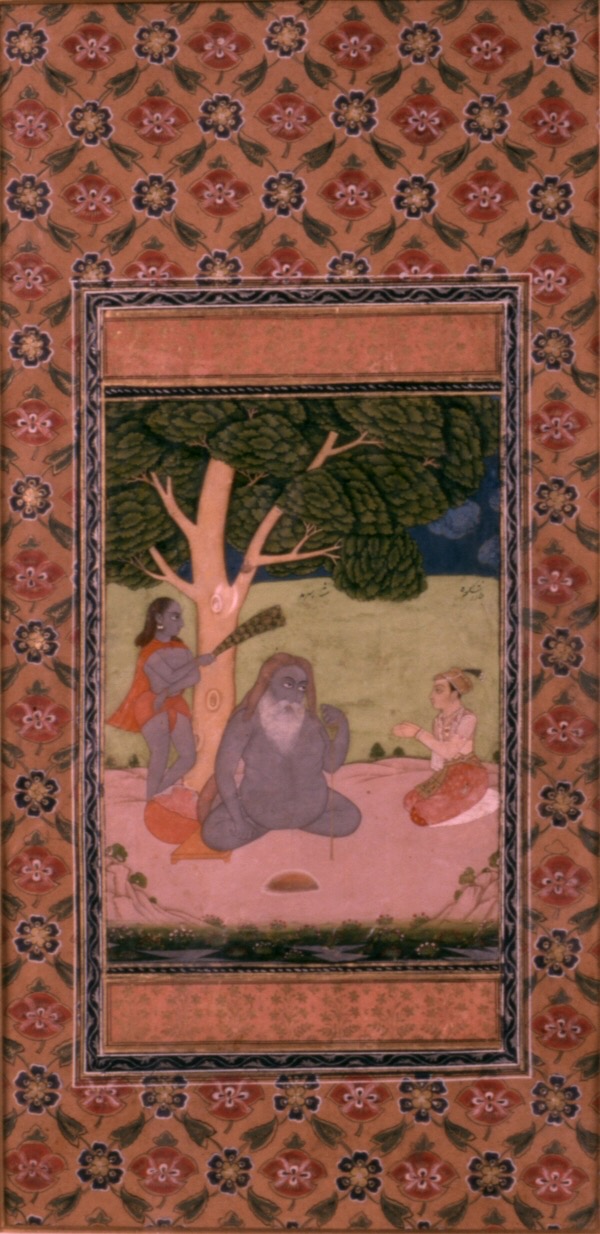
Shah Sarmad and Prince Dara Shikoh — 18th century (later group depiction)
The Scholar Inside the Scandal
The Dabistan author did not know Sarmad only as a notorious naked ascetic. He met him in Hyderabad in 1647 and drew on his knowledge for an account of Jewish religion. The text also describes Abhi Chand’s work on a Persian rendering of biblical material, revised with Sarmad. Behind the later spectacle stood a person able to transmit scripture across languages and communities. That intellectual contribution deserves a place beside the story of his body and his death.
Sarmad came from Kashan and a Jewish background, and traveled to India in connection with commerce. Accounts describe conversion to Islam and attachment to a Hindu youth, Abhi Chand, at Thatta. The contemporary narrative treats their attachment as transformative. Later retellings have made it a romantic legend, a spiritual allegory or a scandal. We can acknowledge the relationship without pretending to recover every feeling, age or private exchange from the stylized account.
The proposed personality interpretation has low confidence. Unconventional behavior can be chosen for many reasons, and a poet’s voice is not a transcript of thought. The strongest basis is the conjunction of personally consequential attachments, sustained religious inquiry and public refusal to fit comfortably within the identities others prescribed.
The tentative INFP reading centers on Introverted Feeling: Sarmad’s remembered commitments carried personal weight even when they brought him into conflict with accepted forms of identity and conduct.
A Commitment Others Had to Interpret
The Dabistan links his abandonment of commerce and conventional dress to his attachment to Abhi Chand. That explanation belongs to the source, not to an omniscient account of motive. What the narrative makes visible is a life redirected around a relationship that did not reproduce the expected path of a merchant. Sarmad’s choices required observers to decide what kind of man they were looking at: lover, madman, saint or transgressor.
Introverted Feeling is proposed as a language for that costly personal commitment. It is not established by nudity, religious dissent or persecution. Those external features become relevant only when considered alongside the remembered reordering of his life. Even then, the evidence is mediated through observers who had reasons to make his difference meaningful. His devotion might become exemplary for a follower and incriminating for an opponent.
His quatrains make this uncertainty productive rather than resolving it. They move through love, belief, refusal and the instability of religious labels. Such language belongs to Persian poetic traditions as well as to a particular author. A speaker who unsettles an identity in verse may be performing an inherited literary possibility. The reading must therefore ask how poem, reported conduct and intellectual work converge, without using a striking line as a psychological confession.
Scripture Beyond a Single Audience
His contribution to the Dabistan offers stronger evidence of intellectual exploration than later miracle stories. Jewish scripture entered a Persian account of religions through a collaboration involving Sarmad and Abhi Chand. The movement required interpretation: concepts familiar to one group had to be made intelligible to readers outside it. The resulting chapter also preserves unusual explanations that should not be accepted as a complete or representative statement of Judaism.
Auxiliary Extraverted Intuition describes a possible readiness to consider religious language from more than one position. Sarmad’s background, conversion and intellectual encounters created opportunities to compare claims without staying inside a single inherited vocabulary. Yet crossing boundaries does not necessarily mean equal acceptance of every tradition. The contemporary account records statements that are difficult to reconcile into a neat doctrinal system. That resistance to neatness is part of the evidence, not a defect to erase.
Dara Shikoh’s association gave Sarmad a place within an imperial environment interested in unconventional spiritual authority. It also made his standing vulnerable when Dara lost the succession. The connection should not be simplified into master and disciple unless a particular source establishes that relation. The secure point is proximity to a prince whose religious circle became politically exposed.
Testing the INFP Reading
Why not ENFP?
ENFP could account for his public encounters and movement across intellectual boundaries. INFP receives a slight preference because the most consequential remembered changes appear organized around deeply personal attachments rather than a clearly documented appetite for multiplying public possibilities. This distinction is weak: surviving accounts naturally foreground the unusual acts that attracted an audience.
Tertiary Introverted Sensing and inferior Extraverted Thinking remain largely inaccessible. Knowledge of inherited scripture does not by itself prove a cognitive preference, and execution cannot establish an inability to manage practical life. The proposed complete stack must remain less certain than the historical conjunction of learning, unconventional conduct and vulnerability.
Connected Figures
Further Reading
- The Dabistan, or School of Manners — Translated by David Shea and Anthony TroyerA contemporary account drawing on Sarmad’s information about Jewish religion and his relationship with Abhi Chand.
- Sarmad: His Life and Quatrains — B. A. HashmiAn essay in Islamic Culture gathering biographical testimony and discussing the poetry.
- The Emperor Who Never Was: Dara Shukoh in Mughal India — Supriya GandhiPlaces the prince’s unconventional religious associates within a political and intellectual setting.
- The Rubaiyat of Sarmad — Sarmad; translated by Syeda Saiyidain HameedAn English encounter with the quatrains; read their speakers as poetry rather than transparent autobiography.
