 Historical Figure MBTI
#1237 · 9-11-26 · The Mughal Empire
Mian Mir
Qadiri Teacher · Saint of Lahore
c. 1550–1635
6 min read
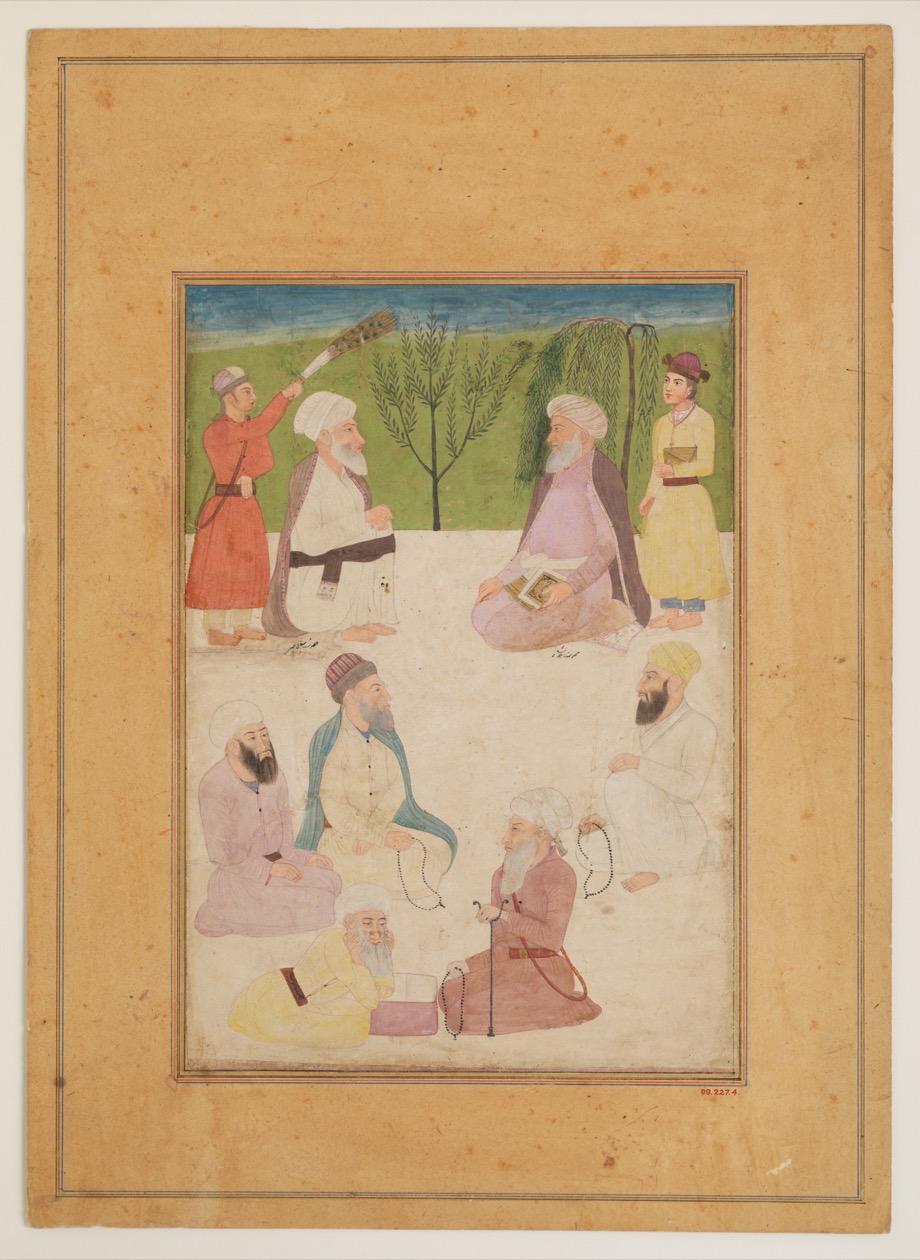
Portrait of Mian Mir with Mulla Shah and other figures — c. 1695–1705 (later depiction)
The Gift the Emperor Did Not Offer
Jahangir wanted to meet the celebrated holy man of Lahore. In his memoir, the emperor describes sending a request because he could not travel there himself; Mian Mir came despite age and weakness. They spoke privately, and Jahangir found the encounter deeply rewarding. The telling detail is the gift. The emperor considered a substantial offering but judged the saint too independent to receive it. He instead left him a white antelope skin for prayer, after which Mian Mir returned to Lahore.
This account differs from the popular image of a ruler arriving at a saint’s barred door and receiving a rebuke. Jahangir’s own version presents esteem and restraint. It cannot tell us everything about Mian Mir, but it gives a contemporary point of contact with a person often enclosed by later legend. The emperor recognized an authority he could honor without converting it into the familiar language of rank, office and reward.
Mian Mir, born around the middle of the sixteenth century and remembered as Sindhi in origin, became one of Lahore’s most important Qadiri teachers. He died in 1635. His lasting significance lies in a network of disciples and devotees, including the spiritual world that later attracted Dara Shikoh and Jahanara Begum. He remains untyped because that significance is secure while the surviving testimony about his individual habits of thought is much less independent.
Lahore as a Place of Spiritual Authority
Mian Mir’s Lahore was an imperial city as well as a center of religious life. A teacher who lived there did not need a government appointment to encounter people connected with the court. The distinction between spiritual independence and complete isolation matters. Jahangir’s invitation reached him; he chose to respond. The memoir therefore records an exchange across different forms of authority, not a saint living beyond every social relation.
The Qadiri affiliation located him within a spiritual lineage associated with Abd al-Qadir al-Jilani. Such a lineage gave disciples a way to understand guidance as transmitted rather than invented by an isolated charismatic individual. Devotion, remembrance and disciplined practice belonged to that world. The order’s presence in India also makes Mian Mir’s career part of a wider history of movement and adaptation, even though later remembrance rightly gives Lahore a central place.
His authority could attract an emperor without making imperial recognition its sole foundation. Jahangir had heard reports of eloquence, austerity and spiritual distinction before requesting the meeting. Those descriptions convey the reputation already circulating around Mian Mir. Their formulaic language also warns against treating every adjective as a personality observation. They identify what an early seventeenth-century writer considered signs of a holy man, shaped by the expectations of the encounter he wished to record.
The Circle a Prince Remembered
Dara Shikoh’s Sakinat al-Auliya, completed in 1642, made Mian Mir and his circle central to an account of sanctity. It includes Mian Mir’s sister Bibi Jamal Khatun and the teacher Mulla Shah Badakhshi. The presence of these figures prevents reducing the spiritual history to a single meeting between a saint and a prince. A community of teachers and devotees existed around the person later royal memory would make especially prominent.
Dara wrote after Mian Mir’s death, as a committed participant in the Qadiri tradition. His book preserves valuable names, relationships and reported practices. It also arranges them to demonstrate spiritual excellence. A miracle in such a work is evidence that the author or his informants understood sanctity in that way; it is not automatically independent verification that the event occurred. Keeping the genre visible allows the text to remain a historical source without requiring every detail to serve the same purpose.
The distinction is particularly important for Mian Mir’s relationship with Dara. The prince revered him and remembered encounters with his spiritual world, but later formal discipleship belonged to Mulla Shah. Making Mian Mir the direct instructor of every subsequent royal devotee compresses the chronology and erases the successor’s work. His influence persisted through transmission, which is itself a substantial form of agency.
A Teacher’s Presence After Death
Mulla Shah initiated Dara and Jahanara into the Qadiri order in 1640, extending the circle beyond Mian Mir’s lifetime. Their writings and patronage made teachers visible through manuscripts, portraits and buildings. An image showing Mian Mir with Mulla Shah could communicate continuity: the viewer encountered a lineage of guidance, not merely two men sharing a pictorial space. This devotional use helps explain why their paired likenesses continued to be copied.
The Metropolitan Museum’s paired portrait, attributed to Muhammad Musa and dated around 1695–1705, is a useful surviving example. Both teachers had died decades earlier. Its date establishes that it belongs to their remembered presence rather than a meeting recorded directly from life. Reading it historically means asking how a later audience received them as authoritative figures, while recognizing the limits of a retrospective image as evidence for their appearance or demeanor.
Jahanara’s own account of discipleship gives the later circle another voice. Her testimony does not make Mian Mir’s personal psychology available, but it shows that the lineage mattered to a woman with major dynastic, economic and architectural responsibilities. The network was neither an exclusively male conversation nor an escape into a world wholly separate from imperial life. Spiritual affiliation and political position could coexist without being identical.
The Foundation Story and Its Limits
The story that Mian Mir laid the foundation stone of the Harmandir Sahib, later known as the Golden Temple, has become a powerful image of friendship across religious communities. It is also disputed and is not securely established by contemporary evidence. It should therefore be identified as a later tradition, not used as the decisive factual episode of his life. The symbolic value attached to a story cannot supply the missing historical documentation.
This caution does not require denying every possible contact between Sikh and Muslim devotional worlds. It requires separating a particular famous claim from a much broader history of encounter. Nor should the story be turned into an argument that one community needed another to authorize its sacred place. Mian Mir’s documented importance as a Qadiri teacher stands independently of the foundation legend, and the history of the Sikh shrine deserves the same care with its own evidence.
Connected Figures
Further Reading
- Sakinat al-Auliya — Dara ShikohA devotional biography of Mian Mir, Bibi Jamal Khatun and their circle; its hagiographic purpose matters.
- The Jahangirnama: Memoirs of Jahangir, Emperor of India — Jahangir; translated by Wheeler M. ThackstonA contemporary royal account of the meeting and the saint’s independence from lavish gifts.
- Faces of God: Images of Devotion in Indo-Muslim Painting, 1500–1800 — Murad Khan MumtazExplains the devotional functions of portraits and the Qadiri circle’s visual presence.
- The Emperor Who Never Was: Dara Shukoh in Mughal India — Supriya GandhiPlaces the prince’s devotion to Mian Mir within his wider intellectual and political life.
