 Historical Figure MBTI
#1238 · 9-11-26 · The Mughal Empire
Mulla Shah Badakhshi
Qadiri Teacher · Guide to Dara and Jahanara
c. 1585–1661
5 min read
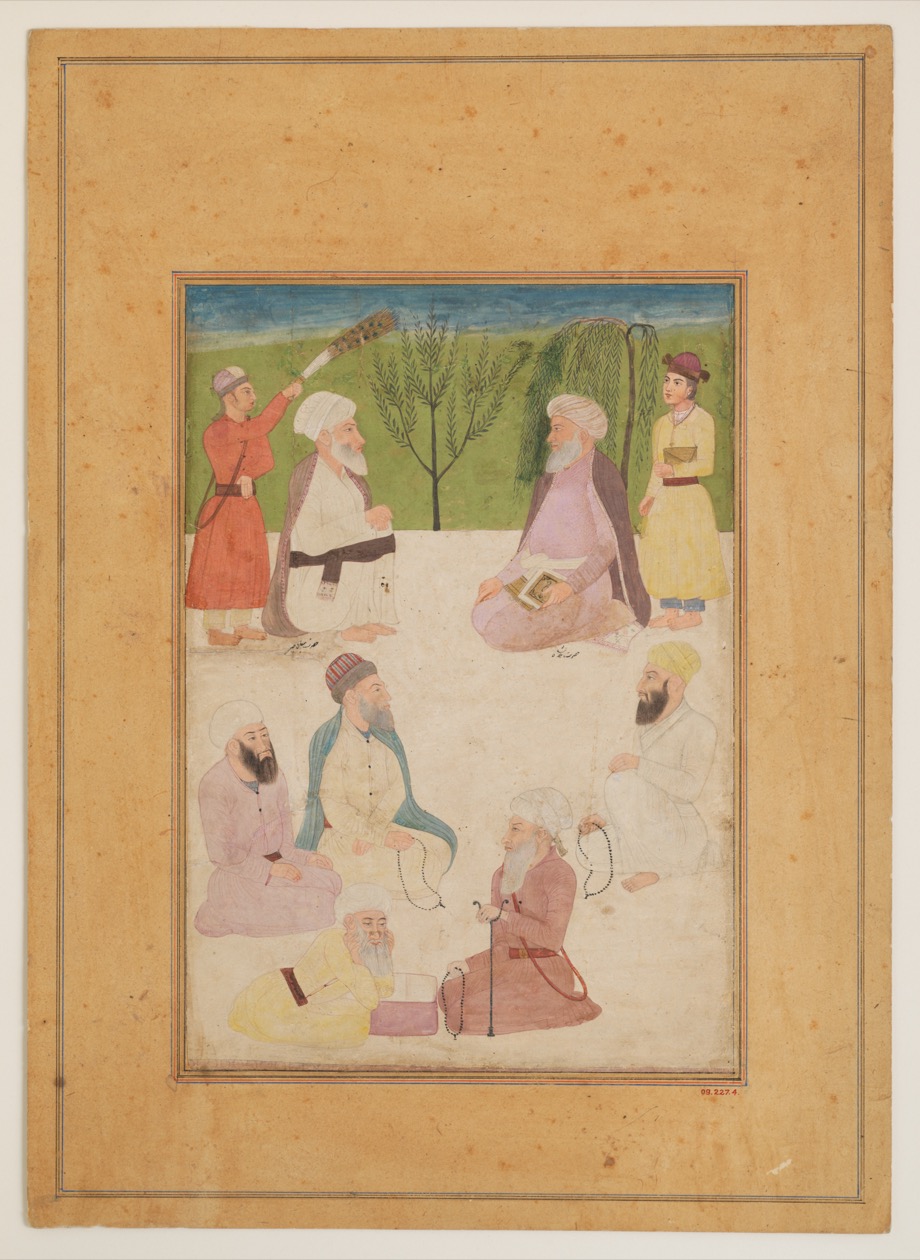
Portrait of Mulla Shah Badakhshi with Mian Mir and other figures — c. 1695–1705 (later depiction)
The Teacher the Princess Sought
Before Jahanara Begum entered the Qadiri order, she exchanged letters and gifts with Mulla Shah. Her account of discipleship describes his eventual visit to her quarters in Kashmir, at Shah Jahan’s invitation, and her initiation in the company of Dara Shikoh. The episode gives the relationship a practical shape: correspondence preceded a meeting, access had to be arranged, and guidance became an acknowledged bond. A royal woman’s search was an active undertaking, not a spiritual identity silently assigned to her.
Mulla Shah Badakhshi, born around 1585 and dead in 1661, came into the teaching lineage associated with Mian Mir. Dara and Jahanara entered the Qadiri order under him in 1640. The names attached to his remembered life can make him seem merely an accessory to famous siblings, but their dependence on his guidance reverses that perspective. Imperial rank did not itself confer the spiritual authority they sought.
He remains untyped. A teacher’s office, the admiration of disciples and the meditative composure of a portrait establish neither inward intuition nor a particular social temperament. The sources make his influence visible more securely than the personal processes through which he exercised it.
A Lineage Carried Forward
Mian Mir’s death in 1635 left disciples through whom his teaching could continue. Mulla Shah’s position within that circle supplied a recognized connection to an earlier master. For Dara, who wrote about saints and their relationships, this continuity mattered. Guidance was not simply the reception of appealing ideas from an interesting stranger; it placed the seeker within a chain whose past gave the present relationship legitimacy.
The shared initiation of Dara and Jahanara also made the lineage part of a dynastic household’s spiritual life. Their accounts should not be collapsed into one experience. Dara’s writings gave broad literary form to his search and to the remembrance of teachers, while Jahanara described her own relation to Mulla Shah in the Risala-i Sahibiyya. Read beside one another, they show a teacher reaching different royal pupils through overlapping but distinct acts of devotion.
These are committed witnesses. They preserve information about meetings, practices and affiliations, yet they also wish to communicate spiritual attainment. An account of guidance can therefore contain both usable chronology and an idealized presentation of the guide. The task is to identify what each part establishes rather than treating reverence as either complete proof or grounds for dismissing the whole text.
The Portrait as an Instrument of Devotion
Jahanara’s account gives portraits a place within her discipleship. Scholarship on the Qadiri circle shows that such images were not merely records of appearance: the teacher’s likeness could support remembrance and devotional attention. This changes how a surviving picture should be read. A quiet seated figure does not provide a personality test. It belongs to a practice in which seeing the guide helped sustain a relationship across physical distance.
The Metropolitan Museum holds a paired portrait of Mian Mir and Mulla Shah, attributed to Muhammad Musa and dated around 1695–1705. Both men had died before that painting was made. Its relationship to earlier imagery shows a remembered spiritual world continuing into a regional Kashmiri style. The later date should remain visible rather than allowing the object to masquerade as direct observation of the teachers together.
Mulla Shah also wrote. His Risala-i Shahiya, completed in 1645, belongs to the textual activity of the same circle, and verses associated with it entered devotional imagery. Teacher, manuscript and portrait could reinforce one another. Recognizing that interplay restores his participation in the production of the circle’s spiritual language, even where the more extensive surviving royal accounts draw attention toward his pupils.
Patronage Without a Psychological Shortcut
Royal support connected his name with building in Kashmir as well as with manuscripts and painting. Such patronage required access to money, craftsmen and an imperial environment capable of making a teacher’s importance materially visible. It did not necessarily mean that the guide simply served the dynasty’s political program. A spiritual relationship could offer legitimacy to royalty while retaining demands that were understood in terms beyond government.
The distinction is also a limit on interpretation. The architecture associated with Mulla Shah may communicate disciplined design, but much of that form belongs to patrons, builders and established conventions. Assigning the teacher a personality because a mosque is orderly would confuse a collaborative material product with evidence of his cognition. The historically stronger claim is that his authority inspired sustained acts of representation and remembrance.
Connected Figures
Further Reading
- Risala-i Sahibiyya — Jahanara BegumThe princess’s own account of her guide and discipleship, with its devotional purpose kept in view.
- Sakinat al-Auliya — Dara ShikohPreserves the Qadiri circle linking Mian Mir and Mulla Shah.
- Faces of God: Images of Devotion in Indo-Muslim Painting, 1500–1800 — Murad Khan MumtazExamines how portraits and texts functioned within the royal siblings’ discipleship.
- The Emperor Who Never Was: Dara Shukoh in Mughal India — Supriya GandhiReconstructs the wider setting of Dara’s spiritual relationships and princely life.
