 Historical Figure MBTI
#1158 · 8-25-26 · The Fall of the Han
Sun Shangxiang
Lady Sun · A Political Marriage With Armed Maids in the Bedroom
fl. c. 209 CE
7 min read
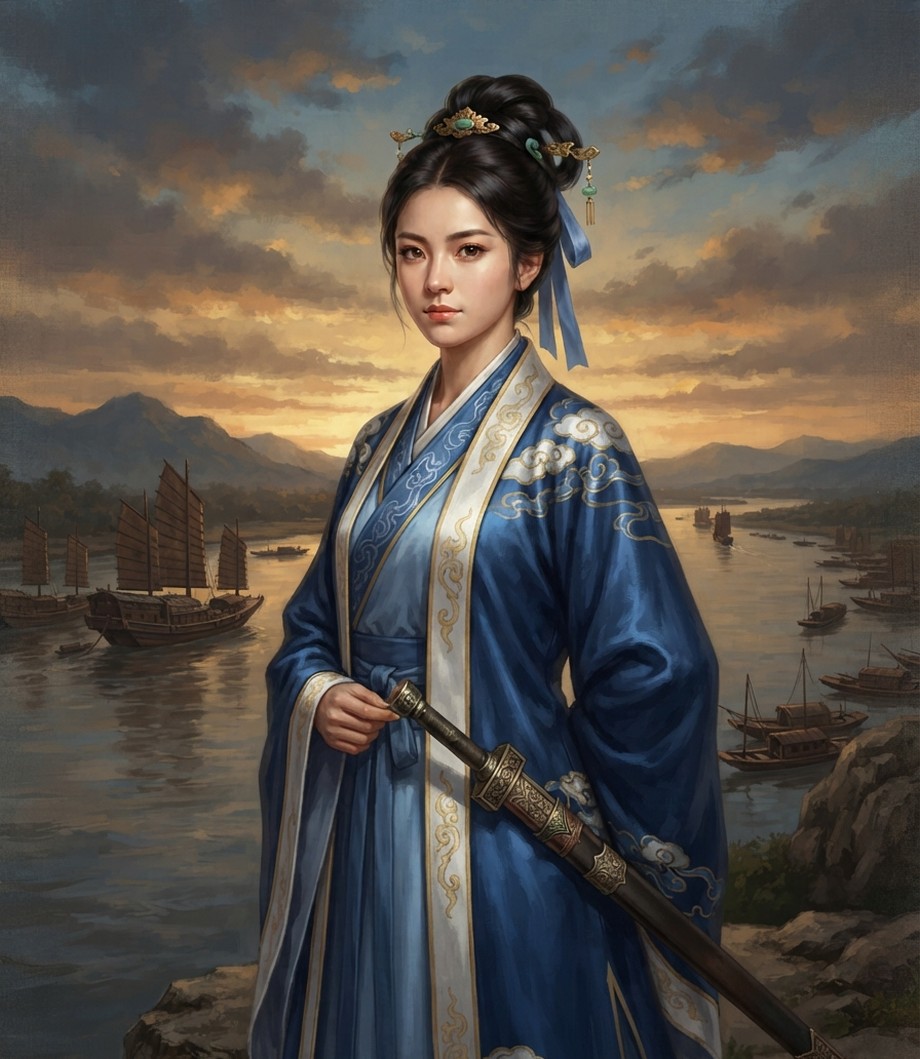
AI-assisted Portrait of Sun Shangxiang
A Bride Who Kept Her Own Guard
In the winter after Red Cliffs, with Cao Cao driven back north in ruin, the victors turned to consolidating what the battle had won them. Sun Quan, ruler of Wu, had a younger sister of marriageable age and a wary new partner in Liu Bei — older than she was by a generation and dangerous precisely because the alliance that had just saved them both was already fraying. A marriage was arranged, and by some accounts the strategist Zhou Yu pressed for it to plant a Sun loyalist inside Liu Bei's household. Nobody pretended the wedding was about affection. It was a treaty with a bride attached.
What survives of Sun Shangxiang in the record is not sentiment but posture. She arrived in Liu Bei's household with her own armed maidservants — a personal guard kept under her own roof, inside her own marriage — a detail strange enough that contemporary writers bothered to record it. Liu Bei himself is said to have gone uneasy entering what should have been his private quarters, more armed camp than domestic chamber. A woman handed into a political marriage as an instrument usually appears in the record as exactly that, silent and disposed of by others; she met the arrangement on her own terms instead.
When the alliance collapsed — after Liu Bei seized Yi province and Wu read it as a betrayal — she did not linger to grieve a union that had never pretended to be more than policy. She returned to Wu, accounts differing on whether she brought her son with her, and the marriage ended in substance well before it ended on paper. The later legend of her drowning herself for love of Liu Bei belongs to romance, not history.
Sun Shangxiang is ESTP down to the armed household guard she kept inside her own marriage — Se so immediate and unapologetic it made her own husband uneasy in his private quarters.
An Armed Camp Behind the Wedding Curtains
Dominant Se reads a room in the present tense and answers it physically, and nothing about her conduct inside the marriage was theoretical. She did not petition her brother for protection or negotiate guarantees before consenting to the match; she simply brought her own soldiers into the house and kept them there, visibly, as a standing fact of daily life. The arrangement did not need explaining to anyone who saw it.
The detail that Liu Bei felt unsettled entering his own private quarters is the clearest evidence of how thoroughly she controlled the immediate, physical terms of the marriage even while occupying its formally subordinate role. A woman content to endure a political placement quietly would have blended in rather than standing apart, visibly armed, visibly hers.
The same sensibility shows in how cleanly she exited once the alliance that had justified the marriage came apart. There is no record of her agonizing over the collapse. She left — the same directness with which she had entered, action answering circumstance in real time.
Seeing the Arrangement for What It Was
Auxiliary Ti shows up as an unsentimental clarity about what the marriage actually was, stripped of the romantic gloss later legend would paint over it. From the outset she seems to have understood the union as a mechanism — bolted together by her brother and Zhou Yu to hold a fraying wartime alliance in place — never owed the emotional weight of an ordinary marriage.
It also explains why she felt no need to dissolve the arrangement through negotiation once its purpose had expired. If the marriage had been, in her own logic, a load-bearing structure for the Wu–Shu alliance and nothing more, then Liu Bei's seizure of Yi province simply removed the premise it rested on. Once the premise was gone, so was she.
Ti in service of Se rarely announces itself in words, and hers left almost no record of stated reasoning — only the coherent shape of her behavior, each move consistent with a private analysis of exactly what kind of arrangement she was in.
Loyalty to the House, Not the Husband
Tertiary Fe surfaces not as warmth toward Liu Bei but as a durable loyalty to the collective she had been born into — the Sun family and the state of Wu — a loyalty that outlasted the marriage itself without difficulty. When the alliance her marriage had underwritten curdled into open grievance between her husband and her brother, she did not agonize over divided allegiance. She went home.
That return is itself a social act rather than a purely private one: it re-declared, publicly and unambiguously, which side of the broken alliance she belonged to. A woman indifferent to group standing could simply have stayed put in Shu. She did not. She repositioned herself back inside the collective whose interests had always taken precedence over the marriage arranged, transactionally, to serve them.
Even the household guard she maintained reads, in this light, as partly an expression of that same group loyalty — soldiers who answered to Wu, not to her husband's house, kept visibly close as a reminder of where her allegiance sat.
No Patience for the Long View
Inferior Ni is visible mostly by absence — in the near-total lack of evidence that she spent the marriage constructing any private, symbolic narrative about her own fate or where the arrangement was ultimately headed. She met the marriage as a present circumstance to be managed and, later, exited, not as one chapter in some larger arc she was quietly authoring in her own head.
Later legend supplies exactly the mythic, fated ending an Ni-dominant reading of her life would want — grief, self-drowning, a tragic love story completing itself — and the fact that it had to be invented after the fact, unsupported by the earlier and more reliable sources, is itself telling. The drowning is what a later, more Ni-hungry culture needed her story to mean, not what the record shows her doing.
Where Ni-dominant figures tend to withdraw into interpretation, she is recorded only in action — the guard she kept, the household she unsettled, the departure she made cleanly once the arrangement no longer served its purpose.
Why ESTP Over ISTJ
Why not ISTJ?
An ISTJ reading would frame her as a dutiful instrument of dynastic policy, quietly executing the role assigned by her brother and Zhou Yu. But dutiful compliance does not keep an armed personal guard inside its own marriage, and it does not unsettle its own husband simply by existing in his private quarters. What the record shows is active, physically expressed self-assertion — Se making itself felt in the room — not Si-style endurance.
The distinction matters because the two readings predict opposite behavior at the moment the marriage broke down. A dutiful ISTJ bound by precedent would likely have stayed and waited for instruction from Wu. Sun Shangxiang simply left — fast, direct, final — the same immediate read-and-respond posture that had her keeping armed maidservants under her own roof from the start.
Connected Figures
Further Reading
- A Biographical Dictionary of the Later Han to the Three Kingdoms — Rafe de CrespignyEntry on Lady Sun.
- Generals of the South — Rafe de CrespignyOn the Sun family and the Wu state's political marriages.
- Sanguozhi (Records of the Three Kingdoms), Book of Wu — Chen ShouThe primary source context for the marriage and its collapse.
