 Historical Figure MBTI
#1159 · 8-26-26 · The Three Kingdoms
Sun Quan
Lord of Wu · Architect of the Three-Way Split · Emperor Who Outlasted Them All
182 — 252
11 min read
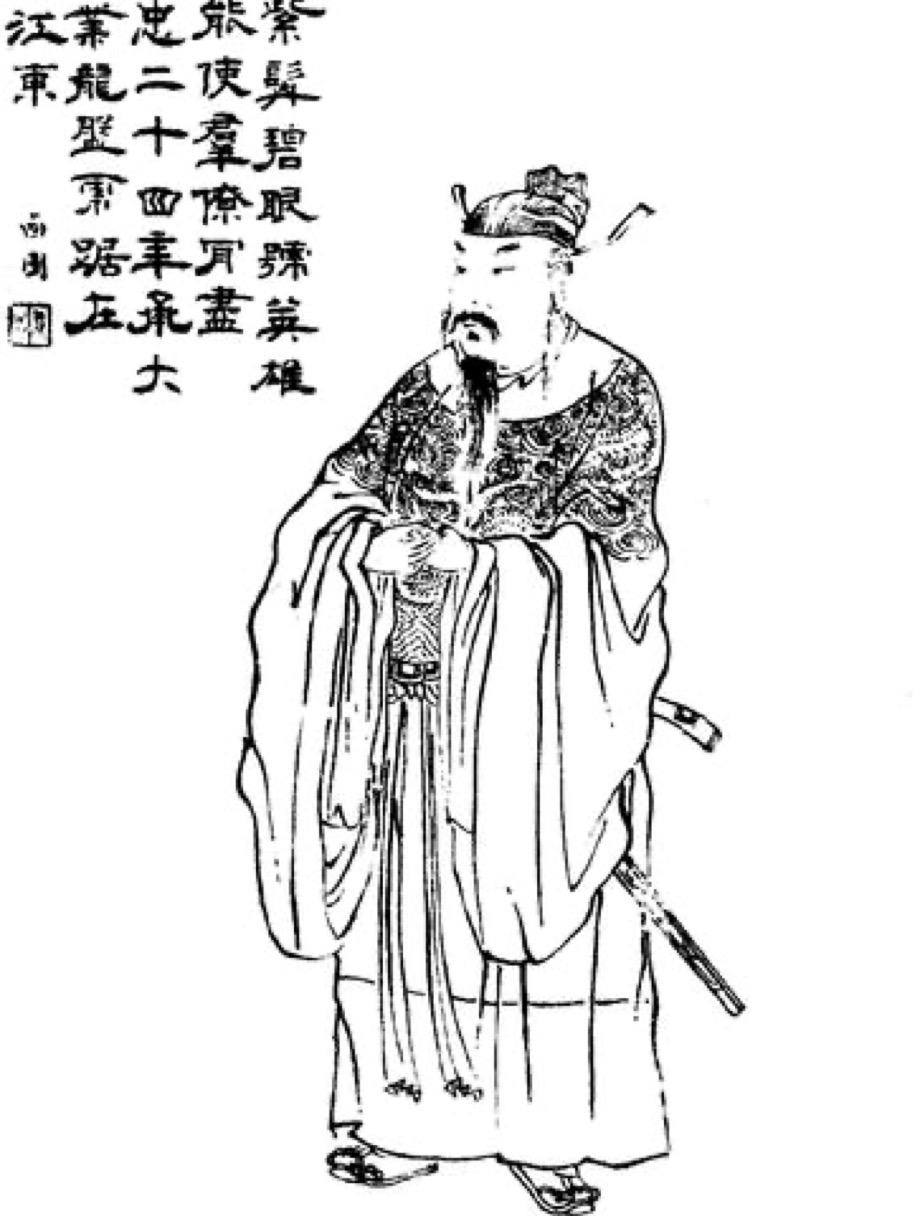
Portrait of Sun Quan
The Man Who Won by Refusing to Move
In the summer of 200, a young warlord named Sun Ce was ambushed while hunting and died of his wounds at twenty-six, leaving the whole southeastern conquest he had carved out in five violent years to a brother who was eighteen. The inheritance was not a state. It was a set of borrowed loyalties held together by the dead man's personal charisma — mercenary generals, unconquered mountain tribes, local gentry families who had submitted at spearpoint and were already writing letters north. Every reasonable observer expected the territory to dissolve within the year.
It did not dissolve. It lasted eighty years, and Sun Quan personally ruled it for fifty-two of them — longer than Cao Cao, Liu Bei, and their immediate heirs combined. He is the least romantic figure of the Three Kingdoms and its most successful survivor. He never won a battle by his own generalship the way Cao Cao did at Guandu; he never out-thought a room the way Zhuge Liang did; he had no sworn-brotherhood myth, no oath in a peach garden. What he had was an unusually clear internal picture of where the world was going, and the discipline to spend half a century declining every opportunity that did not fit it.
That combination — a long, silent, unshakable forecast paired with cold executive delegation — is the signature of an INTJ. Sun Quan's greatness lies almost entirely in the negative space: the northern invasions he never seriously launched, the succession crises he outwaited, the brilliant subordinates he handed total command to and then left alone. He held the Yangtze, and let his rivals exhaust themselves against it.
An INTJ whose dominant Ni was aimed not at conquest but at survival: he saw the shape of a three-way world decades before anyone else conceded it, then spent fifty years refusing to do anything that would collapse it into two.
Ni — dominant · The River as a Thesis
In the winter of 208 Cao Cao came south with an army the histories inflate to eight hundred thousand and a letter inviting Sun Quan to submit. The court at Wu argued for surrender, and the argument was good: the north had the population, the cavalry, the imperial court, and the momentum. Zhang Zhao, the senior civil authority his brother had told him to trust, led the surrender party. Sun Quan listened to everyone, said little, and then — according to the Sanguozhi — drew his sword and cut the corner off the table, declaring that anyone who spoke again of surrender would end the same way. The theatrical gesture is remembered; the reasoning behind it is the interesting part. He had concluded that Cao Cao's northern soldiers could not fight on water, that a fleet packed into the Yangtze narrows was a fire hazard, and that surrender meant becoming a landless pensioner in Xu. Everything after Red Cliffs vindicated a judgment he had made before the evidence arrived.
That is Ni in its native mode: a single convergent picture of the future, arrived at below the level of argument, then held against pressure. Sun Quan's picture never really changed after 208. The river was the thesis. Wu's survival depended on naval supremacy on the Yangtze and control of its middle reach at Jing Province; everything beyond the river was somebody else's problem. He tested Hefei repeatedly and always pulled back — five campaigns over three decades, none of them pressed to the point of real risk. Critics then and since called this timidity. It was closer to a man refusing to be talked out of his own model of the war.
The same foresight explains the coldest act of his reign. In 219 Guan Yu was winning — drowning Cao Cao's armies at Fancheng, threatening Luoyang, and holding Jing Province on Wu's upstream flank. Sun Quan looked at his ally's triumph and saw the danger inside it: a Shu that broke the north would have no further use for Wu, and would own the river above him. So he made peace with the enemy and destroyed his friend. It is impossible to defend morally and difficult to fault strategically — the three-way balance that kept Wu alive for another sixty years was manufactured in that decision.
Te — auxiliary · The Right Man, Then Silence
Sun Quan's executive method was a single repeated move: identify the one person who can run this, give him everything, and then stay out of the way. At Red Cliffs he handed the fleet to Zhou Yu and did not second-guess a plan that involved burning his own ships on the strength of a false surrender by Huang Gai. When Zhou Yu died at thirty-five, he elevated Lu Su, whose policy — keep the Shu alliance — was the opposite of Zhou Yu's. When Lu Su died, he promoted Lu Meng, who reversed the policy again and took Jing Province. Four chief commanders across four decades, each with a different doctrine, each given genuine authority. The through-line was not ideology; it was competence, matched to the moment.
The clearest demonstration came in 222. Liu Bei invaded to avenge Guan Yu with the largest army Shu ever fielded, and Sun Quan gave supreme command to Lu Xun — a scholar-official in his late thirties with almost no battlefield reputation, placed over veterans who had served his brother. The veterans objected loudly. Lu Xun then spent months doing nothing at all while Shu's army stretched itself along seven hundred li of gorge, and Sun Quan, receiving furious dispatches about his commander's cowardice, did not intervene. Yiling ended the war and Shu's ambitions in the south permanently. A ruler with less faith in his own appointment would have replaced Lu Xun in week three.
Te also shows in what he built rather than fought. Sun Quan ran a state, not a warband: he organized the Shanyue hill peoples into taxpayers and soldiers rather than merely raiding them, encouraged the southern gentry into office, moved his capital to Jianye (modern Nanjing) for river logistics, and sent ships as far as Liaodong and Taiwan looking for allies and manpower. Even his imperial title was an administrative decision. He took it in 229 — years after Cao Pi and after Liu Bei — not out of hunger for the honor but because Wu's bureaucracy needed a legitimate fountain of appointments.
Fi — tertiary · A Very Small Circle
For a man capable of ordering an ally's execution as a piece of geometry, Sun Quan was startlingly sentimental inside his own perimeter. He wept openly at Zhou Yu's death and said, decades later, that without Zhou Yu he would never have been emperor. He drank with his officers to the point of scandal, wrestled with them, and on one occasion had to be stopped from forcing a drink on a subordinate at swordpoint — then apologized the next morning. When Zhou Tai, a common-born bodyguard, was resented by aristocratic officers for his rank, Sun Quan made him strip at a banquet and recounted the origin of each scar on his body until the room fell silent. That is not political management. It is a private moral ledger — Fi's tally of who has actually bled for you — enforced in public.
The same ledger explains the ugliest years of his reign. Fi in the tertiary position is loyal but brittle, and it curdles under suspicion. From the mid-240s the succession dispute between his sons Sun He and Sun Ba split the court, and the ruler who had spent forty years trusting his best men began purging them. Lu Xun — the architect of Yiling, by then his chancellor — was interrogated by messenger over his support for the elder heir, repeatedly and humiliatingly, until he died of grief in 245. Chen Shou records that Sun Quan later summoned Lu Xun's son, wept, and admitted he had listened to slander. The remorse was real and useless.
It is worth noting what he never expressed remorse for. He regretted how he treated the men who served him; he never regretted Guan Yu, or the broken pact with Liu Bei, or the humiliating decade spent as Cao Pi's nominal vassal "King of Wu". Outsiders were positions on a board. The moral weight was reserved entirely for the inside.
Se — inferior · The Boy Who Rode Toward the Arrows
The strategist who would not risk his army was reckless with his own body. Sun Quan hunted tigers on horseback and had to be lectured about it by Zhang Zhao, who pointed out that a ruler's job is to command heroes, not to be one; his answer was to build a padded hunting carriage and keep going. In 213, facing Cao Cao across the Ruxu River, he sailed a light ship straight into the enemy fleet to look at it himself, absorbed a barrage of arrows until the vessel listed, calmly ordered it turned so the other side could take an equal weight, and rowed home level — the episode that later gave the novel its famous straw-boat borrowing of arrows. Cao Cao's reported reaction was admiration.
Inferior Se runs like this: dormant for years, then erupting as an appetite for raw, immediate physical stakes — usually at exactly the wrong moment. At Hefei in 215, Zhang Liao caught Wu's army withdrawing and Sun Quan personally became the target of the charge; he escaped only because his guards died in his place and his horse jumped a broken bridge. He had brought a hundred thousand men against seven thousand and came within a few paces of ending the war by dying in it.
The drinking belongs here too — the enormous, undignified banquets, the falling-down nights that even sympathetic historians record with embarrassment. It is the standard release valve of a Ni-dominant who spends his working life inside an abstraction, reaching for something loud and physical to prove the world is still there. That he confined these eruptions to hunts, drink, and the occasional suicidal reconnaissance — and never let them into policy — is a large part of why Wu survived him.
Why INTJ Over ENTJ
Why not ENTJ?
A Te-dominant ENTJ builds outward: he generates objectives and drives an organization through them, and the Three Kingdoms has better candidates for that profile in Cao Cao and Zhou Yu, both of whom wanted to unify the empire and said so. Sun Quan generated almost no new objectives in fifty-two years — his one strategic idea, formed young, was the Yangtze line, and his career consists of protecting it. His Te is real but subordinate: it shows up as personnel judgment and administration in service of a picture he did not argue his way into. And the tell is the emperorship. An ENTJ takes the title as soon as the position supports it; Sun Quan waited eight years after Cao Pi, accepted vassalage to the north in the interim, and only crowned himself in 229 when the paperwork required it.
The distinction is between a man who imposes a future and a man who has already seen one and is waiting for the world to arrive at it. Cao Cao improvised brilliantly and relentlessly forward; Zhou Yu wanted to take Yi Province and finish the job; Zhuge Liang marched north six times against arithmetic. Sun Quan did none of that, and outlived all of them. His decisions read as passivity only if you assume ambition must be additive. Read instead as a fifty-year defense of a single conviction — that the south could not conquer the north, but could not be conquered by it either — they become one of the most consistent strategic performances in Chinese history, and unmistakably the work of dominant Ni backed by a very cold Te.
Connected Figures
Further Reading
- Generals of the South — Rafe de CrespignyThe standard English history of the founding and early years of the state of Wu — the essential book on Sun Quan.
- Records of the Three Kingdoms (Sanguozhi) — Chen ShouThe primary source, written within a generation of Sun Quan's death; the Book of Wu carries his annals and his commanders' biographies.
- Fire over Luoyang: A History of the Later Han Dynasty — Rafe de CrespignyTraces the collapse of Han authority that made the southern warlord state possible.
- The Chronicle of the Three Kingdoms — Achilles Fang, trans.Annotated translation of the Zizhi Tongjian's Three Kingdoms chapters — year-by-year narrative of Red Cliffs, Jing Province, and Yiling.
