 Historical Figure MBTI
#1160 · 8-26-26 · The Three Kingdoms
Zhou Yu
Young Marshal of Wu · Architect of Red Cliffs · Sun Ce's Sworn Friend
175 — 210
10 min read
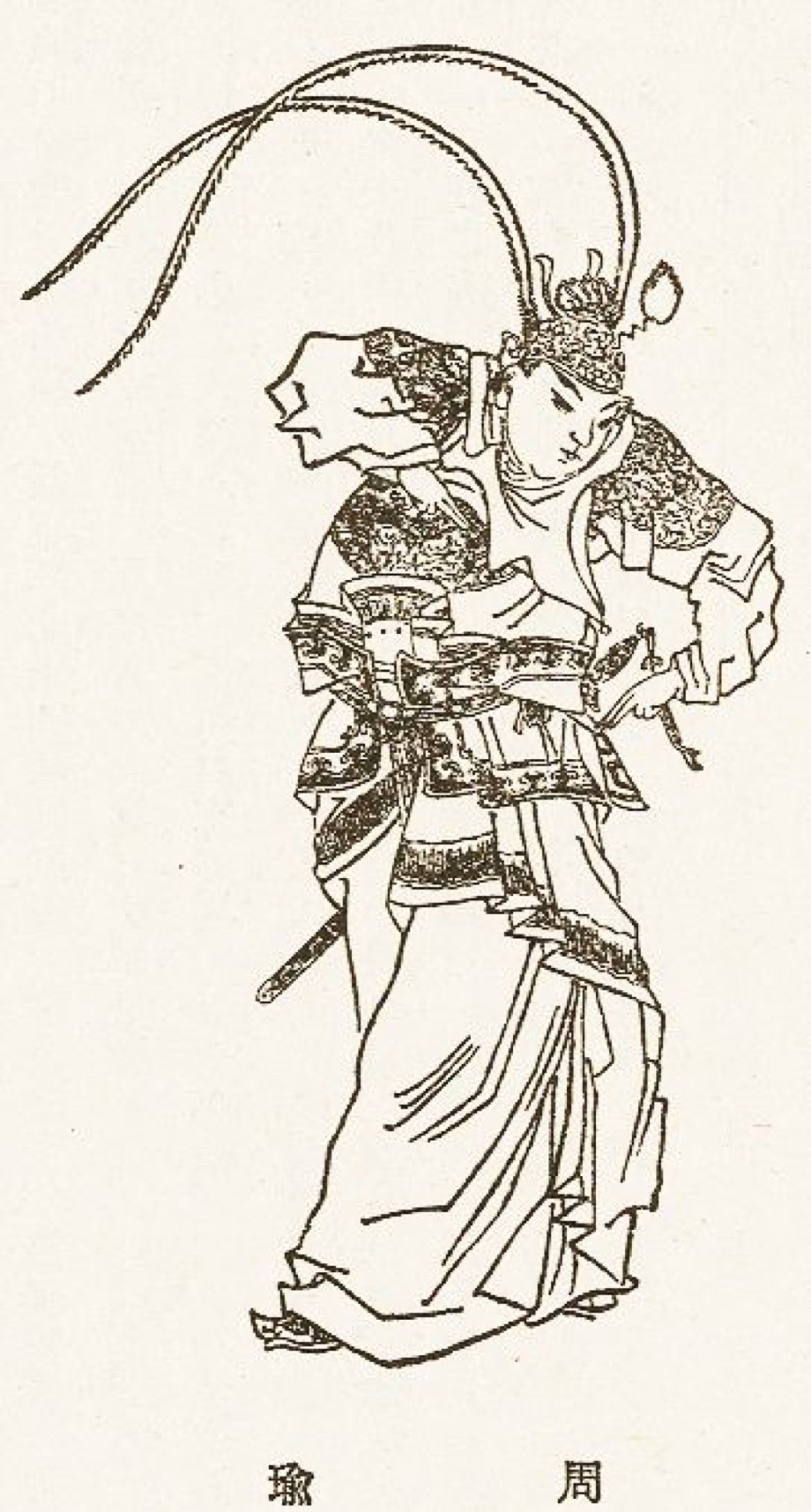
Portrait of Zhou Yu
The Man Who Read the River
In the winter of 208, the largest army the Han world had ever seen came down the Yangtze under Cao Cao's banner, and the court of Wu argued about how to surrender gracefully. Zhang Zhao and the senior civil officials made the sober case: the north had swallowed Jing Province, the fleet was enormous, resistance was arithmetic suicide. Zhou Yu — thirty-three years old, commander of Wu's forces for eight years — stood up and took the arithmetic apart. Cao Cao's northern troops were exhausted and plague-ridden. His cavalry had no ground to ride on. His sailors were landsmen who could not keep their footing on water. The numbers were not a fact about strength; they were a fact about how many men could burn at once.
That is the whole shape of him. Zhou Yu did not win Red Cliffs by inspiration in the moment. He won it because he had already looked at the enemy's greatest asset and located the seam in it, then built an entire campaign — the feigned defection, the fire ships, the timing of the wind — around one structural insight nobody else had bothered to have. He was the most conspicuously gifted man of his generation in the south: a musician so exact that he was said to turn his head at a wrong note mid-cup, strikingly handsome, married to Xiao Qiao while his sworn brother Sun Ce married her sister. Contemporaries called him the Young Marshal, and meant it warmly.
He was dead at thirty-five, of an illness following a wound taken campaigning against Cao Ren, with the conquest of Yi Province mapped out and unexecuted. The plan passed to no one; the province eventually fell to Liu Bei instead. Almost everything Zhou Yu was, he was at speed.
Zhou Yu is the ENTJ commander in his purest form — dominant Te that reorganizes a frightened court into a war machine in a single afternoon, serving a Ni that had already seen where the fire would start.
The Court Argument He Won in One Afternoon
Extraverted Thinking is the function that reaches into a situation and rearranges it into something operable, and it does this most visibly under pressure. Zhou Yu's finest hour was not a battle but a briefing. Recalled to Sun Quan's council while the surrender faction held the room, he did not appeal to honour or dynasty. He itemized: Cao Cao had left an unpacified rear; he had abandoned the cavalry advantage that made him formidable; his newly absorbed Jing Province sailors had no loyalty to him; sickness was already through his camps. Then he named a number — give me thirty thousand picked men — and made the abstract question of Wu's survival into a resourcing decision a lord could actually sign off on. Sun Quan cut the corner off his desk with a sword to close the debate, but it was Zhou Yu who had made the debate closable.
The same executive reflex runs through his career before that. He had brought his own troops and his own family's standing to Sun Ce's side as a young man, when the Sun cause was a landless warband with prospects rather than territory, and the two of them carved out the lower Yangtze in a handful of campaigning seasons. When Sun Ce was assassinated and the eighteen-year-old Sun Quan inherited a half-built state, Zhou Yu came to the capital with his soldiers and performed the subordinate's rituals in public — a deliberate, structural act, telling every wavering commander in the south which way the chain of command now ran.
And after Red Cliffs he did not stop to enjoy it. He immediately drove west against Cao Ren at Jiangling in a long, grinding siege, then began assembling the argument and the logistics for a campaign up the river into Yi Province — the plan that would have made Wu, not Shu, the western power. Te does not treat a victory as a conclusion. It treats it as the new baseline.
One Insight, Built Into a Campaign
Introverted Intuition is not prophecy; it is the compression of a mess of detail into a single governing idea that then dictates everything downstream. At Red Cliffs, the mess of detail was this: northerners could not stand the pitching of boats, so Cao Cao's ships were lashed together to steady them, and the whole fleet lay moored in the shallows across the water. Many people could see that. Zhou Yu saw what it meant — that Cao Cao's fleet had ceased to be many ships and become one very large flammable object, and that its size, the thing everyone was frightened of, was now the precise measure of the disaster available.
Everything after that is engineering in service of the vision. Huang Gai, a veteran of the Sun family since Sun Jian's day, sent a letter offering to defect — plausible precisely because it came from an old soldier who might well resent a young commander's cause. The surrender party was expected. The boats that came across were loaded with dry reeds and oil, and when they were close enough to be committed they were fired and driven into the chained hulls. The wind took the flames into the shore camps. An army that could not be fought was destroyed by the shape of its own solution to seasickness.
The Yi Province plan shows the same faculty pointed further out. Zhou Yu had already worked out, in 210, that the strategic question of the next generation was who took the west, and had proposed to Sun Quan that Wu take it and hold the whole river. He died before he could move. The insight was correct — it was simply executed by Liu Bei's people instead, and the Three Kingdoms took the shape they did because the man who saw it first ran out of time.
Present in the Room, Present on the Deck
Zhou Yu was not a strategist who stayed behind maps. At Jiangling he was hit in the side by a crossbow bolt and withdrew to his tent; when Cao Ren's men came out to test the besiegers' nerve, he had himself carried up through the lines so the troops could see him upright, and the sortie failed. That is tertiary Se doing what it does for a Te-dominant: converting the commander's own body into an instrument of the operation. The wound never properly healed, and it is what killed him within the year.
The same channel is open in peacetime, which is why he is remembered as more than a general. His ear for music was proverbial — the saying ran that if there was an error in the performance, Zhou Yu would look — and his bearing and looks were noted by people who had no reason to flatter him. The famous doubled marriage, Sun Ce to Da Qiao and Zhou Yu to Xiao Qiao, belongs to the same register: an alliance sealed in the most sensory, immediate, worldly way available.
Se is also why his persuasion worked. The council speech before Red Cliffs is full of concrete, touchable facts — horses without pasture, men without sea legs, sickness in the tents — not doctrine. He argued from what was physically in front of everyone, and the room moved.
The Loyalty He Never Explained
The inferior function in an ENTJ is a quiet, absolute, largely unarticulated set of personal commitments — and Zhou Yu's is the friendship with Sun Ce. They were the same age; Zhou Yu gave the Sun family his household's compound when they had nowhere to go, and gave the cause his soldiers when it had none. He never took a rival position, never bargained for terms, never treated the relationship as an asset. When Sun Ce died young and the succession was fragile, that private loyalty simply transferred to the brother, and Zhou Yu spent the rest of his short life making an eighteen-year-old into a lord that hardened generals would obey.
Fi in the inferior position also shows in what he would not tolerate. Chen Shou records that his colleagues found him generous and magnanimous, easy to serve under; the one man who treated him with contempt, the veteran Cheng Pu, was won over not by confrontation but by Zhou Yu's refusal to compete — Cheng Pu later said that associating with Zhou Yu was like drinking fine wine, one grew intoxicated without noticing. That is a man whose values did his arguing for him.
Which makes the literary afterlife an injustice worth naming. Romance of the Three Kingdoms rebuilt him as a brilliant man eaten by envy of Zhuge Liang, dying with the cry that if Heaven made Yu, why did it also make Liang. There is no historical basis for it. The Zhou Yu of the records was the senior partner in that alliance, not the junior, and the impression he left on contemporaries was of largeness rather than pettiness. The novel needed a foil; it took the most gifted man in the south and shrank him to fit.
Why ENTJ Over INTJ
Why not INTJ?
The INTJ reading is tempting because Red Cliffs was won by a single long-range insight, and the archive's other Three Kingdoms strategists — Sun Quan, Zhuge Liang — really do lead with patient, inward Ni. Zhou Yu does not. His vision arrives already attached to an order of battle: he takes the room, names the force he needs, and is on the water. An INTJ waits for the situation to ripen; Zhou Yu spent thirty-five years refusing to wait — carving the lower Yangtze with Sun Ce as a young man, overturning a surrender consensus by argument, besieging Jiangling immediately after the greatest victory of the age, and dying of a wound taken because he insisted on being visible in front of his own siege lines. The dominant function faces outward.
The tell is the direction of the energy. Zhuge Liang's genius is administrative and cumulative; he builds a state and then spends decades pressing on a problem. Zhou Yu's genius is decisive — it wants a single engagement in which everything is settled, and it gets one. He is the type at its best and at its cost: an executive intelligence that converted foresight into immediate physical action, burned the largest fleet in the world with it, and burned out himself two years later with the western campaign still on the desk.
Connected Figures
Further Reading
- Generals of the South — Rafe de CrespignyThe standard English account of the rise of the Sun family and the founding of Wu, with the fullest reconstruction of the Red Cliffs campaign.
- Records of the Three Kingdoms (Sanguozhi) — Chen ShouThe third-century source biography — the origin of the 'drinking fine wine' judgement and of Zhou Yu's council speech.
- A Biographical Dictionary of Later Han to the Three Kingdoms — Rafe de CrespignyReference entries on Zhou Yu, Huang Gai, Cheng Pu and the Wu command, with dates and offices.
- Three Kingdoms: A Historical Novel — Luo Guanzhong, trans. Moss RobertsThe later historical fiction that invented the envious Zhou Yu — read against the records, not as a substitute for them.
