 Historical Figure MBTI
#1163 · 8-26-26 · The Three Kingdoms
Lu Meng
The Scholar-General · Conqueror of Jing Province · Guan Yu's Undoing
178 — 220
6 min read
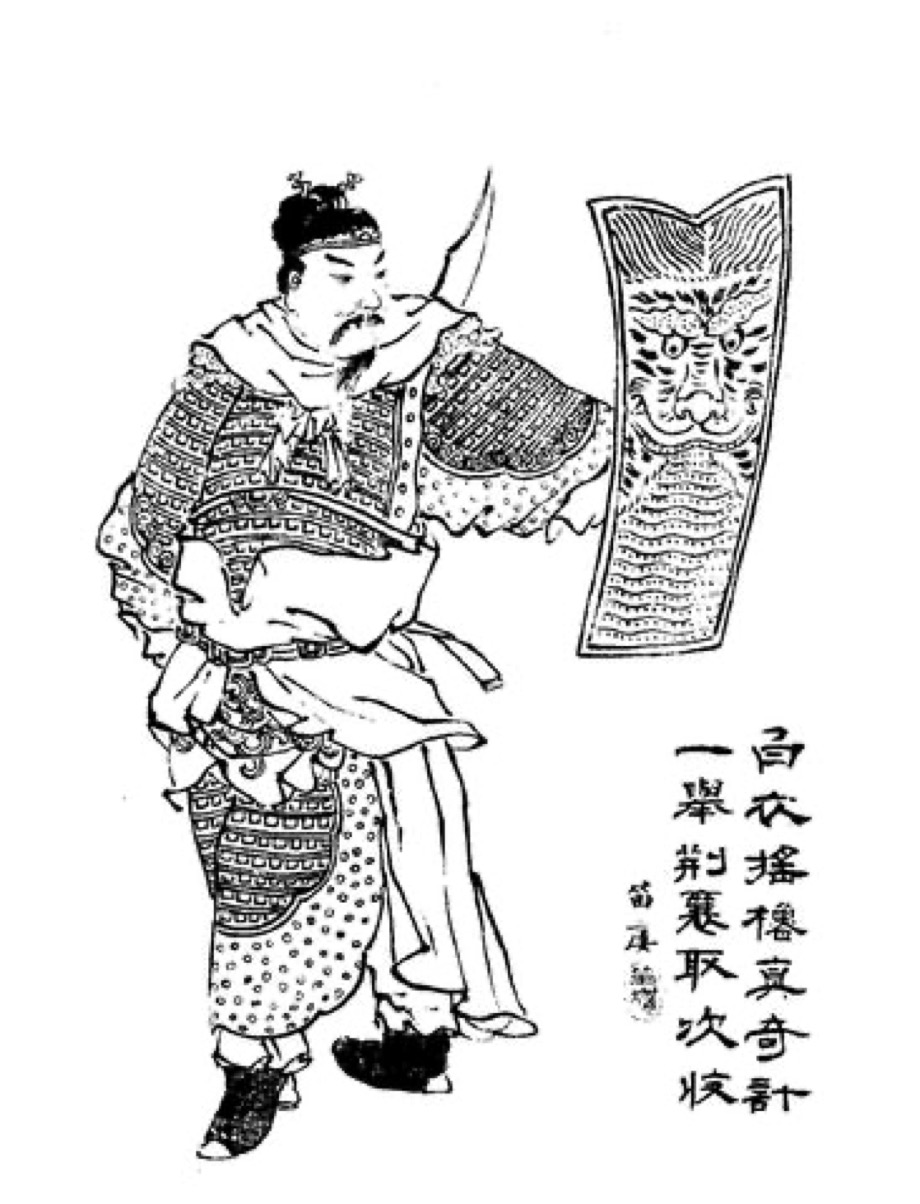
Portrait of Lu Meng
No Longer the Lu Meng of Old
Lu Meng joined Sun Ce's army as a boy who could barely write his own name, and for years that was fine — Wu needed soldiers who could fight, not scholars who could quote the classics. He rose the way physical men rise in a war-band: by showing up in the front rank and surviving. Sun Quan, watching him take on more responsibility than his education could support, finally told him bluntly to go and study. Lu Meng's excuse was the oldest one in the army — too busy with troop affairs — and Sun Quan did not accept it. What followed was not a young man's crash course but a grown soldier's total renovation of himself, undertaken in whatever hours a campaigning life left him, until the strategist Lu Su, passing back through on an inspection years later, sat down to talk with him and rose from the table astonished. The man in front of him quoted precedent, argued strategy, and reasoned like a court official. "You are no longer the Lu Meng of old," Lu Su said — a line that outlived both of them and became the Chinese language's shorthand for a person who has remade himself by discipline alone.
That capacity for total, private self-overhaul is the signature of an ISTJ. Lu Meng did not perform his transformation for an audience; he simply absorbed the classics and the military manuals the way he had once absorbed drill routines, methodically, in order, until the knowledge was load-bearing. And when he was finally handed Wu's grand strategy, he applied the same instinct to Jing Province — not a bold gamble but a patiently assembled certainty, executed only once every variable had been controlled for.
Lu Meng was ISTJ to the bone: a dominant Si that could not rest until a gap in his own competence was closed, in private, methodically, without an audience to perform for.
The Discipline of an Unglamorous Study
Dominant Si is often mistaken for mere caution, but in Lu Meng it looks like appetite: once he decided the classics and the military texts were the thing he lacked, he did not sample them, he consumed them wholesale and kept returning to them until the material sat in his memory the way old campaign routes sit in a veteran's legs. Sun Quan reportedly told him he need not master every commentary the way scholars did, only read enough history and strategy to orient himself — Lu Meng went further than the assignment required anyway, because Si does not stop at "enough." It stops when the internal record is complete.
That same instinct shaped his generalship. Where a flashier commander might have improvised his way into Jing Province, Lu Meng planned it against precedent — how forts had been taken before, how garrisons behaved when surprised, how a population responded to soldiers who kept discipline versus those who plundered. He disguised his troops as merchant traders on the river, a device that depended entirely on his men executing a rehearsed routine without deviation, and it worked because Lu Meng had drilled the plan into something as internally certain as the classical texts he had memorized years earlier.
Even his famous illness-feint before the campaign — resigning his post publicly, citing poor health, so that Guan Yu would relax his guard on Wu's border — was Si's patience wearing a mask. He was willing to let a lie mature for months, trusting a plan he had already fully internalized rather than rushing to prove it in the moment.
Fairness as Policy, Not Sentiment
Auxiliary Te gave Lu Meng's Si-built certainty an outward edge: once he knew what should be done, he organized people and resources to do it without hesitation or apology. He was the hawk in Wu's court on the question of Jing Province, arguing against his own predecessor's more conciliatory line and pushing Sun Quan toward the harder, colder calculation that an alliance with Shu over the territory was not worth what it cost Wu strategically. That is Te reasoning in its purest form: subordinate personal loyalty and sentiment to the logic of the outcome.
It showed most clearly in how he governed captured Jing Province after the forts fell. Rather than let his soldiers loot a defeated population, Lu Meng issued strict orders against plunder, publicly punished violators — including, by some accounts, an officer who was a fellow townsman, executed for taking a civilian's bamboo hat — and made a visible show of returning to families anything his men had seized. This was not mercy for its own sake. It was Te's cold arithmetic: a population treated fairly would not rise against the occupying army, and Guan Yu's own soldiers, hearing their families were being cared for under Wu rule, began deserting rather than fighting on. Lu Meng had converted decency into a weapon.
Why ISTJ Over ESTJ
Why not ESTJ?
An ESTJ's dominant function is outward — Te reaching first to organize other people and structures, decisive from the opening move. Lu Meng's defining act ran the other way: a private, unglamorous rebuilding of his own knowledge, undertaken with no one watching and no command authority required. He needed Lu Su's astonishment to reveal the change at all, because the change itself had happened in silence. His Jing Province campaign, too, was won through patient disguise and controlled timing rather than a blunt public assertion of command — the opposite of an ESTJ's instinct to lead loudly from the front.
The distinction matters because Lu Meng is so often folded into the archetype of the blunt soldier-commander, when his actual arc is a study in inward discipline finding its outward expression only once it was fully formed. ISTJ explains both halves of his life — the illiterate soldier who quietly rewired himself into a scholar, and the scholar who then organized a province's conquest with the same unhurried, internalized certainty. ESTJ would have skipped the private transformation and gone straight to command; Lu Meng insisted on earning the command first, in secret, before he ever used it.
Connected Figures
Further Reading
- Generals of the South — Rafe de CrespignyThe standard English-language study of Wu's military command, including Lu Meng's rise and the Jing Province campaign.
- Records of the Three Kingdoms (Sanguo Zhi) — Chen ShouThe primary Chinese source for Lu Meng's biography, including the Lu Su meeting that produced the idiom of his transformation.
- A Biographical Dictionary of Later Han, Three Kingdoms and Jin — Rafe de CrespignyReference entries situating Lu Meng within Wu's officer corps and the wider Three Kingdoms timeline.
