 Historical Figure MBTI
#1173 · 8-28-26 · The Three Kingdoms
Lu Xun
The Scholar Who Burned an Emperor's Army · Victor of Yiling · Wu's Second Great Strategist
183 — 245
7 min read
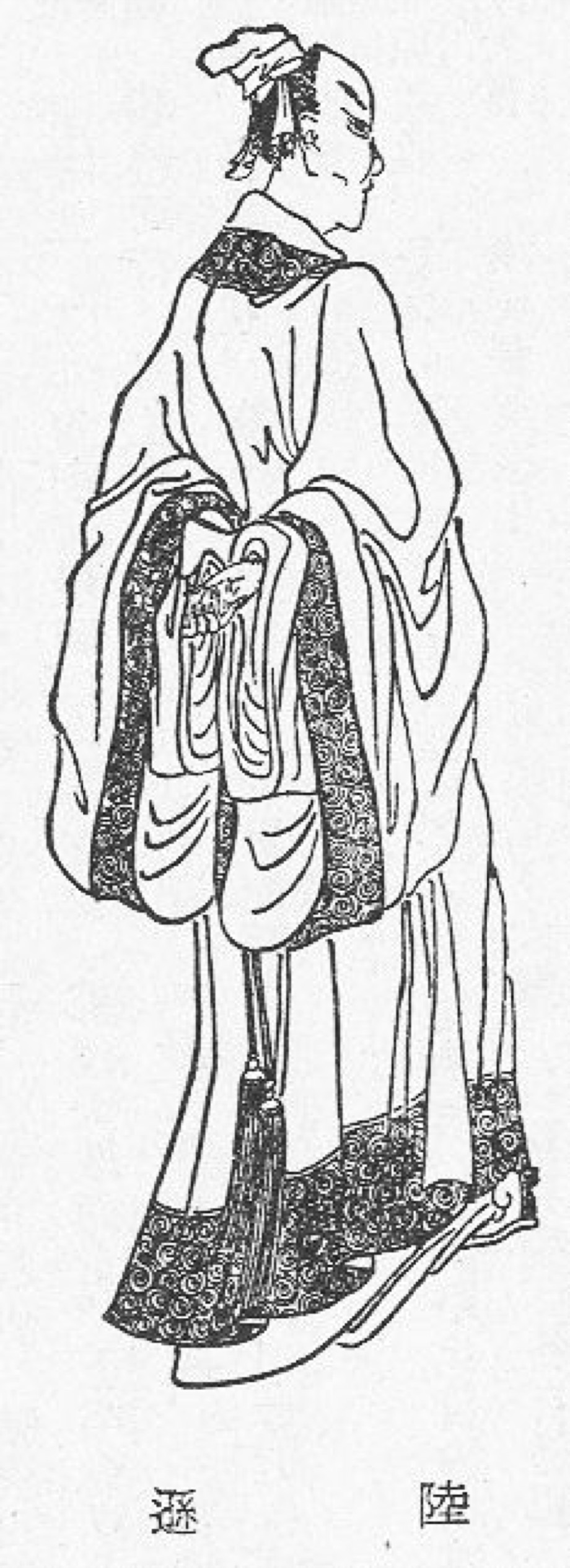
Portrait of Lu Xun
The Cowardice That Was Not Cowardice
In the summer of 222, a scholar with almost no battlefield reputation stood on the Yangtze gorges watching an emperor come to kill him, and did nothing. Liu Bei had marched east out of Shu with an army raised in fury over the death of Guan Yu, and Wu had handed its defense to Lu Xun — a man known until then for administration, for the quiet competence of a provincial official. His officers, several of them veterans of Sun Ce's conquests and socially his superiors, could not believe it. When he ordered them to yield positions without a fight and wait while the invader advanced, they said aloud what everyone was thinking. He was afraid.
He was not afraid. He had already seen the ending. An army moving up a river valley into forested mountains must string itself out along tens of miles of narrow country; a summer campaign denied an early decision rots in the heat; wooden stockades in dry timber are not fortifications but fuel. That is the signature of an INTJ at full power — not aggression, not tempo, but a private certainty about how a thing must end, held through a long humiliating middle in which nothing visible is accomplished. Wu had produced this mind before, in Zhou Yu and Lu Su. Lu Xun is the purest case, because he had none of their standing to borrow. He had only the idea.
Lu Xun is the INTJ whose dominant Ni was his only credential — a single unshared vision of how the war ended, held against his own officers' contempt until the forest itself agreed with him.
Ni — The Fire He Saw Before There Was Any Fire
Dominant introverted intuition does not gather options; it converges on one. From the moment he took the eastern command Lu Xun behaved as though the battle had already been fought and he was waiting for the calendar to catch up. He conceded the outer defenses and refused engagement after engagement. When Liu Bei pushed detachments forward to provoke him, he read the bait as confirmation rather than temptation: an enemy trying this hard to force a battle is an enemy who cannot afford a long one.
What makes this Ni rather than mere caution is that the waiting had a shape. He was holding position for a specific configuration he expected the enemy to produce unprompted — and Liu Bei produced it, moving off the water into the shaded forest and building a chain of wooden camps back through the hills, dispersed and mutually unsupporting. He probed once; the attack failed, and his officers took it as proof the season was wasted. He took it as data on how the camps were spaced. Then he committed everything at once: straw bundles, fire set at multiple points, a simultaneous assault down the whole strung-out line. Liu Bei's army did not lose a battle so much as cease to be an army. He died at Baidicheng the following year, and the map of the Three Kingdoms froze in roughly the shape Lu Xun had described to a staff that called him a coward.
Te — Command Without Credit
A vision that cannot be enforced is a daydream. Lu Xun's auxiliary Te shows in the most awkward fact of the campaign: he held an army together for months while it despised him. He did not persuade his officers — he could not, since the argument required them to accept a conclusion no track record underwrote. He fell back on structure instead, holding up the sword of command Sun Quan had given him, invoking military law plainly, making clear that insubordination would be punished whatever family the offender came from. The orders were obeyed because they were orders.
The execution was Te at its most characteristic: not improvised heroics but a coordinated operation across a wide front, timed so no segment of Liu Bei's line could reinforce another. And when it was over he showed the same instrumental coolness in reverse, declining to pursue into Shu because Cao Pi's Wei was watching the Yangtze and a wrecked Shu was worth more to Wu alive than a conquered one that left him overextended. Total victory was available; he took the useful amount. That same competence carried him to the chancellorship while he remained Wu's senior general — a man trusted with both the army and the administration, arguing steadily against harsh law and campaigns that could not pay for themselves. It was efficient advice, and by the end it was unwelcome.
Fi — The Man Who Did Not Need to Be Believed
Tertiary Fi in an INTJ rarely looks like warmth. It looks like an internal standard that does not consult the room. Through the worst months at Yiling Lu Xun neither defended himself at length nor performed a confidence he did not need to display; he simply continued, absorbing his officers' sneers without retaliating. After the victory he declined to settle scores with them, telling Sun Quan they had been valuable men behaving badly rather than traitors. That is not diplomacy. It is a private judgment about what those men were worth, reached alone and unaffected by how they had made him feel.
The same immovable interior shows in his politics, and it is why the ending hurts. As chancellor he kept telling Sun Quan what Sun Quan had stopped wanting to hear — that the succession quarrel between the heir and the rival prince was tearing the court apart, that the informers were poisoning the state. He was the most decorated man in Wu and perfectly safe if he said nothing. He said it anyway. Sun Quan, aged and suspicious, sent envoys to interrogate and rebuke him, and Lu Xun died in 245 of what the histories name plainly as grief and indignation. The man who could not be provoked by his officers' contempt was destroyed by the loss of a trust he had actually earned.
Se — One Night of Violence
Inferior Se does not make a man tactically blind; it makes his relationship to the physical present all-or-nothing. For most of a year Lu Xun refused the immediate — the taunts, the raids, the visible chance to fight. Then, in a night and a day, he spent everything: fire at multiple points along dozens of miles, general assault, no reserve held for a second attempt. There was no middle setting, and it was the only time in the campaign he touched the enemy at all.
The tell is the dependence on conditions. His great act required the terrain, the season, the dryness, and the enemy's own error to align; he could not manufacture an opening the way Zhang Liao did at Hefei by charging into one. What he could do, once, was recognize the moment's arrival with total clarity and commit without hedging. Ni supplies the picture; Se supplies the match.
Why INTJ Over ISTJ
Why not ISTJ?
The obvious misread is to see months of refusing battle as Si caution — the careful officer going by the book. But there was no book. Nothing in precedent told a Wu commander to surrender the gorges and let an imperial army walk unopposed into his province, and the senior staff who actually held the accumulated experience of Sun Ce's wars believed the opposite and said so loudly. An ISTJ's patience is anchored in established practice and is strongest when the institution agrees with it; Lu Xun's was anchored in a self-generated forecast and held against the institution, with no reputation to make it credible and no protocol to hide behind. Its payoff was not the steady accumulation of small advantages but one irreversible gamble discharged in a single night — the least Si-shaped victory imaginable.
The distinction explains both ends of his life. The same psychology that let him hold an unshared conclusion for months in 222 made him unable to drop an unwelcome one twenty years later, when Sun Quan's court had stopped rewarding men who told the truth about the succession. A procedural mind would have found cover in precedent and survived. Lu Xun had only his own reading of the situation, and he could no more abandon it in politics than he had in war.
Connected Figures
Further Reading
- Generals of the South — Rafe de CrespignyThe standard English account of Wu's rise; the fullest narrative of Yiling and of Lu Xun's later chancellorship.
- Records of the Three Kingdoms (Sanguozhi) — Chen ShouThe third-century primary source; Lu Xun's biography in the Book of Wu is the basis for everything above.
- A Biographical Dictionary of Later Han to the Three Kingdoms — Rafe de CrespignyReference entries for Lu Xun, Sun Quan, and the Wu officer corps who doubted him.
- Imperial Warlord: A Biography of Cao Cao — Rafe de CrespignyUseful for the northern context — why Wu could not afford to pursue Liu Bei into Shu.
