 Historical Figure MBTI
#1175 · 8-28-26 · The Three Kingdoms
Sun Hao
The Last Emperor of Wu · Tyrant Who Squandered His Grandfather's Kingdom · The Three Kingdoms' Final Curtain
242 — 284
12 min read
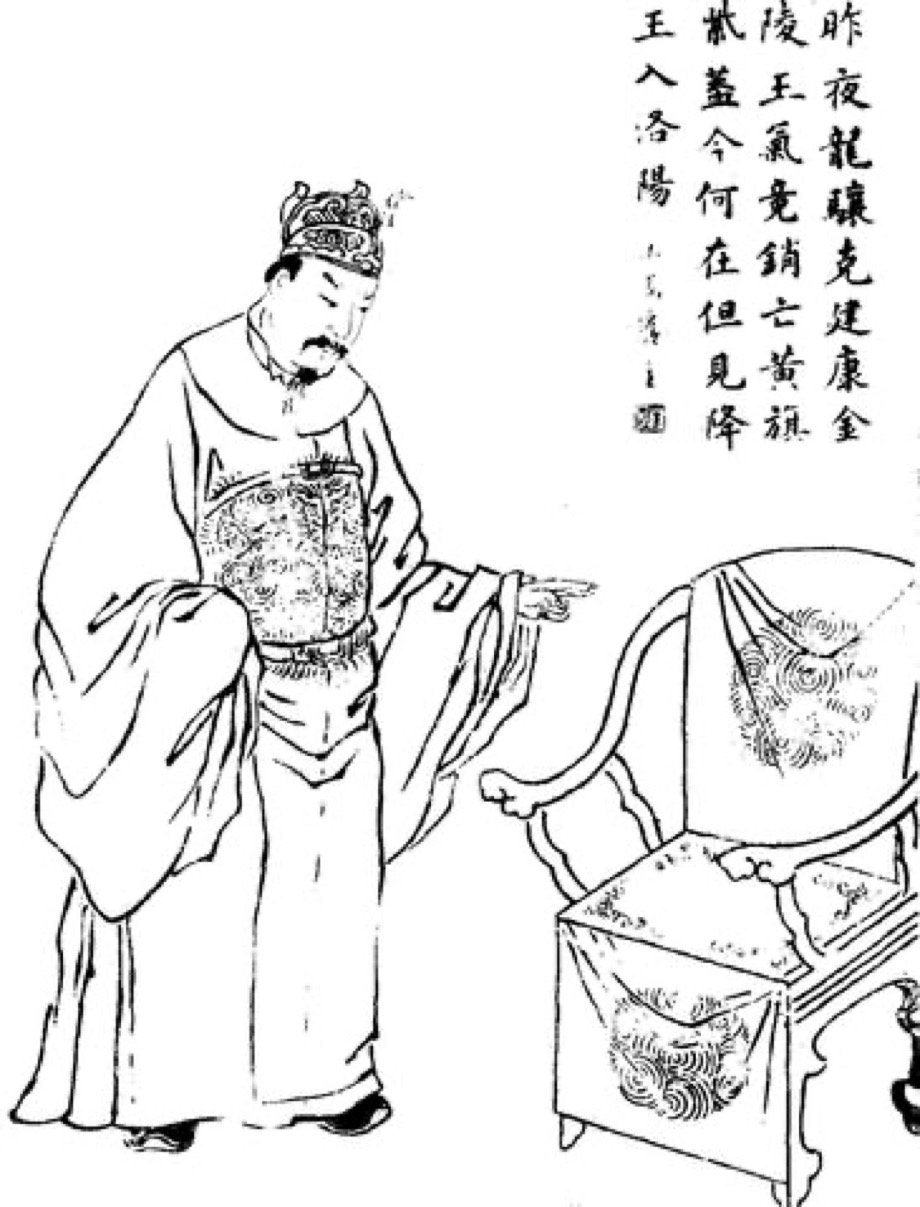
Portrait of Sun Hao
The Ministers Who Chose Him
In 264 the court of Eastern Wu had a problem that looked, at the time, like a technical one. The reigning emperor Sun Xiu had died young, leaving a child heir, and the kingdom was in no condition for another minority — Shu Han had fallen the previous year, the Sima family in the north was consolidating what would shortly be declared the Jin dynasty, and Wu's recent history was a catalogue of regents who had turned the throne into a hostage. So the senior ministers did something reasonable. They passed over the direct heir and installed an adult: Sun Hao, a grandson of the dynasty's founder, twenty-two years old, reported by those who had met him to be intelligent, decisive, and studious. They believed they were choosing competence. They had, in fact, chosen the last emperor of the Three Kingdoms, and within months several of them would be dead by his order.
The reversal was almost immediate, and that speed is the first thing worth noticing about him. Sun Hao did not decay into tyranny across a long reign the way emperors usually do, hardened by decades of plots. He arrived already formed. The generosity of his first weeks — amnesties, grain distributions, the release of palace women — reads in retrospect less like a policy than like a performance he lost interest in, an opening gesture discarded the moment the room stopped requiring it. What replaced it was sixteen years of rule by appetite and terror: an emperor who built palaces while the border thinned, who conscripted women into his harem by the thousand, and who devised for the ministers who displeased him executions so inventive that Chinese historians — writing in a century that had watched Dong Zhuo dismember men at banquets — recorded them with visible disgust.
He is best read as an unregulated ESTP: a man of pure present tense, sensation-hungry and physically fearless, whose analytic faculty existed only to build airtight private cases against the people around him, and whose sense of the future was so atrophied that he did not seriously prepare for an invasion everyone else on the continent could see coming. Power did not corrupt Sun Hao. Power removed the last thing that had been restraining him.
Sun Hao is what ESTP becomes when nothing constrains it: dominant Se ruling by sensation and dominance, Ti rationalizing the cruelty afterward, and an inferior Ni so blind to the horizon that the end of a dynasty arrived as a surprise.
Se — The Appetite That Could Not Wait
Everything Sun Hao wanted, he wanted immediately and in physical form. He built. The Zhaoming Palace went up at enormous cost, with officials of every rank driven out to haul timber and stone, at a moment when Wu's revenue was already strained and its western defenses were being held together by generals writing increasingly desperate memorials from the Yangtze gorges. He moved the capital on impulse and moved it back. He expanded the harem past any conceivable use, ordering that the daughters of officials be inspected and the suitable ones taken — a policy that converted the entire gentry class into people with a personal grievance against the throne, and which he pursued anyway because the pleasure was in front of him and the consequence was not.
The cruelty belongs to the same faculty, and this is the part that makes him genuinely infamous rather than merely bad. Sun Hao's punishments were not efficient. An efficient tyrant kills quietly; the point is the removal. Sun Hao's executions were designed to be watched — flaying, the gouging out of eyes, sawing, faces peeled at court in front of the assembled ministry. He drank with his officials at compulsory banquets where every guest was required to reach a fixed quantity of wine, and stationed attendants whose job was to note down anything said or any expression made, so that the evening's entertainment doubled as an evidence-gathering exercise. That is Se in its darkest register: stimulation sought through the immediate physical domination of other bodies, with the sensory intensity of the act as its own justification.
It is worth saying what this is not. It is not the calculated terror of a ruler building a machine of fear to a purpose — that kind of cruelty is budgeted, and stops when the account balances. Sun Hao's did not stop, and it consumed exactly the men a besieged kingdom could least afford to lose: capable administrators, respected elder statesmen, the officials who had put him on the throne. He hollowed out his own court the way he emptied his own treasury, one satisfying afternoon at a time.
Ti — The Case He Built Against Everyone
Sun Hao was not stupid, and the sources are unanimous that he could be formidable in argument. That intelligence had a specific shape: it was private, self-sealing, and used almost exclusively to construct justifications. When he killed a minister he did not simply kill him; he produced a reason, a chain of inference from some remark or hesitation or family connection to a conclusion of disloyalty, and he held that chain to be proof. The compulsory drinking sessions with their appointed informers were an epistemological instrument — a way of generating the data his suspicion required. Anything a drunk man said could be entered into the case file.
Auxiliary Ti in a healthy ESTP is the corrective faculty: the cool internal check that asks whether the impulse actually makes sense. In Sun Hao it had been inverted into the impulse's advocate. His paranoia had internal consistency and no external anchor — the classic failure mode of a Ti that never tests its premises against anyone. He suspected the very ministers who had elevated him, and there is a grim logic to that which he clearly followed and never questioned: men who could place an emperor on the throne could remove one. The reasoning is sound. It is also the reasoning of a man who has concluded that gratitude is a species of threat, and it destroyed the only faction that had ever been on his side.
Where a persuader would have bought loyalty, Sun Hao proved it unnecessary. He never seems to have entertained the possibility that a court might be governed by argument rather than fear — not because he was incapable of argument, but because terror was faster and he had the tools for it in the room. By 280 the ministry that surrounded him had been selected, across sixteen years, for the single trait of not visibly disagreeing with him. When the invasion came, that is precisely the government he had to fight it with.
Fe — The Room He Refused to Read
Tertiary Fe in an ESTP is real but thin — a live sensitivity to the temperature of a room, usually deployed in bursts, for effect. Sun Hao had it, and the evidence is his opening months. He knew exactly what a court wanted to hear from a new emperor and gave it to them: the amnesty, the relief grain, the palace women sent home, the studied modesty. It was convincing enough that ministers who had spent their lives in politics believed they had made a good bet. That is not the behavior of a man deaf to social signals. It is the behavior of a man who reads them fluently and uses them instrumentally.
What he lacked was any need to be liked once the transaction was complete. The performance ended because its purpose had been served, and nothing in him required the good opinion of the court as a standing condition of comfort. That is the distinguishing mark. A ruler with genuine Fe investment cannot tolerate being hated at close range; he manages his image, cultivates factions, tempers his cruelty in public even when he practises it in private. Sun Hao inverted this. He preferred his cruelty public. The banquet executions were staged for an audience, and their message was not love me but look what I can do to you.
In its inferior expression his Fe surfaced as raw offense-taking: a hair-trigger sensitivity to disrespect, real or inferred, in a glance or a tone or an insufficiently enthusiastic toast. He could feel the room perfectly well. He simply registered it as a source of insult rather than a thing to be won, and he answered slights that a secure ruler would not have noticed with punishments no ruler should have devised.
Ni — The Invasion He Did Not See
The strategic picture facing Wu after 263 was not subtle. Shu Han was gone, conquered by the north. In 265 the Sima family stopped pretending and declared the Jin dynasty outright, which meant that for the first time since the Han collapsed the entire north and west stood under one undivided command, with one obvious remaining objective. Jin spent years openly building a river fleet upstream in the old Shu territory — an enterprise impossible to conceal, aimed at one target. Wu's own commanders on the middle Yangtze understood it completely and said so, in memorials begging for reinforcement of the western defenses and for restraint in the emperor's spending. They were describing a future. That was the one dimension Sun Hao could not perceive.
Inferior Ni does not fail by making bad predictions. It fails by not making predictions at all — by treating the present as the permanent condition of the world. Sun Hao's response to the northern threat was not a mistaken strategy; it was the absence of strategy, punctuated by occasional impulsive raids northward that accomplished nothing except to remind Jin that Wu was still there. He kept building. He kept executing. When his best western general died, the defenses he had been holding together were allowed to decay, because the emperor could not see the shape of a danger that had not yet arrived in the room with him.
It arrived in 280. Jin came down the Yangtze in a coordinated multi-front invasion, the great iron chains strung across the river burned through, the fortified river towns folding one after another. Wu — a kingdom that had held the south for sixty years, that had broken Cao Cao at Red Cliffs and destroyed Guan Yu and stopped Liu Bei — collapsed in a matter of months, with very little serious fighting. There was nothing left to fight with. Sun Hao had spent it. He came out of the capital bound, with a coffin, in the ritual posture of total surrender, and handed over the last independent state of the Three Kingdoms.
Why ESTP Over ESFP
Why not ESFP?
The ESFP case rests on the extravagance — the palaces, the harem, the endless banquets — and it is genuinely tempting, because pleasure-seeking excess is common to both. But ESFP runs Se with auxiliary Fi and tertiary Te, and its characteristic tyranny is a warm one: the ruler who wants to be adored, who buys affection, who surrounds himself with a court that flatters him and stages his generosity in public. Sun Hao did the opposite in every particular. He ruled by open terror and made no attempt to be loved, discarding his one charm offensive within a year of the throne. His cruelty was not emotional flailing but rationalized — each victim came with a constructed case, a chain of inference from a remark to a verdict of treason, generated deliberately by informers he stationed at his own drinking parties. That is Ti building airtight private arguments, not Fi reacting to felt betrayal. And the pleasure he pursued was dominance itself: the peeled face at court, the body broken in front of the assembled ministry. ESFP indulges. Sun Hao overpowered.
The ESTP reading holds because it explains the whole arc rather than a piece of it — the capable opening performance, the appetite, the sealed logic of the purges, and the total blindness at the end. Strip an ESTP of every constraint that normally does its regulating — a rival to answer to, a field where consequences arrive fast, anyone with the standing to say no — and what is left is a man optimizing the present moment with a brilliant faculty for justifying it and no organ for the future. Sun Hao inherited a throne that supplied exactly those conditions. The type did not make him a monster; sixteen unchecked years let him become one at leisure.
Connected Figures
Further Reading
- Records of the Three Kingdoms — Chen ShouThe primary source, compiled within living memory of Wu's fall; its Wu chapters record Sun Hao's punishments in unusually graphic detail.
- Generals of the South — Rafe de CrespignyThe standard English history of the Wu state, from Sun Ce's conquest of the southeast to the collapse of 280.
- A Biographical Dictionary of Later Han, Three Kingdoms and Jin — Rafe de CrespignyReference entries on Sun Hao and the ministers of his court, with the source citations behind each.
- The History of China — David Curtis WrightConcise context on the Jin reunification and where 280 sits in the longer arc of Chinese division and reunion.
